Part 1: The Walk That Began With One Small Promise
The morning of the charity walk began beneath a gray sky.
A light breeze moved through the trees of a small town park, where volunteers were setting up folding tables, tying ribbons to wooden signs, and arranging bottles of water for the people they hoped would come.
At the center of it all stood twelve-year-old Emily Carter.
She wore a pair of well-used sneakers and held a handmade sign that read:
Walking for Every Child Who Needs Hope.
Emily had spent nearly six months planning this day.
But that morning, she couldn’t stop looking toward the park entrance.
Only a few people had arrived.
Her parents were there. Her teachers had come. Several classmates stood nearby with their families. A few neighbors had volunteered to help.
It was a kind group.
But it was much smaller than Emily had imagined.
“Maybe more people will come,” her mother said gently.
Emily smiled.
“I hope so.”
But deep inside, she was disappointed.
This walk meant more to her than anyone realized.
A year earlier, Emily’s best friend, Lily, had been diagnosed with cancer.
The two girls had grown up together. They had shared birthday parties, school projects, secrets, and dreams about the future.
Then suddenly, Lily’s world became filled with hospital rooms, treatments, and long days away from school.
Emily visited whenever she could.
During one visit, she noticed something that stayed with her.
Lily was sitting near the hospital window, watching children playing outside.
“I miss walking to school,” Lily whispered.
Emily sat beside her.
“When you’re better, we’ll walk together again.”
Lily smiled.
“Promise?”
“Promise.”
That simple promise became the beginning of everything.
Emily began thinking about all the other children in hospitals who were waiting for the day they could run, play, and walk freely again.
She decided to organize a charity walk to raise money for programs supporting children with cancer and their families.
At first, people told her it would be difficult.
She was only twelve.
She had no experience organizing an event.
She didn’t have famous sponsors or a large organization behind her.
But Emily refused to give up.
She made posters after school.
She wrote letters to local businesses.
She placed donation jars in neighborhood shops.
Every evening, she sat at the kitchen table with her parents, carefully counting the money they had raised.
Some days, it was twenty dollars.
Other days, only a few coins.
Emily celebrated every donation.
“Every little bit can help someone,” she always said.
There was one more thing Emily had done.
Something even her parents didn’t know about.
Months earlier, Emily had written a letter to Julie Andrews.
Emily had loved Julie’s films and songs since she was a little girl. But more than that, she admired the warmth and kindness she believed Julie represented.
In the letter, Emily told her about Lily.
She told her about the hospital visits.
She told her about the promise to walk together again.
And finally, she wrote:
“Dear Ms. Andrews, I know you are probably very busy. You don’t have to come. But if you ever read this, please remember that there are children fighting very hard every day. I’m going to walk for them. Even if only ten people walk with me, I will still walk.”
Emily mailed the letter and never told anyone.
Weeks passed.
No reply came.
Emily wasn’t upset.
She hadn’t expected one.
Now, standing in the park on the morning of the walk, Emily looked at the small crowd gathering near the starting line.
Twenty-seven walkers.
That was the final count.
Emily’s father placed a hand on her shoulder.
“You did this,” he said proudly.
Emily looked around.
“It just feels so small.”
Her father smiled.
“Kindness doesn’t have to start big.”
At exactly nine o’clock, Emily stepped in front of the group.
Her hands trembled as she held a small microphone.
“Thank you for coming,” she began.
The crowd became quiet.
“I’m walking today for my best friend, Lily. But I’m also walking for children I’ve never met.”
Emily swallowed hard.
“Some of them are in hospitals right now. Some are scared. Some are tired. And some families don’t know what tomorrow will bring.”
Her voice began to shake.
“So today, I want them to know they’re not alone.”
Several people wiped tears from their eyes.
Emily lowered the microphone.
Then something happened near the park entrance.
A car had quietly stopped beside the road.
At first, no one paid much attention.
The door opened.
An elegantly dressed older woman stepped out.
A volunteer looked toward her.
Then froze.
Another person whispered something.
Within seconds, people began turning around.
Emily noticed the sudden silence.
She followed everyone’s gaze.
The woman began walking toward the starting line.
Emily stared.
Her mouth fell open.
For a moment, she couldn’t speak.
It was Julie Andrews.
Emily’s mother looked at her daughter in disbelief.
“Emily… did you know about this?”
Emily shook her head.
“No.”
Julie approached her with a warm smile.
“Are you Emily?”
Emily could barely answer.
“Yes.”
Julie reached into her handbag and carefully removed a folded piece of paper.
Emily immediately recognized it.
Her letter.
“I received this some time ago,” Julie said.
Emily covered her mouth.
“You read it?”
“Every word.”
Julie looked at the handmade sign Emily was holding.
“Especially the part where you said you would walk even if only ten people came.”
Emily’s eyes filled with tears.
Julie smiled.
“Well, I thought perhaps you wouldn’t mind having one more person beside you.”
The small crowd erupted into applause.
Emily began crying.
Julie gently took her hand.
“I would be honored to walk with you.”
News of Julie’s unexpected appearance spread quickly.
People in the park took photographs.
Local reporters arrived.
Messages began appearing online.
But Julie asked that the attention remain focused on Emily’s cause.
“This isn’t about me,” she told a reporter.
“This is about a young person who decided that someone else’s pain mattered enough to do something.”
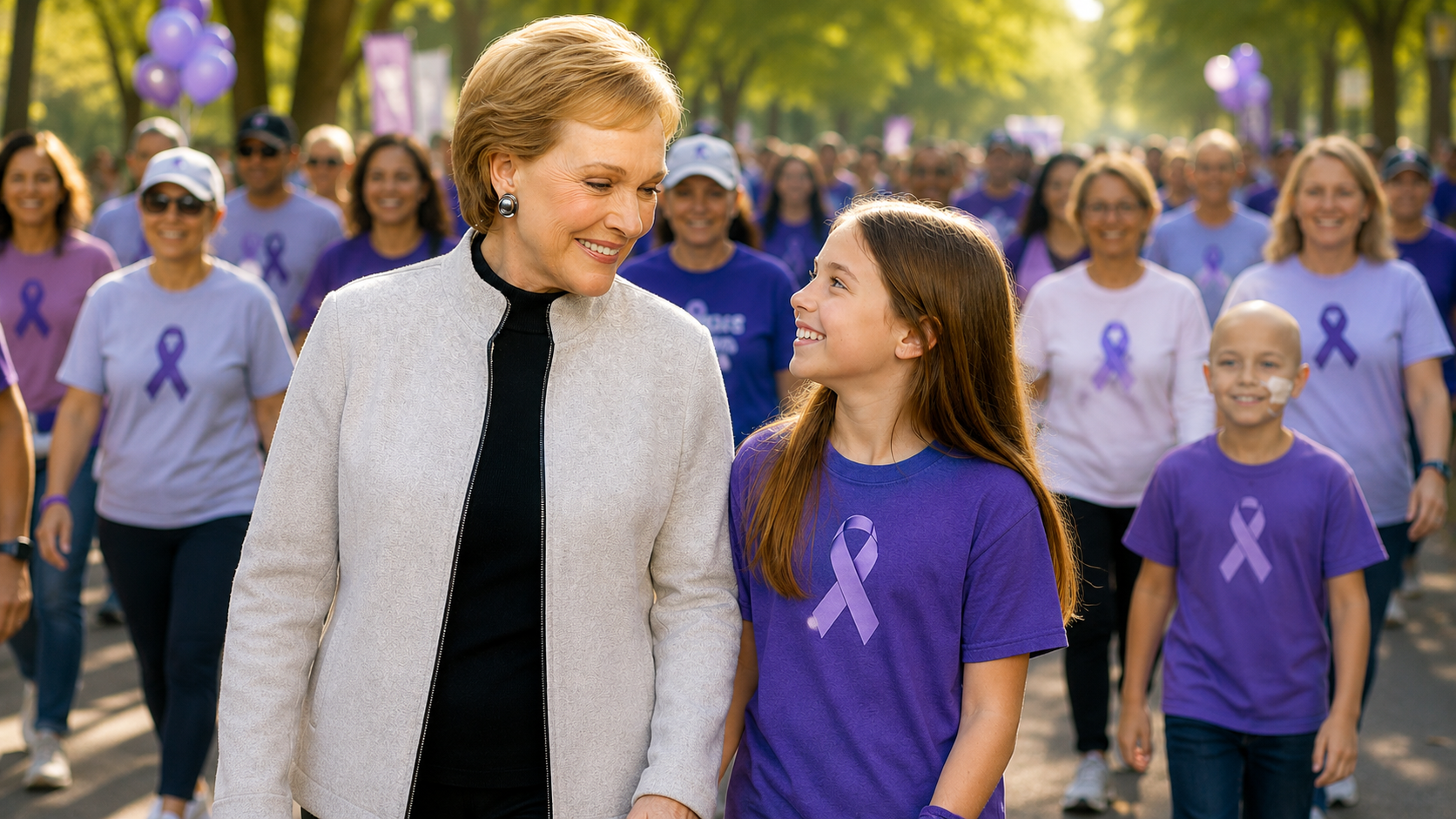
Then the walk began.
Emily and Julie walked side by side.
Behind them came Emily’s family, her classmates, teachers, neighbors, and volunteers.
Twenty-seven walkers had become twenty-eight.
It still wasn’t a large crowd.
But something extraordinary was happening.
As they passed through town, people stepped out of shops to watch.
Some began walking behind them.
A father pushing his young daughter in a wheelchair joined the group.
Then a nurse still wearing her hospital uniform.
Then three teenagers.
Then an elderly couple.
At every street, the line grew longer.
Emily kept looking behind her.
“Where are all these people coming from?” she asked.
Julie smiled.
“Sometimes people are simply waiting for someone else to take the first step.”
By the time they reached the halfway point, more than two hundred people were walking.
But then the crowd suddenly stopped.
Ahead of them, near the side of the road, stood a small boy.
He looked no older than seven.
He wore a knitted cap over his head and held his mother’s hand.
His face was pale.
A hospital identification bracelet remained around his wrist.
The boy slowly stepped forward.
His mother tried to hold him back.
“You don’t have to do this, sweetheart,” she whispered.
But he shook his head.
“I want to walk.”
The crowd became completely silent.
The boy took one step.
Then another.
His legs trembled.
Emily immediately walked toward him.
Julie followed.
The boy looked up at them.
“I had treatment yesterday,” he said quietly. “I can’t walk very far.”
Emily knelt beside him.
“You don’t have to.”
The boy looked toward the hundreds of people waiting behind them.
“But they’re walking for kids like me.”
Then he said something no one there would ever forget.
“So I want to walk for the kid who’s too sick to be here.”
Emily began to cry.
Julie placed a hand over her heart.
The boy took another small step.
Then something unexpected happened.
Without anyone giving an instruction, the hundreds of walkers behind him began moving again.
But this time, they moved slowly.
At his pace.
No one passed him.
No one rushed.
An entire crowd adjusted its steps for one little boy.
Someone recorded the moment.
Within hours, the video began spreading across the country.
Then across the world.
People watched as a young cancer patient struggled forward while hundreds of strangers walked patiently behind him.
And beside him were Emily and Julie Andrews.
But what happened next was something none of them could have imagined.
That evening, thousands of messages began arriving.
People from cities hundreds of miles away were asking the same question:
“Where can we walk?”
By the following morning, people in other towns were organizing their own charity walks.
Then another message appeared.
A group of families planned to travel to Emily’s town for a second walk.
They weren’t coming alone.
Thousands of people were preparing to join them.
Emily’s small promise to one sick friend was about to become something far greater than a single day in the park.
And when Lily heard what had happened from her hospital room, she made a decision that would bring Julie, Emily, and an entire community to tears.
Part 2: The Day Thousands Walked Together
Lily watched the video from her hospital bed three times.
Each time, she cried.
Not because she was sad.
But because she recognized the girl walking beside the little boy.
Emily.
Her best friend.
The same girl who had once sat beside her hospital window and promised:
“When you’re better, we’ll walk together again.”
Now thousands of people had seen what Emily had started.
Nurses gathered quietly near Lily’s door as the video played again on a small tablet.
They watched the little boy take his slow, trembling steps.
They watched hundreds of strangers slow down behind him.
They watched Julie Andrews and Emily walk beside him.
And then Lily whispered something.
“I want to go.”
Her mother looked at her.
“Go where?”
“To the next walk.”
Her mother’s face immediately filled with concern.
“Sweetheart, you’re still recovering.”
“I know.”
“You’ve had a difficult week.”
“I know.”
“You may not be strong enough.”
Lily looked down at her hands.
For months, she had listened to adults tell her what she could not do.
She could not go to school.
She could not stay outside too long.
She could not play with friends when her immune system was weak.
She could not walk too far.
She understood why.
Everyone wanted to protect her.
But this time, Lily looked at her mother and said quietly:
“I don’t need to walk far.”
Her mother sat beside her.
Lily continued.
“I just need to take one step with Emily.”
Her mother began to cry.
The next morning, Emily received a phone call.
She was sitting at the kitchen table surrounded by letters, donation forms, and messages from people around the world.
Her small charity walk had suddenly become something much bigger.
People were volunteering.
Schools were organizing walks.
Hospitals were sending messages of support.
Families who had lost children to cancer were asking to participate in their memory.
Parents of children still undergoing treatment wanted to join.
Emily could hardly understand how everything had changed so quickly.
Then her mother handed her the phone.
“It’s Lily.”
Emily immediately smiled.
“Lily!”
“Hi.”
“How are you feeling?”
There was a pause.
“Emily?”
“Yes?”
“I heard there’s another walk.”
Emily’s voice softened.
“There is.”
“I want to come.”
Emily froze.
“You do?”
“I want to walk with you.”
Tears immediately filled Emily’s eyes.
“But you don’t have to. You should rest.”
“I know.”
Another pause.
Then Lily said:
“You promised we would walk together again.”
Emily covered her mouth.
She remembered that day by the hospital window.
The sunlight.
The playground outside.
Lily’s quiet voice.
Promise?
Promise.
Emily began crying.
“I remember.”
“So let’s keep the promise.”
Three days later, the second charity walk was scheduled.
No one knew exactly how many people would come.
Police helped organize road closures.
Volunteers prepared water stations.
Local businesses donated food.
Several hospitals sent medical teams.
The town park that had seemed almost empty during Emily’s first walk was transformed.
Before sunrise, people were already arriving.
Hundreds.
Then thousands.
Families came carrying photographs of children they loved.
Some wore shirts with names printed across the front.
Others carried ribbons.
Some came in wheelchairs.
Some came with walkers.
Some were cancer survivors.
Some were doctors and nurses.
Some had traveled through the night.
By eight o’clock, the streets surrounding the park were filled with people.
Emily stood near the starting line, staring in disbelief.
Her father walked beside her.
“Remember when you were worried only twenty-seven people came?”
Emily laughed through her tears.
“I remember.”
Her father looked at the enormous crowd.
“Kindness starts small.”
Emily smiled.
Then someone gently touched her shoulder.
She turned.
Julie Andrews was standing behind her.
“You came back.”
Julie smiled.
“I wouldn’t have missed this.”
Emily hugged her.
Julie looked around at the thousands of people gathered.
“This is extraordinary.”
Emily shook her head.
“I don’t understand how this happened.”
Julie looked at her.
“Yes, you do.”
Emily waited.
“You cared about one person.”
Julie pointed toward the crowd.
“And all of this grew from there.”
Suddenly, Emily’s mother called her name.
“Emily.”
There was something different in her voice.
Emily turned.
A car had stopped near the entrance.
A woman stepped out.
Then slowly, another door opened.
Emily stopped breathing.
Lily appeared.
She wore a knitted hat and a light jacket.
Her mother stood beside her.
For a moment, Emily didn’t move.
Neither did Lily.
Then Emily ran.
The two girls met near the center of the park and wrapped their arms around each other.
Neither spoke.
They simply held on.
Around them, people began to notice.
The crowd became quiet.
Julie stood a few steps away, watching.
Emily finally pulled back.
“You really came.”
Lily smiled.
“I told you I would.”
Emily looked down.
Lily was wearing sneakers.
The same pair she had worn before her diagnosis.
Emily began crying again.
“You kept them?”
Lily nodded.
“I was saving them.”
“For what?”
Lily smiled.
“For today.”
Before the walk began, Emily stepped onto the small platform near the starting line.
Thousands of people stood before her.
She held the microphone with shaking hands.
For several seconds, she couldn’t speak.
Then she looked at Lily.
“I started this because my best friend got sick.”
The crowd listened silently.
“I thought I was organizing a small walk.”
A few people smiled.
“I thought maybe fifty people would come.”
Laughter gently moved through the crowd.
“But then I learned something.”
Emily looked toward the little boy from the first walk.
He was there too, sitting in a wheelchair beside his mother.
“You don’t need thousands of people to start something important.”
She took a breath.
“You just need one person willing to take the first step.”
The crowd applauded.
Emily raised her hand.
“But today, I don’t want to take the first step.”
People became quiet again.
Emily walked down from the platform.
She approached Lily.
She held out her hand.
“I want Lily to take it.”
The crowd erupted into applause.
Lily looked terrified.
“Me?”
Emily nodded.
“We promised.”
Lily took Emily’s hand.
Julie stepped beside them.
The starting line waited ahead.
Lily looked at the road.
It seemed impossibly long.
Her mother stood nearby, ready to help.
A medical team watched carefully.
Emily leaned closer.
“We only have to take one step.”
Lily nodded.
Together, the two girls stepped forward.
One step.
Then another.
The thousands of people behind them began walking.
Slowly.
Carefully.
No one rushed.
No one passed.
Just as they had done for the little boy days earlier, everyone adjusted their pace.
Lily walked ten steps.
Then twenty.
After thirty steps, she became tired.
Emily squeezed her hand.
“You did it.”
Lily shook her head.
“One more.”
She took another step.
Then another.
Finally, her mother brought the wheelchair.
Lily sat down.
But she was smiling.
Emily knelt beside her.
“We walked together again.”
Lily reached for her hand.
“We kept the promise.”
Julie turned away for a moment, wiping tears from her eyes.
Around them, thousands of people were crying.
Then something remarkable happened.
The little boy from the first walk asked his mother to move his wheelchair beside Lily.
He looked at her.
“You walked for me.”
Lily smiled.
“No.”
She pointed toward the enormous crowd.
“We’re all walking for each other.”
That sentence became the message of the entire movement.
Within weeks, charity walks inspired by Emily were organized in hundreds of communities.
Schools held their own events.
Businesses donated.
Sports teams joined.
Families walked in honor of children undergoing treatment.
Others walked in memory of children they had lost.
The movement raised millions for programs supporting children with cancer and their families.
But Emily always refused to take credit.
Whenever reporters asked how she had created something so large, she gave the same answer.
“I didn’t.”
Then she would tell them about Lily.
About the promise.
About the little boy who walked after treatment.
About the crowd that slowed down for him.
And about Julie Andrews, who had quietly answered a twelve-year-old girl’s letter.
Months later, Emily and Lily sat together again.
This time, they were not in a hospital room.
They were sitting on a bench in the same park where the first charity walk had begun.
Lily was still receiving treatment.
There were still difficult days.
But she was stronger.
Beside them stood a new wooden sign.
It read:
The First Step Walk
Beneath it were the words:
No child walks alone.
Julie had returned for the small dedication ceremony.
There were no television cameras that day.
No huge crowds.
Just families, volunteers, and friends.
Julie sat beside the girls.
Emily looked at her.
“Did you really come to the first walk just because of my letter?”
Julie smiled.
“I came because of one sentence.”
“Which one?”
Julie looked at her.
“You wrote that even if only ten people came, you would still walk.”
Emily remembered.
Julie continued.
“That told me everything I needed to know.”
“What do you mean?”
Julie looked toward the path.
“Anyone can join something after it becomes important.”
Then she smiled.
“But it takes courage to begin when no one is watching.”
Emily became quiet.
Nearby, children were laughing.
Families were walking along the path.
Some were healthy.
Some were recovering.
Some were still fighting.
Lily stood.
She looked at Emily.
“Want to walk?”
Emily smiled.
“How far?”
Lily shrugged.
“As far as we can.”
Emily stood beside her.
Julie joined them.
Together, they began walking down the path.
There were no thousands of people behind them this time.
No reporters.
No applause.
Just three people walking together beneath the afternoon sun.
But across the country, thousands of others were walking too.
Some walked for a child they knew.
Some walked for a child they had never met.
Some walked because they had survived.
Others walked because they remembered someone who had not.
And all of them carried forward the lesson that began with one young girl, one promise, and one small step.
You don’t have to change the whole world at once.
Sometimes, you simply notice that someone is hurting.
You reach out your hand.
You slow your steps.
And you walk beside them.
Because hope does not always arrive with grand speeches or enormous crowds.
Sometimes, hope begins quietly.
With one person saying:
You will not walk alone.
And when enough people choose to walk together, even the longest road can begin to feel a little less frightening.
The End
This is a fictional, inspirational story created for entertainment. It is not an account of actual events involving Julie Andrews.


