Part 1
The old train station was almost empty when Julie Andrews first heard the piano.
It was a cold autumn evening, and rain tapped softly against the tall glass windows. Most travelers had already hurried home. A station worker swept the floor near the ticket counters, while a tired couple waited silently beneath the departure board.
Then, from somewhere beyond the waiting hall, came a gentle melody.
The notes were quiet at first, almost hidden beneath the sound of rain and distant trains. But there was something deeply moving about them. The music carried sadness, hope, and a kind of courage that made Julie stop walking.
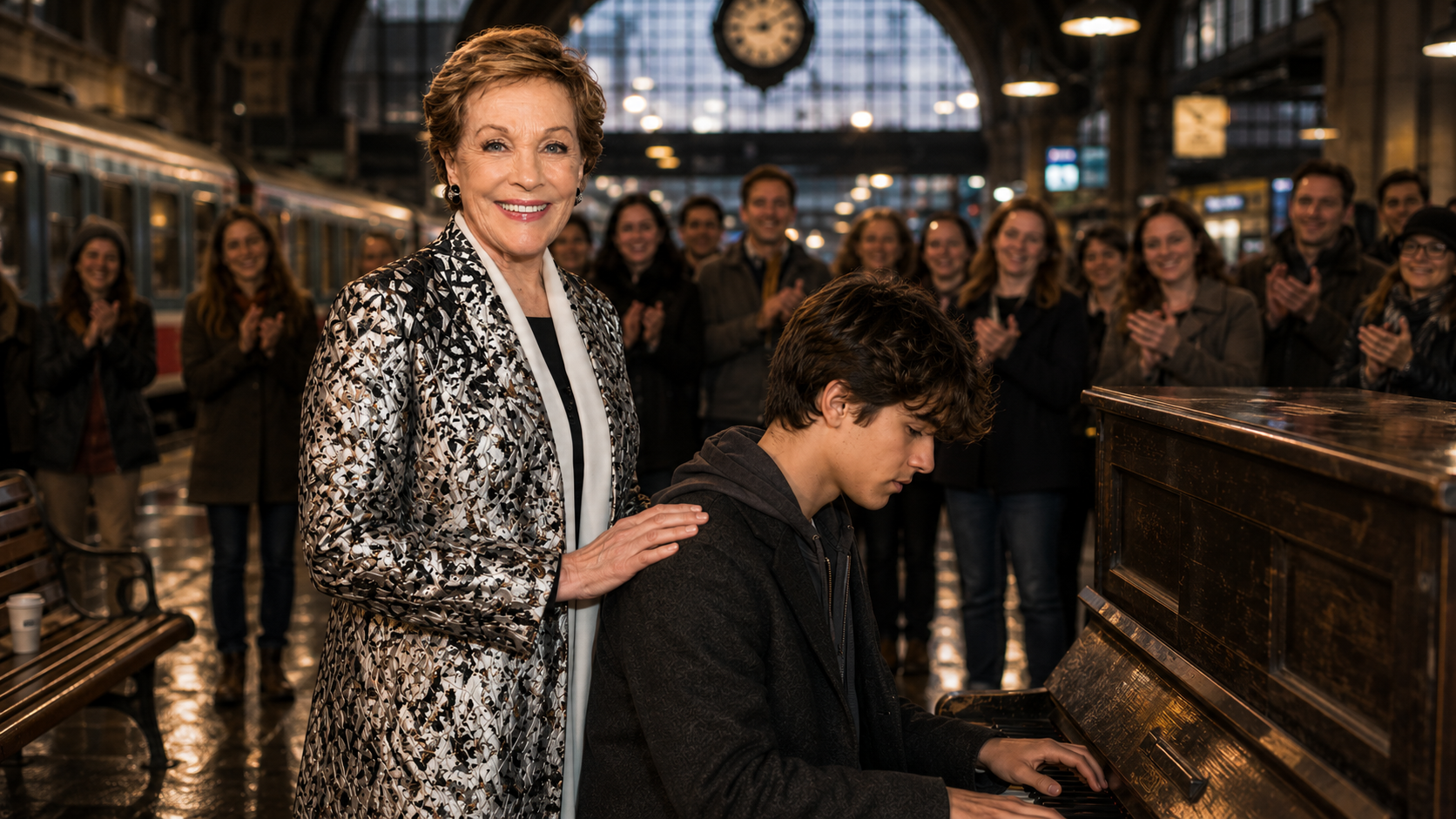
She followed the sound toward an old upright piano standing near Platform Three.
The piano had been placed there years ago for travelers to play, but most people passed it without noticing. Its wooden surface was scratched, several keys were yellowed, and one pedal made a soft squeaking noise.
Sitting at the bench was a young man wearing a thin gray coat.
He looked no older than seventeen.
His dark hair fell over his eyes as his fingers moved carefully across the keys. A worn backpack rested near his feet, and beside it sat a small paper cup filled with loose coins.
The young pianist did not notice Julie standing behind him.
He played with complete concentration, repeating the same difficult section again and again. Each time he made a mistake, he stopped, took a slow breath, and began once more.
Julie listened quietly.
There was no audience.
No applause.
Only the empty station, the rain, and a boy playing as though the music meant everything to him.
When he finally reached the end, Julie smiled and softly clapped.
The young man turned around in surprise.
“I’m sorry,” he said quickly. “Was I disturbing anyone?”
“Not at all,” Julie replied. “You made this station feel less lonely.”
The boy stared at her for a moment. His eyes widened when he recognized her, but he seemed too shocked to speak.
Julie stepped closer to the piano.
“What is your name?”
“Daniel,” he answered.
“And how long have you been playing, Daniel?”
“Since I was six.”
Julie glanced at the cup of coins.
“Do you perform here often?”
Daniel shook his head.
“I practice here.”
“Why not at home?”
His expression changed.
For a moment, he looked down at the piano keys.
“We don’t have one anymore,” he said quietly.
Julie did not press him, but Daniel seemed to sense her kindness. Slowly, he explained.
His mother had once been a music teacher. She had taught him to play on a small piano in their apartment. Music had filled their home every evening. Sometimes they played duets, and sometimes she simply sat beside him and listened.
But two years earlier, Daniel’s mother had become seriously ill.
The family sold many of their belongings to help pay for treatment, including the piano.
Daniel’s mother passed away the following spring.
After that, Daniel stopped playing for nearly a year.
“I thought music would hurt too much,” he told Julie. “Every song reminded me of her.”
“What changed?” Julie asked.
Daniel looked toward the station windows.
“One day, I missed my train and heard someone playing this piano. When they left, I sat down. It was the first time I felt close to my mother again.”
Since then, Daniel had returned three evenings a week. He practiced after school and before the last train home.
He dreamed of studying music, but his family could not afford private lessons. He had applied for a scholarship at a respected music academy, and his audition was only three weeks away.
“I don’t think I’m ready,” he admitted.
Julie sat beside him on the bench.
“Most people who care deeply about something never feel completely ready.”
Daniel gave a small, uncertain smile.
“What will you play for the audition?”
“A piece my mother loved.”
He placed his hands on the keys and began again.
This time, Julie listened more carefully.
The melody was beautiful, but Daniel played it cautiously. His fingers knew the music, yet something seemed to hold him back. It was as if he were afraid to let the emotion inside him become too strong.
When he finished, Julie remained silent for a moment.
Then she said, “You are not only playing notes. You are telling someone’s story.”
Daniel looked at her.
“Whose story?”
“Your mother’s. And yours.”
Julie gently touched the edge of the piano.
“You do not have to hide the sadness. Let it become part of the music.”
Daniel tried again.
At first, the notes sounded the same. Then something changed.
His shoulders relaxed. The melody became warmer and more powerful. Pain and love flowed together through the station hall. The worker stopped sweeping. The tired couple turned toward the piano. A woman who had just entered the station stood still with her suitcase in her hand.
By the final note, six strangers had gathered nearby.
No one spoke.
Then the station worker began to clap.
The others joined him.
Daniel looked around in disbelief.
Julie smiled.
“You see? Music can introduce people before they ever say a word.”
Over the next two weeks, Julie returned several times.
She did not arrive with photographers or assistants. She simply sat beside Daniel, listened to him practice, and offered gentle advice.
She taught him to pause before beginning, to breathe with the rhythm, and to trust the quiet moments between the notes.
But she also asked him questions.
“What did your mother say when you made a mistake?”
Daniel smiled.
“She said mistakes were only places where the music needed patience.”
“And what did she say when you played well?”
“She said music was not about being perfect. It was about making someone feel less alone.”
Julie nodded.
“Then that is what you must remember at your audition.”
Word slowly spread around the station.
The worker who swept the floors began adjusting his break so he could listen. A coffee shop owner brought Daniel hot chocolate. A little girl traveling with her father started leaving hand-drawn pictures on the piano.
Even strangers began speaking to one another.
People who once waited in silence now gathered near Platform Three whenever Daniel played. They shared umbrellas, watched each other’s luggage, and exchanged stories while waiting for trains.
The old station piano became more than an instrument.
It became a meeting place.
One evening, Daniel arrived looking troubled.
His scholarship audition had been moved to a larger concert hall. Several judges would attend, along with dozens of talented students.
“I can’t do it,” he told Julie.
“Yes, you can.”
“They are better than me.”
“Some may be more experienced,” Julie said. “That is not the same as having more to give.”
Daniel shook his head.
“What if I freeze?”
Julie looked around the station.
“What do you see?”
Daniel glanced at the small crowd gathering nearby.
“People waiting for trains.”
“I see people who now know each other because of your music.”
The station worker waved from across the hall. The coffee shop owner lifted a cup in greeting. The little girl placed another drawing on the piano.
Julie continued, “You already performed for the audience that mattered most. You played for people who needed something beautiful after a difficult day.”
Daniel’s eyes filled with emotion.
The next afternoon, Julie quietly spoke with the station manager.
She had an idea.
The station was celebrating its one-hundredth anniversary that weekend. A small ceremony had been planned, but few people were expected to attend.
Julie suggested adding a surprise performance.
At first, the manager stared at her in disbelief.
“You want to perform here?”
“Not alone,” Julie said. “Daniel should be the heart of it.”
Together, they made secret arrangements.
The station workers cleaned the piano. The coffee shop provided warm drinks. A local violinist and cellist agreed to join. Notices were placed around the neighborhood, inviting people to attend an anniversary gathering—but Daniel’s name was not mentioned.
Julie wanted the performance to surprise him too.
On Saturday afternoon, Daniel arrived for what he believed would be an ordinary practice session.
But the station was filled with people.
Families stood beneath the clock. Travelers crowded along the railings. Railway workers, shop owners, teachers, and local musicians had gathered around Platform Three.
Daniel froze near the entrance.
“What is happening?” he whispered.
Julie stepped forward.
“These people came to hear a story.”
Daniel stared at the crowd.
“I can’t play in front of all of them.”
Julie held out her hand.
“You will not be alone.”
A violinist took her place beside the piano. A cellist sat nearby. The station manager dimmed the lights above the waiting hall.
Daniel slowly approached the bench.
His hands trembled as he looked at the keys.
Then he noticed the little girl standing in the front row. She held up a drawing of Daniel playing beside an angel at a piano.
Beneath the picture were five simple words:
Your music makes people feel brave.
Daniel closed his eyes.
He remembered his mother’s voice.
Mistakes are only places where the music needs patience.
Julie stood beside him and gave a small nod.
Daniel placed his fingers on the keys.
The station became completely silent.
Then he played the first note.
What followed would change far more than Daniel’s future.
It would bring together strangers who had passed one another for years without ever speaking—and reveal that one person in the crowd had been searching for Daniel’s family for a very long time.
Part 2
Daniel’s first note floated through the station like a small light entering a dark room.
Then came another.
And another.
At first, his hands trembled. The grand crowd before him seemed to disappear and return with every breath. He could hear the distant sound of a train arriving, the soft rustle of coats, and the nervous beating of his own heart.
Julie Andrews stood beside the piano.
She did not speak.
She simply smiled.
Daniel looked down at the worn keys and remembered why he had begun playing there in the first place.
Not for applause.
Not for a scholarship.
Not to prove that he was better than anyone else.
He played because music made him feel close to his mother.
He played because lonely people sometimes needed a reason to look up.
His shoulders relaxed.
The melody grew stronger.
The violinist joined softly, followed by the cellist. Their music wrapped around Daniel’s piano like warm hands protecting a candle from the wind.
People near Platform Three became still.
A tired nurse who had just finished a long shift closed her eyes. An elderly man removed his hat. Two brothers who had been arguing moments earlier stood quietly beside each other.
The station worker who had first heard Daniel weeks before leaned against his broom and smiled proudly.
Daniel played the piece his mother had loved most.
Every note seemed to carry a memory.
He remembered her sitting beside him at their old piano.
He remembered the way she tapped the rhythm gently against his shoulder.
He remembered her laughter when he played too quickly and her patient voice when he became frustrated.
Music is not about being perfect, she had always said. It is about making someone feel less alone.
Daniel finally understood.
He was not playing for the crowd.
He was playing with them.
Their sadness, hope, worry, and love seemed to move through the melody.
By the final section, Daniel was no longer afraid.
His fingers flew across the keys with courage. The violin rose above the piano, and the cello gave the music a deep, steady heartbeat.
Then the last note faded beneath the station’s high ceiling.
For one long moment, there was silence.
Daniel looked up.
A woman near the back of the crowd was crying.
Then the little girl with the drawing began to clap.
Her father joined her.
The station worker clapped next.
Within seconds, the entire station erupted.
Travelers cheered. Railway workers lifted their hats. People who had never met embraced one another as though they had shared something precious.
Daniel stood slowly.
He looked at Julie with tears in his eyes.
“I did it,” he whispered.
Julie squeezed his hand.
“You gave them something they will remember.”
Before Daniel could answer, the woman at the back of the crowd began moving toward him.
She was in her early sixties, with silver hair pinned neatly behind her head. She carried an old leather handbag and walked as though her knees might fail at any moment.
When she reached the piano, she stared at Daniel.
“Your mother’s name,” she said softly. “Was it Elena?”
Daniel’s expression changed.
“Yes.”
The woman covered her mouth.
“My name is Margaret Hale.”
Daniel waited, confused.
Margaret opened her handbag and removed a faded photograph.
It showed two young women sitting at a piano. One was Daniel’s mother. The other was Margaret.
“We studied music together,” Margaret said. “Your mother was my closest friend.”
Daniel took the photograph with shaking hands.
“I’ve never seen this.”
Margaret nodded through tears.
“We lost contact many years ago. I moved away, and your mother changed addresses. I wrote letters, but they were returned. I searched for her more than once.”
She looked toward the piano.
“Then today, I heard you play our song.”
Daniel stared at her.
“Our song?”
Margaret smiled sadly.
“The piece you just performed. Elena and I played it together at our final school concert.”
The crowd around them grew quiet.
Margaret reached into her bag again and pulled out a bundle of old letters tied with blue ribbon.
“These were meant for your mother,” she said. “I never stopped hoping I would find her.”
Daniel held the letters carefully.
For years, he had believed that part of his mother’s life had disappeared forever. Now, standing inside the station where he had come to escape his loneliness, he had found someone who remembered her as a young woman full of dreams.
Margaret sat beside him on the piano bench.
“She spoke about having a son one day,” she said. “She said she would teach him music, but only if he promised never to become proud.”
Daniel laughed through his tears.
“That sounds like her.”
Margaret placed her fingers on the keys.
“Would you play with me?”
Daniel looked at Julie.
She nodded.
Together, Daniel and Margaret played the piece again.
This time, the music carried two generations.
Margaret played the notes she remembered from long ago. Daniel followed with the style his mother had taught him. Some sections were imperfect, and once they even lost the rhythm and began laughing.
But no one in the station cared.
The performance was not polished.
It was real.
And somehow, that made it more beautiful.
Afterward, people remained at the station long after their trains had arrived.
The nurse introduced herself to the elderly man. The two brothers apologized to each other. The coffee shop owner gave free drinks to everyone who had attended.
Strangers exchanged phone numbers.
Parents arranged music lessons for their children.
The station manager placed a wooden sign beside the piano:
This piano belongs to everyone. Sit. Play. Listen. Stay awhile.
Daniel’s scholarship audition took place four days later.
He entered the concert hall wearing the same gray coat he had worn when Julie first found him.
Margaret sat in the audience.
So did the station worker, the coffee shop owner, the little girl and her father, and several travelers who had met during the surprise performance.
Julie sat quietly in the final row.
Daniel had never seen so many familiar faces in one place.
When his name was called, he walked onto the stage.
The judges looked serious. The hall was larger than he had imagined, and the piano shone beneath bright lights.
For a moment, fear returned.
Then Daniel pictured the old station piano.
He remembered scratched wood, yellowed keys, and strangers waiting in silence.
He sat down.
Before playing, he said, “This piece was taught to me by my mother. I am playing it for everyone who has ever felt alone.”
Then he began.
He did not play perfectly.
But he played honestly.
When he finished, the judges remained silent for several seconds.
One of them leaned forward.
“Who taught you to express music this way?”
Daniel looked toward Julie, then toward Margaret and the friends from the station.
“A lot of people,” he replied.
Two weeks later, a letter arrived.
Daniel had received a full scholarship.
He ran all the way to the station, holding the envelope above his head.
The moment he entered the waiting hall, the station worker rang an old brass bell. The coffee shop owner cheered. Margaret hugged him tightly.
Julie stood near the piano.
Daniel handed her the letter.
“You knew I could do it,” he said.
Julie smiled.
“I knew you could touch people. The scholarship committee simply noticed.”
Daniel began studying at the academy that winter, but he never stopped returning to Platform Three.
Every Friday evening, he played at the station.
Margaret joined him often.
The little girl began taking piano lessons and performed her first song there six months later. The nurse and the elderly man became close friends and started organizing monthly dinners for people who lived alone.
The two brothers opened a small music-repair shop across the street.
Travelers began leaving handwritten messages beside the piano.
One said:
I missed my train, but found a friend.
Another read:
I came here grieving and left with hope.
A third simply said:
Thank you for making this place feel like home.
Years passed.
Daniel became a gifted pianist and teacher. He performed in concert halls around the world, but his most important performance remained the one inside the old train station.
Whenever he returned from a tour, he visited Platform Three.
The piano had been repaired many times, yet its scratches were never completely removed. Daniel insisted they remain.
“They are part of its story,” he said.
On the tenth anniversary of the surprise performance, hundreds of people gathered at the station.
Some had met there and later married.
Some had built friendships that carried them through illness, grief, and difficult years.
Others had become musicians because they once heard a frightened young man play with courage.
Julie attended quietly.
Daniel stood before the crowd, now a confident adult.
“This station changed my life,” he said. “But not because it gave me a place to practice. It gave me people who stayed.”
He looked at Margaret, the station worker, the coffee shop owner, and the little girl, now a young pianist herself.
Then he turned to Julie.
“And one person taught me that music does not need a perfect stage. It only needs an open heart.”
The crowd applauded.
Julie wiped a tear from her cheek.
Daniel sat at the piano and began the same melody his mother had loved.
One by one, other musicians joined him.
A violin.
A cello.
A flute.
Then another piano.
Soon, the old station was filled with music once again.
Strangers stopped.
Children smiled.
Old friends embraced.
And beneath the great station clock, surrounded by people who had once known only loneliness, Daniel understood the true gift his mother had left him.
It was not simply the ability to play.
It was the courage to bring people together.
The trains continued arriving and leaving.
But near Platform Three, no one felt like a stranger anymore.
THE END


