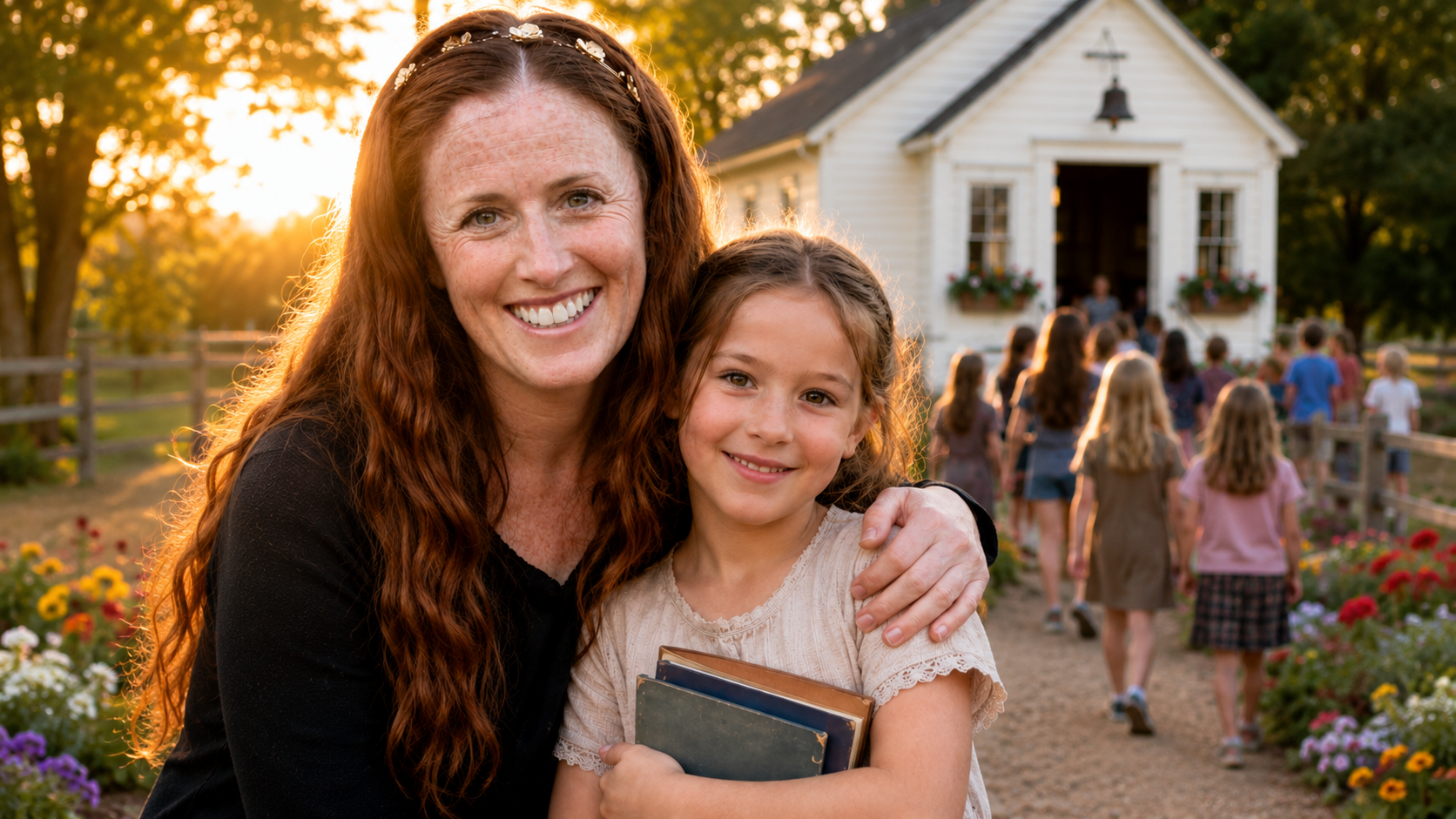
Part 1: The Schoolhouse Behind the Trees
At the edge of the small town of Willow Creek stood an old one-room schoolhouse almost completely hidden behind tall grass and wild blackberry vines.
Its white paint had faded to gray. Several windows were broken, the wooden steps leaned to one side, and the little brass bell above the roof had not rung in more than thirty years.
Most people passed the building without looking at it.
But twelve-year-old Lily Harper never did.
Every afternoon after school, Lily walked down the narrow dirt road and stopped beside the rusted gate. She would stare through the weeds at the forgotten building and imagine children sitting inside, reading books beneath the warm sunlight.
The schoolhouse had once belonged to her grandfather, Samuel Harper.
He had not owned it in the usual sense. For nearly forty years, he had been its teacher, caretaker, and greatest defender.
Long before Lily was born, Samuel had taught hundreds of children there. He taught them reading, mathematics, history, music, and something he believed was even more important.
“Every child deserves a place where they feel seen,” he often said.
Lily had heard those words many times from her mother.
Her grandfather had died when Lily was only six, but she still remembered sitting beside him on the front porch while he told stories about the schoolhouse.
He spoke of winter mornings when children arrived with snow on their boots. He remembered spring concerts, handmade Christmas decorations, and quiet students who discovered talents they never knew they had.
Samuel had dreamed of turning the schoolhouse into a free community learning center after it closed.
But his health began to fail before he could restore it.
After his death, the building remained empty.
Years passed.
The town council considered tearing it down several times, but no one wanted to be responsible for destroying such an important part of Willow Creek’s history.
Still, no one stepped forward to save it.
No one except Lily.
She carried a small notebook filled with drawings of how the schoolhouse could look again. She sketched repaired windows, shelves of books, bright curtains, flower boxes, and a polished wooden floor.
At the top of every page, she wrote the same words:
Grandpa Samuel’s Learning House.
Lily wanted to tell people about her plan, but she was painfully shy.
At school, she rarely raised her hand. During group projects, she spoke so softly that other students often talked over her. When teachers asked her to present in front of the class, her hands trembled and her voice nearly disappeared.
Her mother, Rachel, knew how much the schoolhouse meant to her.
“You have a beautiful idea,” Rachel told her one evening. “But people cannot help you unless they know what is in your heart.”
Lily looked down at her notebook.
“What if they laugh?”
“Then they will be laughing at something brave,” her mother replied. “And brave ideas are always worth sharing.”
Lily wanted to believe her.
But fear held her silent.
Then, one rainy Saturday morning, a visitor arrived in Willow Creek.
Kami Cotler had been invited to speak at the town library about childhood, education, and the lasting influence of teachers. The event drew families from across the county.
Rachel encouraged Lily to attend.
“You might enjoy hearing her,” she said.
Lily agreed, but she brought her schoolhouse notebook with her, holding it tightly against her chest.
The library meeting room was crowded. Folding chairs filled every row, and people stood along the walls.
Kami spoke warmly about the adults who recognize the quiet gifts inside children.
“Sometimes,” she said, “the child who speaks the least is carrying the biggest dream.”
Lily looked up.
The sentence felt as though it had been spoken directly to her.
After the talk, people lined up to greet Kami. Some asked for photographs. Others shared memories and thanked her for visiting.
Lily stood near the back of the room, clutching her notebook.
Twice, she stepped toward the line.
Twice, she lost her courage and stepped away.
Kami noticed her.
When the room had nearly emptied, she walked over and smiled.
“That looks like an important notebook,” Kami said.
Lily froze.
Her mother gently placed a hand on her shoulder.
“Would you like to show her?” Rachel asked.
Lily slowly opened the notebook.
Kami studied the drawings carefully. She did not rush. She turned every page, reading Lily’s notes about bookshelves, art tables, tutoring rooms, and a small garden where older residents could teach children how to plant vegetables.
“Did you design all of this?” Kami asked.
Lily nodded.
Kami knelt slightly so they were at eye level.
“Tell me about the building.”
At first, Lily could barely speak.
But when she began talking about her grandfather, the words slowly came.
She told Kami how Samuel had taught generations of families. She explained his dream of reopening the schoolhouse as a place where children could learn without worrying about money.
Then Lily whispered the part that frightened her most.
“The town might tear it down.”
Kami looked at the final drawing.
It showed the schoolhouse glowing beneath the evening sky while families gathered outside.
“This should not stay only inside a notebook,” she said. “Will you take me there?”
That afternoon, the rain stopped.
Lily, Rachel, and Kami walked down the dirt road toward the abandoned schoolhouse.
Kami stood before the rusted gate and looked at the sagging roof, cracked windows, and weeds covering the steps.
“It needs a great deal of work,” Rachel admitted.
Kami turned toward Lily.
“Old buildings can look hopeless from the outside,” she said. “But sometimes they are simply waiting for someone to remember why they mattered.”
Lily unlocked the gate with the old key her grandfather had left behind.
The front door opened with a long creak.
Inside, dust covered the desks. Pieces of plaster had fallen from the ceiling. A faded alphabet chart still hung on one wall, and an old blackboard stretched across the front of the room.
Lily walked to the teacher’s desk.
In the top drawer, she found a small wooden box she had never seen before.
Inside were photographs, class lists, handwritten lessons, and dozens of letters from former students.
One letter read:
Mr. Harper, you were the first person who told me I was intelligent. Because of you, I became a nurse.
Another said:
When my family had no money for books, you gave me your own. I became a teacher because I wanted children to feel the way you made me feel.
Kami read the letters quietly.
“These are more than memories,” she said. “They are proof.”
“Proof of what?” Lily asked.
“Proof that one small schoolhouse changed many lives.”
Near the bottom of the box, Lily discovered an envelope with her name written across the front.
Her breath caught.
The handwriting belonged to her grandfather.
She opened it carefully.
Dear Lily,
You may be very young when you read this. Perhaps you will be older. Perhaps the schoolhouse will still be standing, or perhaps it will only exist in photographs.
But I hope you remember this: buildings are not saved by wood and nails alone. They are saved when people believe the work done inside them still matters.
You have always had a gentle heart. Never mistake gentleness for weakness. Quiet people can carry powerful ideas.
If this schoolhouse ever calls to you, listen.
Lily could not finish reading aloud.
Tears slipped down her face.
Kami placed a comforting arm around her shoulders.
“Your grandfather knew you might come back,” she said.
That evening, Kami met with several town leaders at the library.
She did not ask them to repair the schoolhouse for Lily.
Instead, she asked them to listen to Lily’s idea.
The mayor agreed to give Lily ten minutes at the next council meeting.
When Lily heard the news, her excitement disappeared beneath fear.
“I cannot speak in front of all those people,” she said.
“Yes, you can,” Kami replied gently.
“What if my voice shakes?”
“Let it shake.”
“What if I forget the words?”
“Then speak from your heart.”
For the next week, Kami helped Lily prepare.
They practiced in the empty library meeting room. At first, Lily could only say two sentences before stopping.
Kami never criticized her.
She taught Lily to breathe slowly, look at one friendly face at a time, and remember that courage did not mean feeling unafraid.
“Courage means your dream matters more than your fear,” Kami told her.
On the night of the council meeting, every seat was filled.
News had spread that Samuel Harper’s granddaughter wanted to save the old schoolhouse.
Some people supported the idea.
Others believed the building was too damaged and the repairs would cost too much.
Lily stood beside a large poster displaying her drawings.
Her hands trembled.
For several seconds, no words came.
Then she saw Kami sitting in the second row.
Kami smiled and nodded.
Lily took a breath.
“My grandfather believed every child deserved a place where they felt seen,” she began.
Her voice was quiet, but the room became still.
She showed the council her plans for a free learning center. She read several letters from Samuel’s former students. Finally, she held up her grandfather’s note.
“This schoolhouse is not empty,” Lily said. “It is filled with everything he taught us. We only have to open the door again.”
When she finished, no one spoke.
Then an elderly man rose slowly from the back row.
“My name is Daniel Foster,” he said. “Samuel Harper taught me in that schoolhouse.”
A woman beside him stood.
“He taught me too.”
Then another person rose.
And another.
Within moments, nearly half the room was standing.
A retired carpenter offered to repair the steps.
A local builder volunteered to inspect the roof.
A bookstore owner promised boxes of children’s books.
Parents offered paint, tools, food, and time.
The mayor wiped his eyes before calling for a vote.
The council unanimously agreed to delay demolition and give the town ninety days to restore the building.
Lily turned toward Kami, hardly believing what had happened.
But the real challenge had only begun.
The next morning, volunteers gathered outside the schoolhouse.
They cut weeds, removed broken boards, carried out damaged desks, and opened windows that had been sealed for decades.
Lily worked beside everyone, sorting books and cleaning her grandfather’s old classroom materials.
Day after day, the schoolhouse slowly changed.
Fresh white paint covered the walls. New glass filled the windows. The roof was repaired, and flower boxes appeared beneath every window.
Former students returned with stories and photographs.
Children painted signs.
Local farmers built garden beds.
Kami remained in Willow Creek longer than planned, helping organize donations and encouraging Lily whenever the work felt overwhelming.
Then, just three weeks before the scheduled reopening, the builder discovered a dangerous crack beneath the schoolhouse foundation.
The repair would cost far more than the town had raised.
Without it, the building could not safely open.
That evening, the volunteers gathered silently inside the nearly restored classroom.
The walls were bright. Books filled the shelves. New curtains moved gently in the breeze.
Everything looked ready.
But the schoolhouse might still be closed forever.
Lily stood at her grandfather’s desk, fighting back tears.
“We came so close,” she whispered.
Kami looked around at the disappointed faces.
Then she noticed the old brass bell resting in the corner—the same bell that had once called children to class.
She touched its weathered surface and turned toward Lily.
“Your grandfather’s schoolhouse changed this town once,” she said. “Perhaps it is time to let the entire town hear its voice again.”
The next morning, Lily climbed the repaired front steps holding the brass bell in both hands.
A crowd had gathered outside.
She was still shy.
Her voice still trembled.
But this time, she did not step backward.
She raised the bell and prepared to announce one final plan that could either save the schoolhouse—or end the dream forever.
Part 2: When the Bell Rang Again
This is a fictional story created for inspiration and entertainment.
Lily stood on the front steps of the old schoolhouse with the brass bell held tightly in both hands.
The morning sun shone through the trees, warming the freshly painted walls behind her. Around the yard, volunteers waited in silence. Carpenters, parents, farmers, shop owners, former students, and children had all gathered to hear what she would say.
Only a few months earlier, Lily would have hidden behind her mother.
Now she faced the crowd.
Her hands trembled, but she did not lower the bell.
“The schoolhouse is almost ready,” she began. “But the foundation is not safe. We need more money than we have.”
A quiet sadness moved through the crowd.
Everyone already knew the problem. What they did not know was why Lily had called them together.
She looked toward Kami Cotler, who stood beside the old gate.
Kami smiled gently.
Lily took a slow breath.
“My grandfather used this bell to call children to class,” she continued. “People heard it across the fields and knew the school doors were open.”
She raised the bell slightly.
“I want to ring it again. But this time, I want everyone who hears it to bring one thing they can give.”
The mayor looked puzzled.
“One thing?” he asked.
“It does not have to be money,” Lily explained. “It can be time, wood, tools, food for the workers, or a story about someone who learned here. We will call it the Bell of Hope.”
A little boy near the front raised his hand.
“What if we only have a few coins?”
Lily smiled.
“Then bring the coins. Small things become big when enough people share them.”
Kami’s eyes filled with pride.
Lily rang the bell.
Its first sound was rough and uneven.
Then the clear tone traveled across the yard, through the trees, and down the quiet road.
For a moment, everyone stood still.
Then Daniel Foster, one of Samuel Harper’s former students, stepped forward.
“I can give two weeks of work,” he said. “I may be old, but I can still carry boards.”
The bookstore owner raised her hand.
“I will donate every dollar from Saturday’s sales.”
A farmer offered stone for the foundation.
A restaurant owner promised lunch for every volunteer.
A group of teenagers offered to wash cars in the town square.
A young mother said she would organize a bake sale.
Then the children began speaking.
One offered the money from his piggy bank.
Another promised to sell handmade bookmarks.
A shy girl named Ava said she would paint small pictures of the schoolhouse and ask people to donate whatever they could.
By noon, the Bell of Hope campaign had begun.
Word spread far beyond Willow Creek.
Former students who had moved away heard about Lily’s plan through letters, telephone calls, and local news reports.
Donations arrived from places Lily had never visited.
A retired doctor sent a note saying Samuel had once helped him stay in school when his father became ill.
A woman from another state sent enough money to repair one entire wall.
A former student who had become an engineer offered to review the restoration plans for free.
Every contribution came with a story.
Kami helped Lily create a large display inside the library. On one wall, they hung photographs of the schoolhouse through the years. On another, they placed handwritten memories from former students.
At the center of the display was Samuel’s message:
Quiet people can carry powerful ideas.
People came to read the stories and often left in tears.
Within ten days, the town had raised more than half the money needed.
But they were still far from the final amount.
One evening, after everyone had gone home, Lily sat alone on the schoolhouse steps.
Kami found her there.
“You did something wonderful,” Kami said.
“But it might not be enough,” Lily replied.
Kami sat beside her.
“Do you know why people are helping?”
“Because they loved my grandfather?”
“That is part of it,” Kami said. “But they are also helping because you reminded them that this town can still build something together.”
Lily looked toward the open doorway.
The classroom beyond it was bright and nearly complete.
“I wanted to save his dream,” she whispered.
Kami shook her head gently.
“You are not only saving his dream. You are giving it a future.”
The next morning brought unexpected news.
A large construction company from the nearest city had heard about the project. The company’s owner, Thomas Reed, had attended Samuel Harper’s school as a child.
He arrived in Willow Creek carrying an old class photograph.
In the picture, Thomas stood in the back row wearing a shirt that was too large and shoes with worn soles.
“Your grandfather knew my family was struggling,” Thomas told Lily. “He never embarrassed me. He quietly left books and school supplies on my desk.”
Thomas looked toward the cracked foundation.
“My company will repair it.”
Lily stared at him.
“We cannot afford—”
“You already paid,” he said.
She looked confused.
Thomas pointed to the old photograph.
“Your grandfather paid years ago with kindness.”
The foundation work began immediately.
For several days, the schoolhouse yard was filled with workers, machinery, stone, and timber. The damaged area was reinforced, the floor was stabilized, and the entire building was inspected again.
At last, the builder stood before the volunteers and smiled.
“The schoolhouse is safe.”
Cheers erupted across the yard.
Lily ran to her mother and hugged her.
Rachel held her tightly.
“Your grandfather would be so proud,” she whispered.
Kami stood nearby, wiping away a tear.
The reopening was scheduled for the first Saturday in September.
During the final week, everyone worked from sunrise until evening.
Children placed books on the shelves.
Parents hung curtains.
Farmers planted flowers along the walkway.
A local artist painted a small wooden sign that read:
Samuel Harper Community Schoolhouse
A Place Where Every Child Is Seen
Lily kept one desk exactly as it had been.
It was her grandfather’s old desk.
She polished it carefully and placed his photograph beside the wooden box of letters.
On the morning of the reopening, Lily woke before sunrise.
She dressed quietly and walked with her mother down the familiar dirt road.
The schoolhouse appeared through the trees.
For the first time in decades, light glowed through every window.
The white walls looked fresh. The repaired steps stood straight. Red and yellow flowers filled the window boxes.
Above the roof, the brass bell waited.
Lily stopped at the gate.
“I wish Grandpa could see it,” she said.
Rachel placed an arm around her.
“Maybe he can.”
By nine o’clock, the road was filled with cars, bicycles, and people walking from town.
Former students arrived carrying photographs, books, and memories.
Families brought children who had never seen the inside of a one-room schoolhouse.
Older residents greeted one another with tears and laughter.
Daniel Foster stood beneath a tree with three classmates he had not seen in forty years.
The mayor spoke first.
“This building was nearly lost,” he told the crowd. “Not because it lacked history, but because we forgot what it meant.”
He turned toward Lily.
“One young girl remembered.”
The crowd applauded.
Lily stood beside Kami near the front steps.
Her heart beat quickly.
She had prepared a speech, but when she saw the faces before her, the words on the page no longer felt right.
She folded the paper.
“My grandfather believed this schoolhouse belonged to everyone,” she said. “He believed children should never feel too poor, too quiet, too different, or too afraid to learn.”
Her voice trembled.
But she continued.
“I used to think being shy meant I could not make a difference. Kami taught me that courage does not mean having a loud voice. It means using the voice you have.”
Kami lowered her head, deeply moved.
Lily looked toward the children waiting near the door.
“This place is open again because all of you gave something. Some gave money. Some gave work. Some gave stories. Some gave only a few coins.”
She smiled.
“But every gift mattered.”
Then she climbed the steps and reached for the bell rope.
The crowd became silent.
Lily pulled.
The bell rang across Willow Creek.
Its clear sound traveled over the rooftops, fields, and gardens.
Some of Samuel Harper’s former students began to cry.
For them, the sound brought back winter mornings, wooden desks, spelling lessons, and a teacher who had believed in them before they believed in themselves.
The doors opened.
Children entered first.
Inside, the schoolhouse no longer looked abandoned.
One corner held shelves of books.
Another had art supplies and musical instruments.
A long table was prepared for tutoring and community classes.
Old photographs covered one wall, while the opposite wall displayed blank frames waiting for new memories.
Lily led the first group toward the reading area.
A small boy named Noah stopped beside Samuel’s photograph.
“Was he a good teacher?” Noah asked.
Lily looked at the smiling face of her grandfather.
“The best,” she replied.
Kami read the first story of the day.
Children gathered around her on a large rug while parents and grandparents stood near the walls.
She chose a simple story about a tiny candle that believed its light was too small to matter.
As she read, sunlight streamed through the repaired windows.
When the story ended, Kami closed the book.
“What happened when the little candle finally shone?” she asked.
A child near the front raised her hand.
“It helped other lights find their way.”
Kami looked at Lily.
“Exactly.”
Throughout the day, the schoolhouse filled with life.
A retired teacher offered free reading lessons.
A local musician taught children their first song.
Farmers showed families how to plant vegetables in the garden.
Teenagers helped younger children with homework.
Former students shared stories of Samuel Harper.
One woman told how he had walked three miles through snow to bring medicine to her family.
A man said Samuel had stopped him from leaving school at fourteen.
Another remembered how Samuel had stayed late every afternoon to help him learn to read.
Each story made the schoolhouse feel warmer.
Near sunset, Lily noticed a girl standing alone near the doorway.
She was about eight years old and held a notebook against her chest.
Lily recognized the look in her eyes.
It was the same fear she had once carried.
Lily walked over.
“What is in your notebook?” she asked.
The girl looked down.
“Drawings.”
“May I see them?”
The girl hesitated, then slowly opened the cover.
Inside were careful drawings of birds, trees, houses, and smiling families.
“They are beautiful,” Lily said.
The girl’s eyes widened.
“My teacher says I should show them to people, but I get scared.”
Lily knelt beside her.
“I understand.”
“Were you scared today?”
“Very.”
“But you still spoke.”
Lily smiled.
“Sometimes your hands shake and your heart beats fast. You can still be brave.”
The girl looked around the restored classroom.
“Can I draw here?”
“You can draw here anytime.”
That evening, the last families gathered outside beneath strings of small lights.
The mayor announced that the schoolhouse would offer free weekend classes, after-school tutoring, music lessons, gardening workshops, and storytelling events.
No child would be charged.
Before leaving, Kami asked Lily to walk with her to the old desk.
She handed her a small wrapped package.
Inside was a new notebook.
On the first page, Kami had written:
For Lily, whose quiet dream taught an entire town how to believe again.
Lily hugged the notebook to her heart.
“Will you come back?” she asked.
Kami smiled.
“Of course. But you do not need me to keep this place alive.”
“I think I do.”
“No,” Kami said gently. “You needed someone to remind you that your voice mattered. Now you can remind others.”
Lily looked around the room.
Children’s drawings already covered the tables. Books rested open on the shelves. Fresh flowers sat beside her grandfather’s photograph.
The schoolhouse was no longer a memory.
It was alive.
Years later, people would still speak about that first day.
They remembered the bell.
They remembered the children running through the doors.
They remembered former students standing together with tears in their eyes.
But most of all, they remembered the shy young girl who refused to let a forgotten building disappear.
Lily eventually became a teacher.
She traveled away for college, but she returned to Willow Creek and taught in the same schoolhouse her grandfather had once protected.
Above her desk, she kept his letter beside the notebook Kami had given her.
Whenever a quiet child entered the classroom and sat alone, Lily would offer the same gentle encouragement she had once received.
“Your voice does not have to be loud to matter.”
And every September, on the anniversary of the reopening, the entire town gathered outside.
Lily would invite one child to ring the old brass bell.
Its sound would travel through Willow Creek again, reminding everyone that hope often begins quietly—
with one forgotten place,
one brave idea,
and one person willing to believe.
The End


