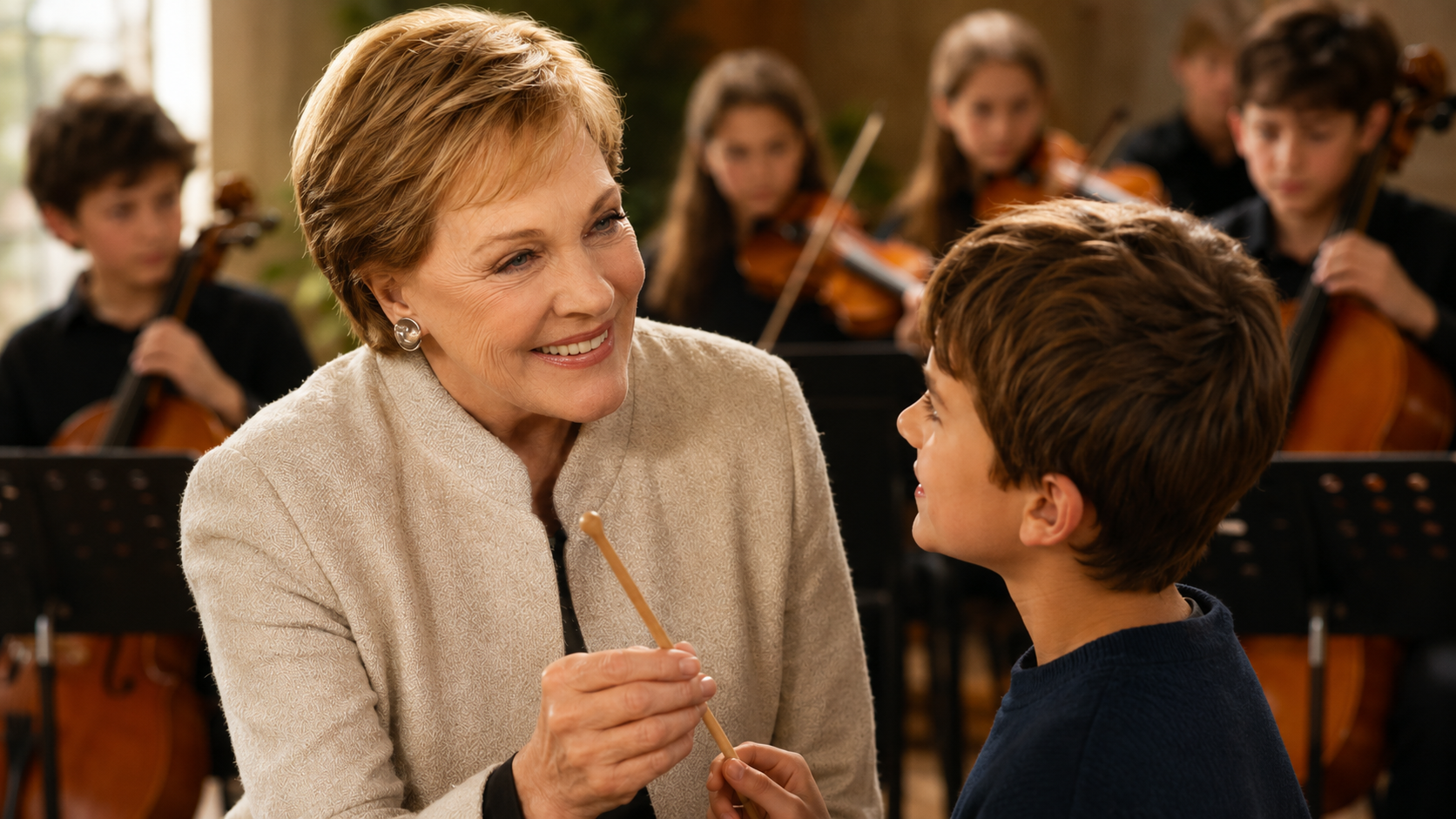
Part 1: The Boy with the Wooden Baton
Twelve-year-old Oliver Reed had never seen a live orchestra.
He had only heard one through the small radio beside his bed.
Every evening, after finishing his homework, Oliver would close his eyes and imagine himself standing beneath bright stage lights. In his hand, he held a shining conductor’s baton. Before him sat dozens of musicians, waiting for his signal.
Then he would raise his arm.
The violins would begin.
The cellos would answer.
The whole room would come alive.
In reality, Oliver’s baton was a thin wooden spoon borrowed from his mother’s kitchen.
His concert hall was their narrow living room in a quiet English village.
His orchestra consisted of empty chairs.
Oliver’s mother, Anna, worked long hours at a bakery. Since Oliver’s father had passed away three years earlier, money had been tight. Music lessons, concert tickets, and trips to the city were luxuries they could not afford.
Still, Oliver never stopped dreaming.
His father had loved classical music. Before his illness, he often sat with Oliver beside the radio and explained how every instrument carried a different feeling.
“The conductor doesn’t control the music,” his father once said. “A good conductor helps everyone find the courage to play together.”
Oliver never forgot those words.
At school, however, the other children sometimes laughed when they saw him waving his wooden spoon in the air.
“You can’t even play an instrument,” one boy teased. “How are you going to lead an orchestra?”
Oliver usually smiled and pretended the words did not hurt.
But they did.
One rainy afternoon, his music teacher, Mrs. Bell, found him alone in the classroom. He was standing before the empty desks, quietly conducting a piece playing through an old speaker.
Mrs. Bell watched from the doorway.
Oliver’s movements were not perfect, but they were full of feeling. He knew when the music grew soft. He understood when it needed strength. Most importantly, he listened carefully to every note.
When the piece ended, Mrs. Bell gently applauded.
Oliver turned around, embarrassed.
“I know it looks silly,” he said.
“It does not look silly,” she replied. “It looks like the beginning of something.”
The next week, Mrs. Bell gave the class an assignment. Each student had to write a letter to someone who had inspired them.
Most children chose athletes, singers, or movie stars.
Oliver chose Julie Andrews.
He had grown up listening to her songs and watching her films with his father. To Oliver, her voice represented hope, gentleness, and the belief that ordinary people could do extraordinary things.
In his letter, he wrote:
“Dear Ms. Andrews,
My name is Oliver, and I am twelve years old. I want to become an orchestra conductor one day. I do not have a real baton, so I use a wooden spoon. Some people laugh at me, but my father told me that music can bring people together.
He is not here anymore, but when I conduct, I feel close to him.
I know you are very busy. I only wanted to tell you that your songs helped me keep dreaming.
Sincerely,
Oliver”
Mrs. Bell quietly sent the letter.
Weeks passed.
Oliver received no reply.
He was disappointed, but he understood. Julie Andrews must have received thousands of letters.
Then, one Friday morning, Mrs. Bell announced that a special guest would visit the school music room.
The students whispered excitedly.
Oliver assumed it would be a local musician.
When the door opened, the room became completely silent.
Julie Andrews stepped inside.
Oliver stared in disbelief.
She carried a small black case in her hands.
“Is there a young conductor named Oliver here?” she asked warmly.
Oliver slowly stood.
His knees trembled as Julie walked toward him.
“I received a very important letter,” she said. “It reminded me that dreams often begin with simple things—a song, a kind word, or even a wooden spoon.”
The class laughed gently, but this time Oliver did not feel ashamed.
Julie opened the case.
Inside was a conductor’s baton.
It was polished wood with a silver handle.
She placed it in Oliver’s hands.
“This does not make you a conductor,” she told him. “Your patience, discipline, and love for music will do that. But perhaps it can remind you not to stop.”
Oliver held the baton carefully, as though it were made of glass.
Tears filled his eyes.
Julie then turned toward a small group of musicians who had quietly entered behind her. They were members of a nearby chamber orchestra.
“Would you like to conduct them?” she asked.
Oliver could barely speak.
He nodded.
The musicians sat in a semicircle while Oliver took his place before them. Julie stood beside Mrs. Bell and watched.
Oliver raised the baton.
For one frightening second, he froze.
Then he remembered his father’s words.
A good conductor helps everyone find the courage to play together.
Oliver gave the signal.
The first notes filled the classroom.
His hands shook at first, but as the melody continued, he became calm. He listened. He breathed with the musicians. He guided them through the soft passages and lifted them toward the powerful ending.
When the final note faded, no one moved.
Then the entire room erupted in applause.
Julie stepped forward and hugged him.
“One day,” she whispered, “you must conduct a concert that tells people why kindness matters.”
Oliver looked down at the baton in his hand.
“I promise,” he said.
That afternoon changed everything.
But keeping the promise would require years of sacrifice, disappointment, and courage.
And there were many moments when Oliver almost gave up.
Part 2: The Concert of Kindness
After Julie Andrews visited his school, Oliver’s life did not suddenly become easy.
He still lived in the same little house.
His mother still woke before sunrise to work at the bakery.
And Oliver still had no money for private music lessons.
But now, whenever doubt entered his mind, he opened the black case and looked at the baton Julie had given him.
Her words returned to him.
Your patience, discipline, and love for music will make you a conductor.
Mrs. Bell began teaching him basic music theory after school. A retired pianist from the village offered him free lessons once a week. The local librarian saved old books about famous composers and conductors for him.
Soon, people across the village heard Oliver’s story.
A bus driver gave him free rides to youth orchestra rehearsals in the neighboring town.
The bakery customers placed spare coins in a jar labeled “Oliver’s Music Fund.”
An elderly violinist named Mr. Harris allowed Oliver to sit quietly during rehearsals and study the conductor’s movements.
Every act of kindness carried him one step farther.
Oliver worked harder than anyone expected.
He studied scores late into the night.
He learned piano.
He trained his ear to recognize every instrument.
At sixteen, he applied to a respected music academy.
He was rejected.
The letter said he showed promise but lacked formal training.
Oliver sat on the kitchen floor that evening, holding the rejection letter. For the first time in years, he considered giving up.
His mother sat beside him.
“Do you remember what your father said?” she asked.
Oliver nodded.
“Then listen carefully,” she continued. “One person has said no. That does not mean the music has ended.”
Oliver applied again the following year.
This time, he was accepted with a scholarship.
At the academy, he often felt behind the other students. Many had studied music since early childhood. Some came from wealthy families and owned expensive instruments.
Oliver owned one treasured baton.
Whenever he felt embarrassed, he remembered the empty chairs in his childhood living room.
He remembered conducting them before anyone believed in him.
Years passed.
Oliver became known not only for his talent but also for the way he treated musicians. He never shouted or humiliated anyone. He listened to their ideas. He thanked stage workers, cleaners, and assistants by name.
When asked why kindness mattered so much to him, Oliver always gave the same answer.
“Because no dream grows alone.”
At twenty-eight, Oliver received the opportunity he had waited for all his life.
He was invited to conduct his first major public concert with the Royal Westbridge Orchestra.
The performance would take place in a grand concert hall before more than two thousand people.
Reporters called him one of the most promising young conductors of his generation.
But Oliver did not want his first concert to celebrate only his success.
He wanted it to honor everyone who had helped him.
He named the evening “The Concert of Kindness.”
He invited Mrs. Bell, the retired pianist, Mr. Harris, the village bus driver, the bakery customers, and every teacher who had encouraged him.
He also reserved one special seat in the front row.
For Julie Andrews.
Oliver wrote to her personally.
“Years ago, you asked me to conduct a concert that showed people why kindness matters. I have tried to keep my promise. This concert belongs partly to you.”
He did not know whether she would be able to attend.
On the night of the performance, Oliver stood backstage, holding the same baton she had given him sixteen years earlier.
Its silver handle had small scratches now, but he had never replaced it.
The concert hall filled.
Oliver looked through the curtain.
Mrs. Bell was there.
His mother sat beside her, wiping tears from her eyes.
The villagers occupied several rows together.
But the special seat remained empty.
Oliver felt a quiet sadness, though he told himself it was enough that Julie had once believed in him.
The lights dimmed.
The orchestra prepared.
Oliver walked onto the stage.
The audience rose in applause.
Before beginning, he turned toward them.
“When I was twelve,” he said, “I believed a conductor stood alone at the front of an orchestra. I was wrong. No one stands alone. Every person who offers encouragement becomes part of the music.”
He lifted the baton.
At that moment, the back doors of the concert hall opened.
A gentle murmur moved through the audience.
Julie Andrews entered.
She walked slowly down the aisle as the crowd rose once again.
Oliver stood completely still.
For a moment, he was no longer a celebrated young conductor.
He was the boy in the classroom holding his first real baton.
Julie reached the front row and smiled at him.
“You kept your promise,” she said.
Oliver placed one hand over his heart.
The concert began.
The program included pieces his father had loved, music from Oliver’s childhood, and a new composition created especially for the evening.
The final piece was titled “The Wooden Spoon.”
It began with a single quiet violin.
Then another instrument joined.
Then another.
Slowly, the music grew until the entire orchestra played together, each sound carrying the next.
Behind Oliver, a children’s choir entered softly.
Many of the children came from families who could not afford music lessons. Proceeds from the concert would establish a foundation providing free instruments and training to young people.
As the final note rose through the hall, Oliver thought of his father.
He thought of his mother working before sunrise.
He thought of Mrs. Bell standing in the classroom doorway.
He thought of Julie arriving with the small black case.
When the music ended, the audience remained silent for one powerful second.
Then two thousand people rose to their feet.
Oliver turned toward Julie.
She was crying.
So was he.
Afterward, she met him backstage.
“You became a wonderful conductor,” she said.
Oliver shook his head gently.
“You showed me where to begin.”
Julie looked toward the young choir members waiting nearby.
“Then perhaps it is your turn to show someone else.”
Oliver smiled.
From that year forward, the Concert of Kindness became an annual event. Young musicians received scholarships, instruments, and opportunities to perform.
Oliver visited schools and community centers, often carrying two things with him.
The beautiful silver-handled baton Julie had given him…
And an ordinary wooden spoon.
He showed both to the children.
“This baton reminds me of the person who believed in my dream,” he explained. “But this wooden spoon reminds me that the dream already existed before anyone else could see it.”
Years later, one shy little girl approached him after a school visit.
She confessed that she dreamed of composing music but feared she was not talented enough.
Oliver knelt beside her and placed the wooden spoon in her hands.
“Keep this,” he said. “Not because it is special, but because you are.”
And once again, a simple act of kindness became the first note in someone else’s extraordinary story.


