Part 1
On a quiet autumn morning, tucked between rows of golden maple trees, stood the tiny Willow Creek Public Library. It was one of those places where every shelf seemed to hold not only books but memories. For more than fifty years, the library had been lovingly cared for by an elderly librarian named Margaret Ellis.
Margaret was seventy-nine years old. She knew nearly every child in town by name, remembered their favorite stories, and could recommend the perfect book after just a short conversation.
To the children, she wasn’t simply a librarian.
She was the keeper of adventures.
Every Saturday morning, she gathered young readers into a cozy corner filled with colorful cushions. There, she read stories with such warmth that dragons felt real, forests whispered secrets, and ordinary children became brave heroes.
But times had changed.
Tablets replaced picture books.
Phones replaced bedtime stories.
Week after week, fewer children walked through the library’s old wooden doors.
The once lively reading corner slowly became silent.
Margaret never complained.
Instead, she continued arranging books every morning, dusting every shelf, and placing fresh flowers beside the reading chair, hoping one more child might come inside.
One rainy afternoon, her doctor gently gave her difficult news.
Her heart was growing weaker.
She needed to retire soon.
Margaret accepted the news with quiet grace, but one dream remained unfinished.
She wanted to hear children’s laughter filling the library one last time.
That evening she sat at her old oak desk and carefully wrote a handwritten letter.
Not to the mayor.
Not to a famous publisher.
But to someone whose stories had inspired generations around the world.
Julie Andrews.
Margaret explained how books had shaped countless young lives and how she feared many children were forgetting the simple joy of turning a page.
Near the end of the letter, she wrote:
“This may be my final invitation as a librarian. If you could spend just one afternoon reading with our children, it would mean more than words can ever express.”
She folded the letter carefully and mailed it without expecting an answer.
Weeks passed.
Life at the library remained quiet.
Margaret continued welcoming every visitor with her gentle smile.
Only a handful of children stopped by each afternoon.
Then, one crisp October morning, a small white envelope arrived.
The return address simply read:
Julie Andrews.
Margaret’s hands trembled as she slowly opened it.
Inside was a handwritten reply.
“Dear Margaret, thank you for reminding me why stories matter. I would be honored to accept your invitation. Please don’t tell the children. Let us make it a wonderful surprise.”
Tears rolled gently down Margaret’s cheeks.
She read the letter three times before placing it carefully inside her favorite novel.
For the first time in months, excitement returned to the old library.
She began preparing every corner.
Children’s artwork decorated the walls.
Fresh flowers filled every window.
Volunteers polished bookshelves that hadn’t shined in years.
Parents quietly spread the news—but only to one another.
The children still knew nothing.
Meanwhile, Julie Andrews quietly planned the visit herself.
She requested no cameras.
No stage.
No special decorations.
She wanted the day to feel like every magical afternoon that Margaret had created for decades.
As the special Saturday approached, something unexpected began happening.
Families from neighboring towns heard whispers about a mysterious storytelling event.
Teachers encouraged students to visit.
Grandparents offered to bring their grandchildren.
The little library that had once struggled to welcome ten visitors suddenly prepared for hundreds.
On the morning of the event, Margaret unlocked the front door before sunrise.
She gently touched the worn wooden reading chair where she had shared thousands of stories throughout her life.
She smiled softly.
No matter what happened that afternoon, she already felt her lifelong dream had been fulfilled.
Outside, children began forming a line that stretched farther than anyone had imagined.
And just as the library clock struck one, a simple blue car quietly pulled into the parking lot.
Julie Andrews stepped out with a warm smile, carrying only one well-loved storybook beneath her arm.
None of the waiting children recognized her at first.
But within moments, something unforgettable was about to begin…
Part 2
Julie Andrews walked toward the library entrance as the autumn wind lifted a few silver strands of hair around her face.
Margaret stood waiting beneath the old wooden sign.
For a moment, neither woman spoke.
Then Margaret stepped forward and gently took Julie’s hands.
“You came,” she whispered.
Julie smiled warmly.
“You asked for one afternoon,” she said. “How could I refuse?”
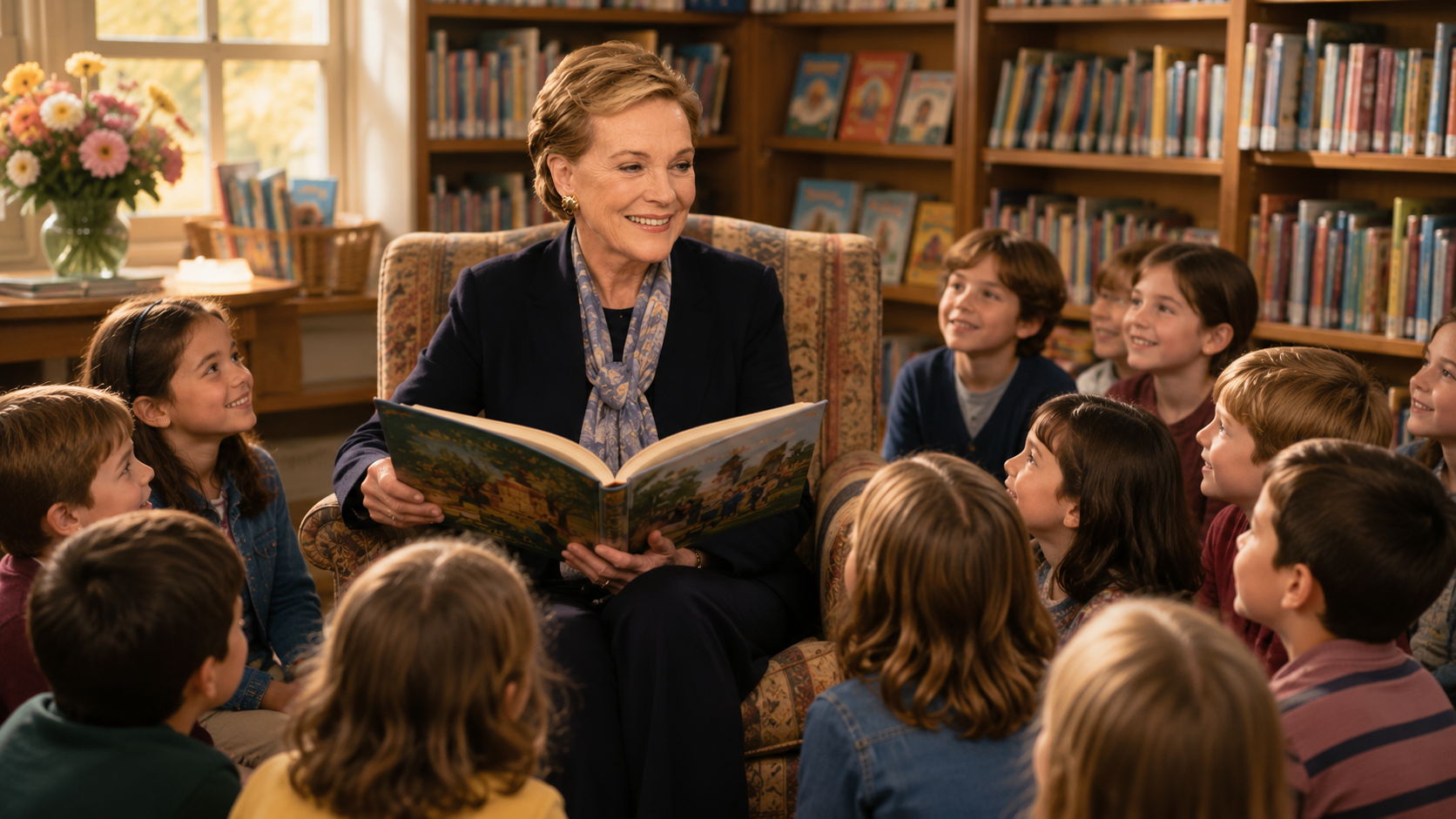
Inside, children filled every chair, cushion, and open space between the bookshelves. Parents stood along the walls. Teachers crowded near the back. Even the staircase was lined with young faces waiting to discover what the mysterious event was about.
When Julie entered the reading room, the children grew quiet.
A little girl near the front gasped.
“Are you really Julie Andrews?”
Julie placed one finger gently to her lips and smiled.
“Only for today,” she said, “I would rather be your fellow reader.”
The room filled with soft laughter.
Margaret introduced her in a trembling voice.
She explained that Julie had traveled there because she believed stories still had the power to change lives.
Then Margaret slowly lowered herself into the old reading chair.
But Julie shook her head.
“That chair belongs to you,” she said.
Instead, Julie pulled a small wooden stool beside Margaret and sat at her feet.
The gesture touched everyone in the room.
Julie opened the worn storybook she had carried with her. It was filled with handwritten notes, folded corners, and faded pencil marks.
“This book was read to me when I was very young,” she explained. “It taught me that a story does not have to be loud to stay in your heart.”
She began to read.
Her voice was gentle and clear.
Within moments, the library disappeared.
The children imagined castles rising beyond the shelves, forests growing beneath the tables, and tiny ships sailing across invisible seas.
Even the adults listened like children again.
Julie changed her voice for each character. She paused at the most exciting moments. She asked the children what they believed would happen next.
Hands shot into the air.
Children who rarely spoke in class began offering ideas.
A shy boy named Thomas, who had never finished a book on his own, raised his hand.
“I think the hero goes back,” he said softly. “Because being brave does not mean you are never afraid. It means you return even when you are.”
Julie looked at him with surprise.
“That,” she said, “is one of the finest descriptions of courage I have ever heard.”
Thomas sat a little taller.
When the story ended, no one moved.
Then Margaret reached for another book.
“Perhaps one more?” she asked.
The children cheered.
Julie and Margaret spent the next three hours reading together.
They told stories about friendship, kindness, loneliness, adventure, and hope.
Between each book, Margaret shared memories from her fifty years as a librarian.
She spoke of children who had entered the library unable to read and later returned as teachers, doctors, parents, and writers.
She told them that every book was a door.
“But the reader,” she said, “must choose to open it.”
Near the end of the afternoon, Julie asked each child to select one book from the shelves.
There was no competition.
No prize.
They simply had to choose a story they were curious about.
Soon, children were kneeling beside shelves, comparing covers, reading first pages, and asking Margaret for advice.
The old library came alive again.
One child chose a book about space.
Another found a story about a girl who trained a wild horse.
Thomas selected the same book Julie had read aloud.
“I want to read it by myself this time,” he said.
Margaret pressed the book into his hands.
“I believe you will,” she replied.
Before Julie left, she stood beside Margaret at the front of the room.
“There are many ways to become rich,” Julie told the children. “But few treasures are greater than a mind filled with stories and a heart able to understand someone else’s life.”
Then she turned toward Margaret.
“This library is not quiet because it has been forgotten,” Julie said. “It is quiet because it has been waiting.”
Margaret covered her mouth as tears filled her eyes.
That afternoon did not end when the last family left.
The story of Julie’s visit traveled from home to home.
Teachers created weekly reading circles.
Parents began bringing their children to the library every Saturday.
Local businesses donated new books, chairs, and reading lamps.
Teenagers volunteered to read to younger children.
Within a month, more than three hundred children had signed up for library cards.
The once-empty reading corner became so crowded that the town opened a second room.
They named it the Margaret Ellis Story Hall.
Margaret retired soon after.
Her health continued to weaken, but she visited every Saturday whenever she could.
She would sit quietly near the window and listen as children read aloud to one another.
One winter morning, Thomas approached her carrying the worn storybook.
“I finished it,” he said proudly.
Margaret smiled.
“I knew you would.”
“And I started another one.”
That was the moment she understood her final invitation had become something far greater than one afternoon.
Months later, Margaret passed away peacefully at home.
Beside her bed was Julie’s handwritten letter and a stack of thank-you notes from children.
At her memorial, no one gave long speeches.
Instead, hundreds of children gathered inside the library.
Each child carried a favorite book.
Julie returned quietly and sat in Margaret’s old reading chair.
She opened the same worn storybook and read the first page.
Then she stopped.
Thomas stood beside her and continued the second page.
One by one, the children took turns reading aloud.
Their voices filled every corner Margaret had once feared would remain silent.
Outside, snow fell gently against the windows.
Inside, stories lived again.
And long after that afternoon became a memory, children continued walking through the old wooden doors, opening books, turning pages, and discovering new worlds.
Because one elderly librarian had sent one final invitation.
And because Julie Andrews had answered with kindness.
The End


