Part 1: The Garden Behind the Gate
At the edge of a quiet English village stood an old iron gate that no one opened anymore.
Beyond it was a garden hidden beneath years of weeds, tangled vines, and fallen branches. A stone path had disappeared under moss. Wooden benches leaned sideways. The small fountain in the center had been dry for so long that birds had built nests inside it.
But what saddened the villagers most were the roses.
Long ago, the garden had been famous for them.
Red roses climbed the walls. White roses surrounded the fountain. Soft pink blooms lined the pathway like tiny lanterns. Families once gathered there for summer picnics, wedding photographs, and peaceful afternoon walks.
Then the woman who cared for the garden passed away.
Her name was Margaret Bell.
She had planted nearly every rose herself, often attaching a small wooden sign beside each plant. On the signs were names—not the names of flowers, but the names of people.
Margaret believed every rose should honor someone deeply loved.
After her death, no one knew how to continue her work. Slowly, the garden was forgotten.
One rainy afternoon, Julie Andrews arrived in the village to visit an old friend. While walking along the narrow road, she noticed a group of children peering through the rusted gate.
“What are you looking at?” Julie asked gently.
A boy named Thomas pointed through the bars.
“That used to be the rose garden,” he said. “My grandmother says it was beautiful.”
“Why doesn’t anyone care for it now?” Julie asked.
A little girl called Lily lowered her eyes.
“People say it is too much work.”
Julie looked beyond the gate. Beneath the wild grass and broken branches, she could still see the shape of the old garden. A few stubborn rose stems reached toward the cloudy sky.
“Perhaps,” she said, “it is not waiting for one person.”
The children looked at her.
“Perhaps it is waiting for all of us.”
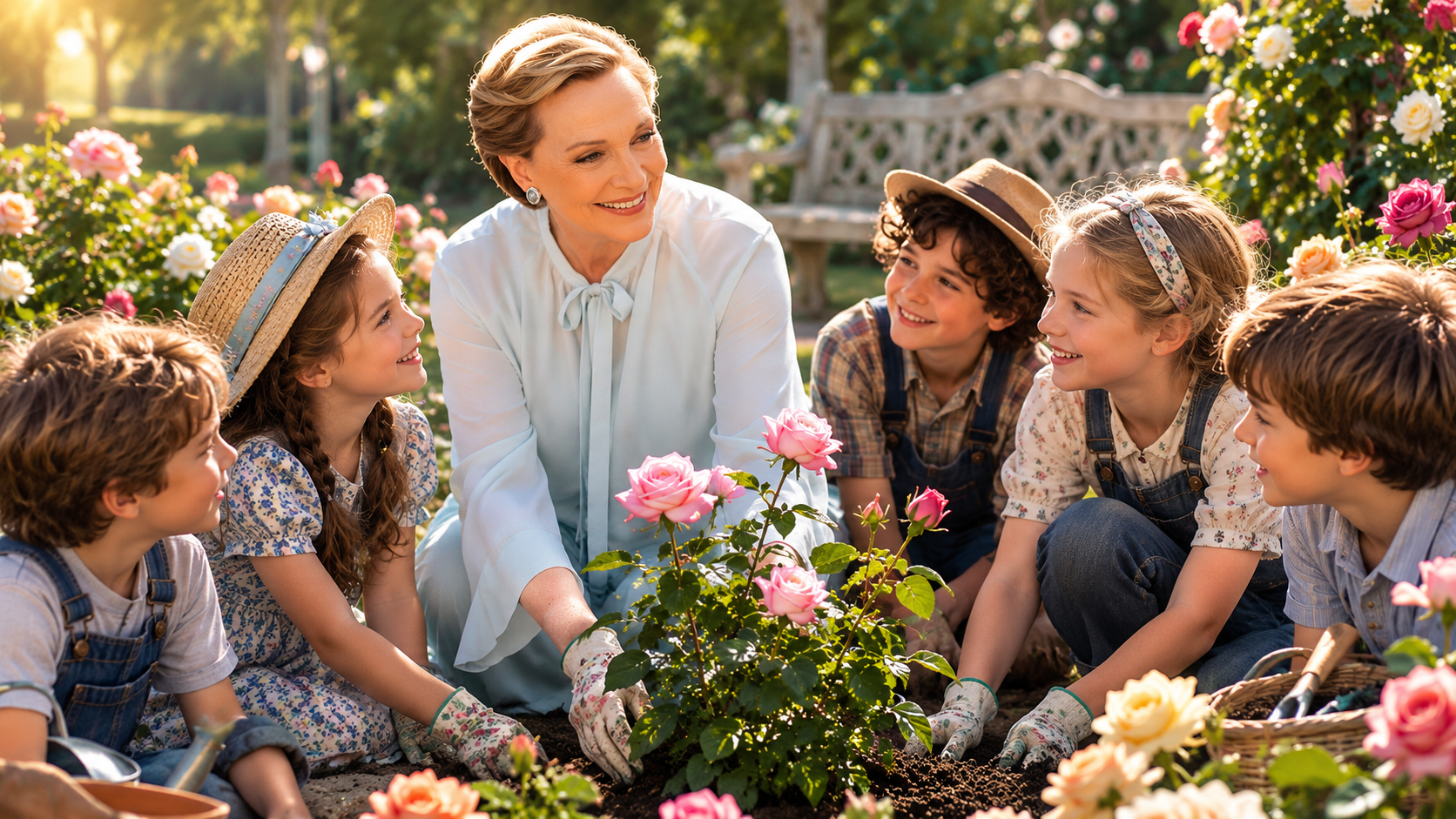
The following Saturday, Julie returned wearing gardening gloves and an old pair of boots. She brought tools, bags, and a large basket of sandwiches.
To her surprise, twelve children were waiting at the gate.
Thomas carried a small shovel. Lily brought a watering can covered in painted butterflies. Two brothers arrived with a wheelbarrow that squeaked loudly every time it moved.
Together, they opened the gate.
The work was harder than anyone expected.
They pulled weeds until their arms ached. They carried away broken branches. They scrubbed moss from the stones and found the old pathway beneath it.
Julie worked beside them without complaint.
When someone grew tired, she told a funny story. When someone became discouraged, she reminded them to look at how much they had already cleared.
By late afternoon, they uncovered the first wooden sign.
The writing had almost faded, but Julie carefully brushed away the dirt.
It read:
For Eleanor, who always made room at her table.
Thomas stared at the name.
“That was my great-grandmother,” he whispered.
His grandmother had often spoken about Eleanor, who had fed neighbors during difficult winters and never allowed anyone to leave her home hungry.
Thomas sat quietly beside the damaged rosebush.
“Can we save it?” he asked.
Julie studied the dry branches. Near the bottom, one small stem was still green.
“I believe we can,” she said.
That evening, Thomas told his grandmother what they had found. She cried when she heard the words on the sign.
The next morning, she arrived at the garden carrying a bucket of compost and an old photograph of Eleanor standing beside the same rosebush many years earlier.
Soon, other villagers began visiting.
An elderly man found a rose planted for his brother, who had never returned from the war. A woman discovered her late mother’s name near the fountain. A shopkeeper found a sign honoring the teacher who had taught him to read.
Every name carried a story.
Every story brought another pair of hands.
Within two weeks, parents, grandparents, teachers, and shopkeepers were helping the children. The broken benches were repaired. The fountain was cleaned. New soil was spread across the garden beds.
But there were not enough surviving roses to restore the garden.
So Julie gathered the children beneath the old oak tree.
“We will plant new ones,” she said.
Each child would choose someone they wished to honor.
Lily chose her older sister, Emma, who had died after a long illness when Lily was very young.
“I do not remember her voice anymore,” Lily admitted. “But Mum says she loved yellow roses.”
Julie placed a hand over Lily’s.
“Then we will plant one bright enough to hold every happy memory.”
Thomas chose the village doctor who had cared for his grandfather without accepting payment. Another child chose a beloved dog. One chose a teacher. One chose a neighbor who had always waved from her window.
No name was considered too important or too ordinary.
Julie told them, “Love is what makes a tribute meaningful.”
The children painted new wooden signs. Some wrote carefully. Others drew small hearts, stars, birds, and smiling faces.
Then, just as the garden began to take shape, a violent storm swept through the village.
Heavy rain flooded the pathways. Strong winds tore young plants from the earth. A large branch fell across the newly repaired fountain.
By morning, much of their work had been destroyed.
The children stood at the gate in silence.
Lily’s yellow rose lay broken in the mud.
“We cannot do it again,” she whispered through her tears.
Julie knelt beside the damaged plant.
For a long moment, she said nothing.
Then she noticed something beneath the mud—a tiny green bud still attached to the stem.
She gently lifted it for the children to see.
“This garden has survived loneliness, neglect, and now a storm,” she said. “Yet it is still trying to bloom.”
She looked around at their disappointed faces.
“So must we.”
Part 2: When Every Rose Began to Bloom
That morning, the children returned home covered in mud and sadness.
Julie worried they might not come back.
But just after sunrise the next day, she heard the squeaking wheelbarrow approaching the garden.
The two brothers pushed it through the gate. Inside were ropes, tools, and a handwritten sign:
Storms do not get the last word.
Lily arrived next, carrying the broken yellow rose in a flowerpot.
Then Thomas came with his grandmother. Behind them walked dozens of villagers.
No one had organized them.
They had simply heard what happened and decided that the children should not rebuild alone.
The baker brought warm bread. The carpenter brought new timber. A farmer arrived with rich soil. The owner of the hardware shop donated tools and fencing.
People worked from morning until evening.
They lifted the fallen branch from the fountain. They cleared the flooded paths and built small channels to guide future rainwater away. They tied young rose stems to strong wooden supports.
Lily and Julie carefully replanted the yellow rose.
“Do you think it will live?” Lily asked.
Julie smiled.
“Let us give it every reason to.”
During the following weeks, the garden became the center of village life.
The children visited before school to water the plants. Older residents taught them how to prune, compost, and protect roots from cold weather.
More tribute signs appeared every day.
For David, who taught us courage.
For Mrs. Finch, who believed every child could learn.
For Samuel, who made us laugh when life was difficult.
For Mum, whose love still guides me home.
Visitors began leaving small notes beside the roses.
Some wrote messages to people they had lost. Others wrote words of gratitude to people still living.
One afternoon, Julie found Thomas sitting beside his great-grandmother’s rose. He was reading a letter aloud.
“Dear Eleanor,” he said, “I never met you, but Grandma says I have your stubborn heart. I hope that is a good thing.”
Julie laughed softly.
“It sounds like a wonderful thing.”
Slowly, green leaves covered the garden. New buds appeared along the branches.
The children began planning a reopening celebration for the first day of summer. There would be music, food, and a special moment when each family could share the story behind its rose.
But Lily’s yellow rose remained weak.
All the other plants grew stronger, while hers produced only a few pale leaves.
Lily cared for it every day. She watered it carefully and spoke to it as if her sister could hear.
Still, no flower appeared.
A week before the celebration, Lily sat beside Julie near the fountain.
“Maybe Emma’s rose does not want to bloom,” she said.
Julie looked at the small plant.
“Flowers do not follow our calendars,” she replied. “Some need more time because they are growing strong where we cannot see.”
Lily leaned against her shoulder.
“Like people?”
“Very much like people.”
On the morning of the celebration, the garden opened beneath a bright blue sky.
Hundreds of people passed through the restored gate. Children guided visitors along the paths, proudly explaining every rose and every name.
A local musician played near the fountain. Families shared photographs and memories. People who had not spoken in years stood together beside roses planted for friends they had once shared.
Julie did not stand on a stage.
Instead, she moved quietly through the garden, helping elderly visitors find seats and listening to every story.
Then Lily came running toward her.
“Julie!” she cried. “Come quickly!”
Beside the old wall, the yellow rose had opened.
There was only one flower.
But it was large, golden, and glowing in the morning light.
Lily’s mother covered her mouth as tears filled her eyes.
“She loved that exact shade,” she whispered.
Lily knelt beside the rose and touched its petals gently.
“I cannot remember Emma’s voice,” she said, “but now I have something beautiful that carries her name.”
Julie knelt beside her.
“And every time someone sees it, they will know she was loved.”
The villagers gathered around as Lily read the words painted on the wooden sign:
For Emma, whose short life left a long trail of love.
For a moment, the entire garden became silent.
Then another child stepped forward and shared the story of his rose. An elderly woman followed. Then a father, a teacher, a widow, and a young boy.
One by one, they spoke the names of people who had shaped their lives.
The garden was no longer simply a collection of flowers.
It had become a living book of love.
Years passed.
The children grew older, but many continued caring for the garden. Each spring, they welcomed younger children through the same iron gate and taught them how to plant roses of their own.
Thomas eventually became a gardener. Lily became a nurse who often brought grieving families to sit beside Emma’s yellow rose.
Visitors came from distant towns after hearing about the garden where every bloom carried someone’s name.
Julie returned whenever she could.
During one visit, she found a new rose planted near the gate. Its petals were soft pink, and beside it stood a freshly painted sign.
She bent closer to read it.
For Julie, who reminded us that forgotten things can live again when people care together.
The children—now young adults—stood behind her.
Julie touched the sign, deeply moved.
“You did not need to do this,” she said.
Lily smiled.
“You taught us that every rose should honor someone deeply loved.”
Julie looked across the garden.
The fountain sparkled. Families walked along the stone paths. Children knelt beside the flowers, listening as grandparents shared stories of people from long ago.
Among thousands of petals were memories of mothers, fathers, siblings, teachers, neighbors, friends, and even faithful animals.
Some roses honored lives that had lasted many decades.
Others remembered lives that had been far too short.
Yet every bloom carried the same message:
Love does not disappear when someone leaves us.
It grows in the kindness we continue to give.
And in the forgotten garden, restored by small hands and hopeful hearts, every rose became proof that those we love can keep blooming in the world through us.


