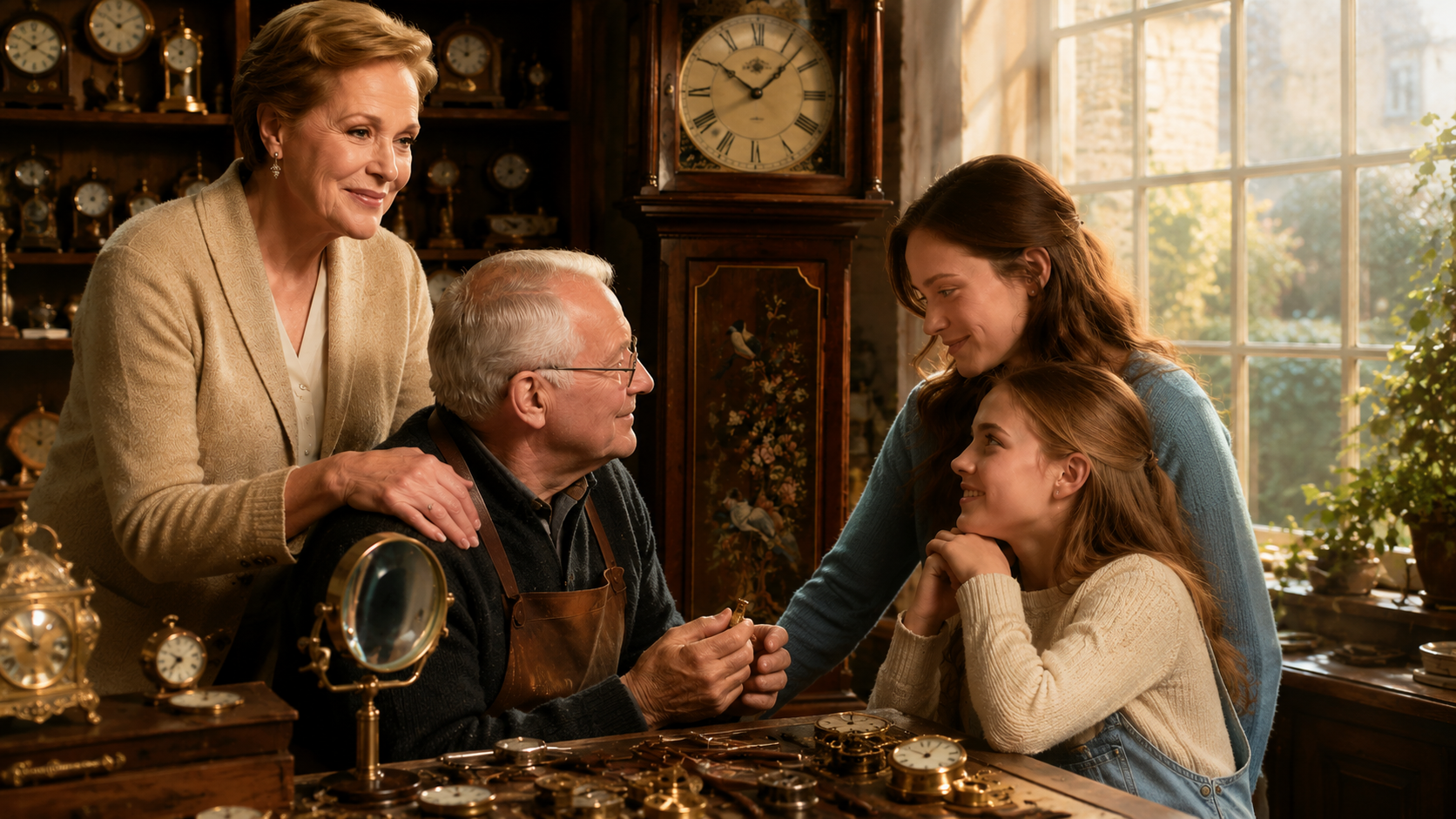
Part 1: The Clock That Had Stopped
On a quiet autumn afternoon, Julie Andrews wandered along a narrow street in a small English village.
The village was charming, with stone cottages, flower boxes, and little shops tucked beneath weathered wooden signs. Julie had come to visit an old friend, but after lunch, she decided to take a peaceful walk before returning home.
Near the end of the street, she noticed a shop most people seemed to pass without seeing.
Its sign was faded.
HENRY BELL — CLOCKS REPAIRED
Behind the dusty window stood dozens of clocks.
Tall grandfather clocks.
Small brass carriage clocks.
Delicate wooden clocks with painted faces.
Yet none of them appeared to be moving.
Julie paused.
The silence inside the shop felt unusual for a place filled with timepieces.
She gently pushed open the door.
A tiny bell rang above her head.
Inside, the air smelled of old wood, oil, and metal. Hundreds of clock parts rested in carefully labeled drawers. Small tools covered a long workbench beneath a yellow lamp.
At the bench sat an elderly man with silver hair and round glasses.
He was bent over a pocket watch, holding one tiny gear between a pair of tweezers.
“Good afternoon,” Julie said warmly.
The man looked up.
For a moment, surprise crossed his face.
Then he gave her a polite nod.
“Good afternoon.”
“I hope I’m not disturbing you.”
“No,” he replied. “There isn’t much here left to disturb.”
His name was Henry Bell.
He had repaired clocks in the village for nearly fifty years. At one time, customers had filled the shop every week. Families brought him wedding clocks, retirement watches, and treasured timepieces passed down through generations.
But times had changed.
People bought cheap digital clocks. When they stopped working, they replaced them.
“They don’t repair memories anymore,” Henry said softly. “They throw them away.”
Julie looked around the shop.
The clocks were beautiful, but the room felt lonely.
“Do you work here every day?” she asked.
“Every day except Sunday.”
“Alone?”
Henry returned his attention to the pocket watch.
“My wife, Margaret, used to sit near the window. She kept the accounts and made tea for customers.”
His hands became still.
“She passed away seven years ago.”
Julie’s expression softened.
“I’m very sorry.”
Henry nodded, but he did not look up.
“My daughter used to help us too. Clara had a gift for painting clock faces. But we had an argument many years ago.”
“What happened?”
Henry placed the tweezers on the table.
“She wanted to become an artist. I wanted her to continue the family business. I told her painting was not a dependable life. She told me clocks were the only things I truly cared about.”
He looked toward an empty chair beside the window.
“She left the village. We stopped speaking.”
Julie could hear regret beneath every word.
“Do you have grandchildren?”
“A granddaughter,” Henry said. “Sophie. I met her only once, when she was a baby.”
He opened a drawer and removed a small photograph.
It showed a young woman holding a little girl wrapped in a white blanket.
The photograph was faded from years of being handled.
“Sophie must be grown now,” Julie said.
“Twenty-three.”
Julie studied the picture.
“Have you tried contacting Clara?”
Henry slowly returned the photograph to the drawer.
“I wrote letters. None were answered.”
He did not mention that most of those letters had never been mailed.
They were still hidden inside an old wooden box beneath his workbench.
Julie did not press him.
Instead, she asked about the clocks.
For the first time, Henry’s voice became brighter. He explained how each mechanism worked. He showed her how a tiny broken spring could silence an entire clock. He described how patience mattered more than force.
“A clock tells you what is wrong,” he said. “But only when you are willing to listen.”
Julie smiled.
“That sounds true of people as well.”
Henry looked at her, surprised.
Then, after a long pause, he smiled too.
Before leaving, Julie noticed a large grandfather clock standing beneath a cloth in the corner.
Unlike the others, it had been carefully protected from dust.
“What is that one?” she asked.
Henry’s expression changed.
He slowly walked toward it and removed the covering.
The clock was magnificent.
Its dark oak case had been carved with roses, birds, and curling vines. A silver moon moved across the face above the numbers.
But its hands were frozen at 8:17.
“It belonged to Margaret’s family,” Henry explained. “Her grandfather built it. It stood in our home for more than sixty years.”
“Why did it stop?”
“The night Clara left.”
Henry ran his fingers over the polished wood.
“Margaret asked me to repair it many times. I always said I would. But after she died, I could not bring myself to open it.”
Julie studied the clock’s face.
“Perhaps it isn’t waiting to be repaired,” she said gently. “Perhaps it is waiting for the family to return.”
Henry shook his head.
“Some things cannot be restored.”
Julie looked at him with quiet certainty.
“You have spent your life proving otherwise.”
The next morning, Julie returned to the shop carrying a small box of tea and two pastries.
She found Henry sitting beside the grandfather clock.
Its back panel was open.
Tools were spread across the floor.
“You decided to repair it,” she said.
“I decided to try.”
Over the next several days, Julie visited whenever she could.
She watched Henry clean the gears, replace worn pins, and polish the brass movement. The work was slow. Several parts had been damaged by rust.
But as Henry worked, he began telling stories.
He spoke about Clara painting flowers on scrap pieces of wood when she was six.
He remembered Margaret singing while she swept the shop.
He described the night Sophie was born and how he had stood outside the hospital, too proud to go inside after arguing with Clara.
Each memory made his hands tremble.
But each day, he continued.
Julie soon discovered that Clara had become a successful illustrator living in London. Her name appeared inside several children’s books sold at the village bookshop.
With Henry’s permission, Julie found her professional mailing address.
She wrote a short letter.
She did not ask Clara to forgive her father.
She simply told her the truth.
Her father was restoring the family clock.
He still kept her childhood paintbrushes in the top drawer.
And he had never stopped placing her photograph beside his workbench.
Two weeks passed.
No reply came.
Henry finished repairing the movement, but the clock still would not start.
“I knew it,” he said bitterly. “Some things stay broken.”
Julie examined the clock.
“Have you checked everything?”
“Every wheel. Every spring. Every pin.”
“Then perhaps it needs something more than a repair.”
Henry looked confused.
The following afternoon, Julie entered the shop carrying a parcel.
It had arrived for Henry that morning.
There was no return address.
Inside was a small painted wooden panel.
It showed three bluebirds sitting together on the branch of an apple tree.
Beneath the painting were four handwritten words:
For the clock’s empty door.
Henry recognized the brushstrokes immediately.
“Clara,” he whispered.
The panel had been painted to replace a missing piece in the lower section of the clock.
Henry held it against his chest.
Then he noticed a letter beneath it.
His hands shook as he opened the envelope.
Clara had written only a few lines.
I do not know whether I am ready to come home.
But Sophie wants to meet you.
We will be in the village on Saturday.
Henry read the words again and again.
Saturday was only three days away.
He worked late into every night, determined to finish the clock before they arrived.
On Saturday morning, he installed Clara’s painted panel.
He adjusted the pendulum.
He wound the mechanism.
Then he stepped back.
The clock remained silent.
At exactly noon, the bell above the shop door rang.
Henry turned.
A middle-aged woman stood at the entrance.
Beside her was a young woman carrying a worn leather case.
Henry did not need an introduction.
Clara had Margaret’s eyes.
Sophie had Clara’s smile.
Three generations stood inside the silent shop, separated by years of anger, regret, and words never spoken.
No one moved.
Then Sophie looked past Henry toward the grandfather clock.
“You repaired it,” she said.
Henry lowered his eyes.
“I tried.”
Sophie placed the leather case on the workbench.
“My mother said something was missing.”
She opened the case.
Inside rested a long brass pendulum decorated with three engraved bluebirds.
Henry stared at it.
He had not seen that pendulum in more than twenty years.
Clara’s eyes filled with tears.
“I took it the night I left,” she admitted. “I wanted something that belonged to home.”
Henry looked at his daughter.
Without the pendulum, the clock could never run.
And without Clara, the family had remained frozen in the same painful moment.
Henry reached for the brass piece.
But Clara did not release it.
“Before we repair the clock,” she said, “we need to speak about why it stopped.”
The shop became silent once more.
This time, however, the silence was not empty.
It was waiting for the truth.
Part 2: Time Begins Again
Henry slowly lowered his hand.
For years, he had imagined Clara returning.
In those imagined reunions, she always forgave him immediately.
She always smiled.
She always said the past no longer mattered.
But the real Clara stood before him with tears in her eyes and pain still visible on her face.
Henry pulled three chairs toward the workbench.
Julie quietly prepared tea.
Then father, daughter, and granddaughter sat together beneath the soft yellow lamp.
Clara spoke first.
“When I told you I wanted to study art, I wasn’t rejecting the family,” she said. “I was trying to discover who I was.”
“I understand that now,” Henry replied.
“But you didn’t then.”
“No.”
“You called my dream foolish.”
Henry looked down.
“I was afraid.”
Clara seemed surprised.
“You never looked afraid.”
“I was terrified,” he admitted. “The shop was struggling. Your mother’s health was becoming worse. I believed that if you stayed, everything would remain safe.”
His voice cracked.
“I tried to hold the family together so tightly that I pushed you away.”
Clara wiped her cheek.
“Mum wrote to me.”
Henry looked up.
“She did?”
“For years. She never blamed you. She kept asking me to come home.”
“Why didn’t you?”
“Pride,” Clara whispered. “The same reason you never came to find me.”
Henry nodded.
There was no defense he could offer.
Sophie listened quietly.
Then she opened the worn leather case again and removed a bundle of letters tied with a blue ribbon.
“Grandmother kept copies of every letter she sent Mum,” Sophie said. “We found them after moving apartments last year.”
Clara placed the letters on the table.
“She wrote about you constantly. About how you waited near the window whenever a car stopped outside. About how you bought children’s books with my illustrations but pretended they belonged to customers.”
Henry gave a broken laugh.
“I have every one of them.”
“I know,” Clara said. “Julie told me.”
Henry turned toward Julie.
She had not revealed secrets to cause shame. She had shared them because love sometimes needed help finding its voice.
Henry stood and walked to the wooden box beneath his bench.
He carried it to Clara.
Inside were years of unsent letters.
Some were addressed to Clara.
Others were written to Sophie.
Henry opened the oldest one.
Dear Clara,
Today a little girl came into the shop and asked why clocks tick. I remembered how you used to ask the same question. I gave her the answer I should have given you many years ago: clocks move because every part is allowed to follow its own purpose.
Clara covered her mouth.
Henry handed her another letter.
Then another.
“I thought writing them was enough,” he said. “But words kept in a box cannot reach anyone.”
Sophie picked up one addressed to her eighteenth birthday.
“You remembered my birthday?”
“Every year.”
“Why didn’t you send it?”
Henry’s eyes filled with tears.
“I was afraid you had been told to hate me.”
Sophie stood.
“I was never told to hate you.”
She stepped forward and wrapped her arms around him.
Henry froze.
Then his arms closed around his granddaughter.
His shoulders shook as years of grief finally escaped.
Clara watched them.
The anger in her face softened, though it did not disappear completely.
Forgiveness did not arrive like a door suddenly opening.
It came slowly, like morning light entering a dark room.
Clara walked toward them.
Henry looked at her.
“I cannot change what I said,” he told her. “I cannot return the years we lost. But I am sorry, Clara. Not because I am lonely. Not because I am old. I am sorry because I made you believe that my love depended on you becoming who I wanted.”
Clara began crying.
“For years, I waited to hear you say that.”
“I should have said it the night you left.”
She reached for his hand.
“I am not ready to forget everything.”
“I would never ask you to.”
“But I am ready to begin again.”
Together, the three of them carried the brass pendulum to the grandfather clock.
Henry opened the wooden case.
Sophie held the flashlight.
Clara guided the pendulum into place.
When it was secured, Henry adjusted the mechanism.
Then he gently moved the pendulum to one side.
It swung back.
Once.
Twice.
Three times.
A soft ticking filled the shop.
Henry held his breath.
The clock’s gears began turning.
The silver moon above the face slowly moved across the painted sky.
Then the clock struck one.
Its deep, warm chime traveled through the shop and out into the street.
People stopped outside.
Shopkeepers stepped into their doorways.
For decades, the village had heard that clock marking family celebrations, holidays, and quiet evenings.
Many residents believed it would never sound again.
But now it was alive.
Henry looked at Clara.
Clara looked at Sophie.
And Julie smiled as three generations stood together beneath the sound of restored time.
Sophie remained in the village for several weeks.
She had studied mechanical engineering and had always loved working with small, complicated parts. Henry began teaching her how to repair clocks.
Clara brought her paints into the shop.
She restored faded faces, painted delicate flowers, and added tiny scenes to wooden cases.
For the first time in years, the windows were cleaned.
The silent clocks were repaired one by one.
Soon, the shop was filled with ticking.
Some clocks moved quickly.
Others moved slowly.
But each one made its own steady sound.
Word spread through the village that Henry Bell’s shop had reopened with his daughter and granddaughter working beside him.
People began bringing in old timepieces from attics and cupboards.
A widow brought the watch her husband had worn on their wedding day.
A young father carried in a broken nursery clock that had belonged to his mother.
A retired teacher arrived with a classroom clock that had stopped on her final day of work.
Henry repaired each one carefully.
But before beginning, he always asked the owner to share its story.
Julie visited again several months later.
The faded sign had been replaced.
The new one read:
BELL & FAMILY — CLOCKS, MEMORIES, AND SECOND CHANCES RESTORED
Inside, Sophie worked at Henry’s old bench.
Clara painted beside the window.
Henry poured tea for a customer.
The grandfather clock stood in the center of the shop. Clara’s bluebirds decorated the lower door, while Sophie’s brass pendulum moved steadily behind the glass.
One afternoon, a little boy entered with his mother.
He pointed at the grandfather clock.
“Why does it keep ticking?” he asked.
Henry smiled.
“Because every part has a place,” he replied. “And because sometimes, even after a long silence, things can begin moving again.”
The boy listened to the ticking.
“Was it badly broken?”
Henry looked across the room at Clara and Sophie.
“Yes,” he said softly. “But not beyond repair.”
Years later, when Henry was no longer strong enough to work every day, he still visited the shop each morning.
His chair waited beside the window.
Clara brought him tea.
Sophie showed him the clocks she was repairing.
And every evening at 8:17—the exact time the grandfather clock had once stopped—the three of them paused their work.
They listened as it chimed.
Not to remember the moment their family had fallen apart.
But to celebrate the moment they had chosen to begin again.
Julie never accepted credit for bringing them together.
She simply said she had opened a shop door and listened.
But Henry knew kindness had done what even his finest tools could not.
It had reached the hidden places.
It had loosened years of pride.
It had helped three hearts move forward.
And in a little village shop once filled with silence, time no longer sounded lonely.
It sounded like home.
THE END


