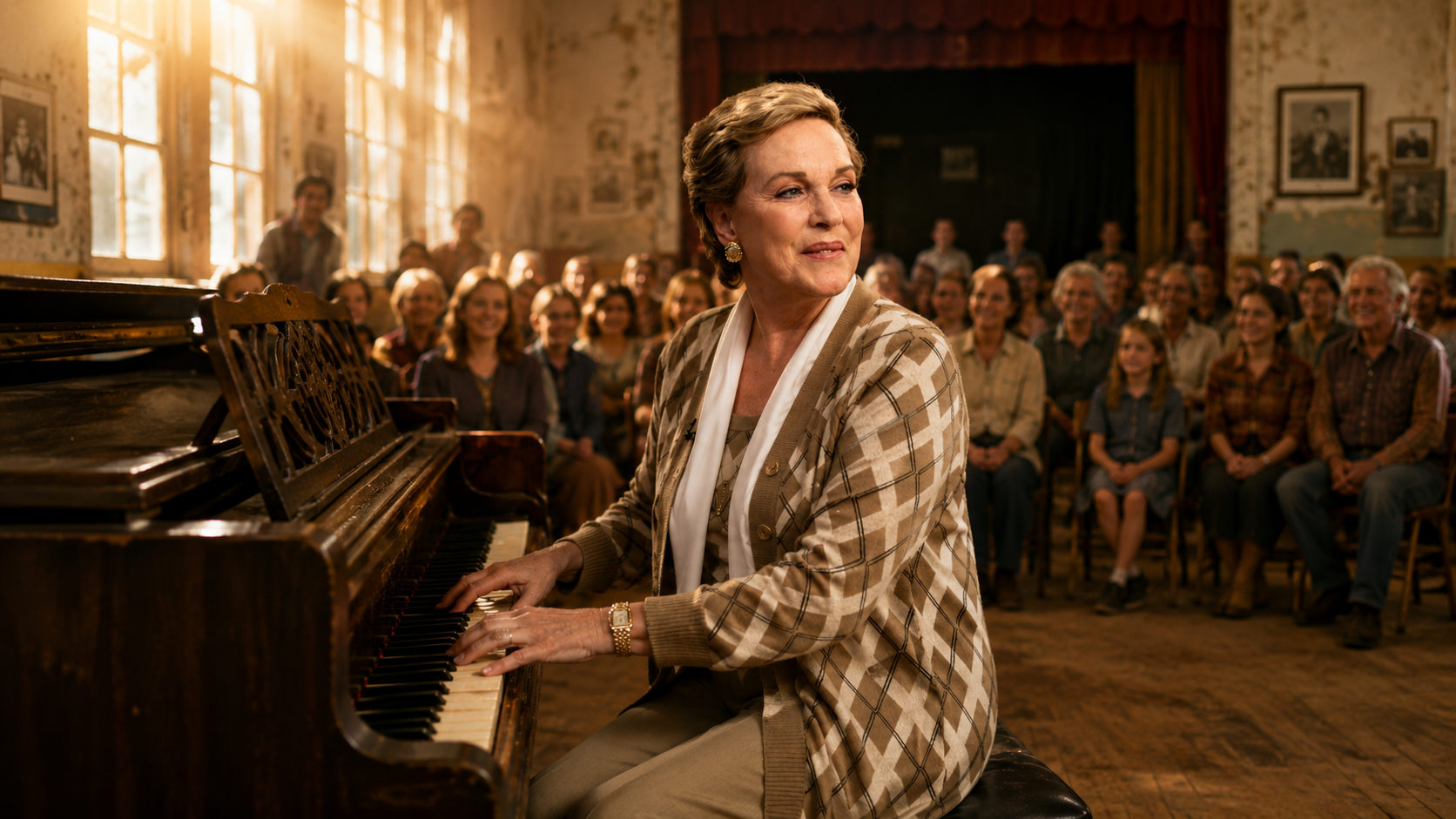
Part 1: The School at the End of Willow Lane
The abandoned school stood at the end of Willow Lane, hidden behind tall weeds and a rusted iron gate.
Its windows were cracked. Ivy covered the old brick walls. Above the entrance, several faded letters still formed the name Willowbrook School.
For almost forty years, generations of children had learned, laughed, and dreamed inside those walls. But after a newer school opened across town, Willowbrook had been closed and forgotten.
The building was not the only thing the town had abandoned.
Once, the people of Willowbrook had known one another by name. Families shared meals. Neighbors helped repair fences. Every spring, the entire town gathered at the school for a music festival.
Then a disagreement divided them.
Years earlier, the town council had argued about what should happen to the old school. Some wanted to restore it as a community center. Others wanted to sell the land to a private company.
The debate became bitter.
Friends stopped speaking. Families chose sides. Local businesses refused to support one another. Even the annual music festival disappeared.
By the time Julie Andrews arrived in Willowbrook on a quiet autumn afternoon, the town felt like two separate places sharing the same streets.
Julie had come to visit her longtime friend Margaret Ellis, a retired music teacher who lived in a small cottage near the edge of town.
Margaret had taught at Willowbrook School for thirty-five years. She had once directed the children’s choir and organized every community concert.
But age had weakened her legs, and she rarely left her house now.
Over tea, Margaret showed Julie an old photograph.
It pictured dozens of children standing on the school steps. Parents and teachers crowded behind them, smiling beneath strings of colorful flags.
In the center stood a grand piano.
“That was the final music festival before the arguments began,” Margaret explained.
Julie studied the photograph.
“Where is the piano now?”
Margaret looked toward the window.
“Still inside the school, I suppose.”
“No one moved it?”
“We tried,” Margaret said. “But it was too heavy. When the building closed, everyone assumed someone else would take care of it.”
Her voice softened.
“That piano heard every child in this town sing.”
The next morning, Julie asked Margaret to show her the school.
They walked slowly along Willow Lane. Margaret used a cane, and Julie remained beside her, matching every careful step.
When they reached the iron gate, Margaret stopped.
“I haven’t been here in twenty years.”
Julie gently touched her arm.
“Then perhaps today is the right day.”
The gate groaned as they pushed it open.
Dry leaves covered the path. The old playground was silent, except for the creaking of an empty swing moving in the wind.
Inside the school, dust floated through beams of sunlight. Desks lay overturned. Children’s drawings still hung on the walls, their bright colors faded by time.
Margaret led Julie toward the assembly hall.
The double doors were difficult to open. Together, they pushed until the hinges finally gave way.
There, beneath a torn stage curtain, sat the piano.
It was covered in dust.
Several keys were yellow. One leg was cracked, and the wooden surface had been damaged by years of damp air.
Yet when Julie pulled away the old cloth covering it, she saw something beautiful beneath the neglect.
On the front of the piano, hundreds of names had been carefully carved into the wood.
Children.
Teachers.
Parents.
Entire families.
Margaret ran her fingers across one of the names.
“Thomas Reed,” she whispered. “He was the finest young pianist I ever taught.”
“What happened to him?” Julie asked.
“He left town after the council dispute. His father supported restoring the school. His uncle wanted to sell it. The family stopped speaking, and Thomas never returned.”
Julie pressed one key.
A weak, uneven note filled the hall.
Margaret closed her eyes.
“That sound,” she said. “I thought I would never hear it again.”
Julie tried several more keys. Some worked. Others remained silent.
“This piano may be damaged,” she said, “but it has not forgotten how to sing.”
Margaret smiled sadly.
“The town has.”
Julie looked around the dark hall.
“Perhaps the town only needs to be reminded.”
That afternoon, they visited Daniel Harper, the only piano repairman in Willowbrook.
Daniel was nearly seventy. He had once maintained instruments for schools and churches across the county. But after his wife died, he closed his workshop and stopped accepting customers.
When Julie told him about the piano, he shook his head.
“That instrument has been sitting in a leaking building for decades. It would cost more to restore than it is worth.”
“Worth can mean many things,” Julie replied.
Daniel looked at her.
She placed the old festival photograph on his workbench.
Daniel stared at it for a long time.
Near the piano stood a young woman with dark hair, holding a violin.
“My wife,” he whispered.
Margaret nodded. “Anna played at every festival.”
Daniel’s eyes filled with tears.
“She always said that school was where she first felt she belonged.”
Julie did not pressure him. She simply left the photograph beside his hands.
The following morning, Daniel appeared at Margaret’s cottage carrying a toolbox.
“I will look at the piano,” he said. “I am not promising anything.”
Julie smiled.
“That is more than enough.”
For the next several days, the three of them worked inside the abandoned school.
Daniel repaired cracked wood and cleaned the strings. Margaret sorted through boxes of old music. Julie swept the stage, washed the windows, and carefully cleaned each piano key.
Word soon spread around town.
Some people were curious.
Others were angry.
Councilman Robert Hale arrived one afternoon and stood in the doorway with his arms crossed.
“You cannot enter this building without permission,” he said.
Margaret straightened as much as she could.
“I taught here before you were born.”
“That does not make it safe.”
“We are not damaging anything,” Julie said calmly. “We are trying to save something.”
Robert glanced toward the piano.
“My family spent years trying to sell this property. That piano is worthless.”
From behind him came another voice.
“It was not worthless when your mother played it.”
Everyone turned.
An elderly woman named Beatrice Cole stood in the hallway. She and Robert’s family had not spoken for years because of the school dispute.
Beatrice carried a faded notebook.
“I found this in my attic,” she said. “It contains the songs from the last festival.”
Robert’s expression hardened.
“Why are you here?”
Beatrice looked directly at him.
“Because I am tired of crossing the street whenever I see someone I once called a friend.”
She placed the notebook on the piano.
The next day, more people arrived.
A carpenter repaired the stage steps. Two former students replaced broken windows. A local baker brought bread and soup for the volunteers.
Still, many townspeople refused to help.
Old wounds remained.
Then Daniel discovered the piano’s greatest problem.
The soundboard was badly split.
Without replacing it, the piano would never hold its tuning.
Daniel removed his glasses and rubbed his tired eyes.
“I can repair many things,” he said. “But not this. We need a piece of seasoned spruce, and it must be cut exactly to size.”
Margaret’s shoulders fell.
“Where could we possibly find that?”
Daniel hesitated.
“There is one person who might have what we need.”
“Who?” Julie asked.
“Thomas Reed.”
The young pianist from Margaret’s photograph had become a respected instrument maker in another city. But he had not returned to Willowbrook since the argument that divided his family.
Margaret wrote him a letter.
Julie added a short message beneath it:
Sometimes an instrument carries more than music. Sometimes it carries a way home.
They sent the letter and waited.
A week passed.
No answer came.
Autumn rain began falling through new leaks in the school roof. The volunteers covered the piano with heavy sheets, but the restoration could not continue without the soundboard.
Then, late one evening, Margaret received a telephone call.
It was Thomas.
His voice was guarded.
“I received your letter.”
Margaret gripped the phone with both hands.
“Will you come?”
There was a long silence.
“I swore I would never return to that town.”
“The piano needs you,” Margaret said.
“The town did not need my family when it mattered.”
Julie sat quietly beside her.
Margaret closed her eyes.
“No,” she answered softly. “We failed your family. And we failed one another. But perhaps returning is not about pretending the past never happened. Perhaps it is about deciding the past will not control what happens next.”
Thomas did not respond.
Then the call ended.
Two days later, a truck stopped outside the abandoned school.
A tall man with silver hair stepped out. In the back of the truck lay a carefully wrapped piece of spruce.
Thomas Reed had come home.
But as he entered the assembly hall, Councilman Robert Hale was waiting beside the piano.
The two men stared at each other.
Their fathers had been brothers.
They had once been best friends.
Neither had spoken in thirty-two years.
Robert’s voice trembled.
“You should not have come back.”
Thomas placed his toolbox on the stage.
“I did not come back for you.”
“No,” Robert replied. “You came back for a piano that should have been destroyed years ago.”
Thomas suddenly pulled an old envelope from his coat.
“My father gave me this before he died.”
Robert’s face changed when he recognized the handwriting.
The envelope had been addressed to both of them.
It had never been opened.
Julie, Margaret, Daniel, and the volunteers gathered silently as Thomas broke the seal.
Inside was a letter—and one final sheet of music written by their fathers together.
At the top of the page were four words:
The Song of Willowbrook.
Thomas stared at the notes.
Then he looked at Robert.
“Our fathers wrote this before the town divided.”
Robert’s eyes filled with tears.
Thomas turned toward the damaged piano.
“I will repair it,” he said. “But when it is ready, this must be the first song played.”
What none of them knew was that the unfinished melody contained a secret—one that would bring every divided family in Willowbrook back to the abandoned school.
Part 2: The Song That Brought Them Home
Thomas spent the next two weeks restoring the piano.
Each morning, he arrived before sunrise. He measured the damaged soundboard, shaped the spruce by hand, and worked in silence while Daniel repaired the action and replaced the worn felt beneath the keys.
Robert returned too.
At first, he stood at the back of the assembly hall and said nothing.
Then one afternoon, Thomas struggled to lift the heavy frame into place.
Robert stepped forward.
Without a word, he took the other side.
Together, the two cousins raised the frame and lowered it carefully into position.
It was the first thing they had done together in thirty-two years.
Julie watched from the stage.
She did not interrupt.
Some apologies begin with words.
Others begin when two people quietly carry the same weight.
The old school slowly came alive around them.
Former students swept the floors. Parents repaired chairs. Teenagers painted the hallways. Children collected old photographs and hung them along the walls.
Every photograph told the same story.
A town that had once belonged to everyone.
Still, the old disagreement had not fully disappeared.
Some residents refused to enter the building.
A few said the restoration was too little, too late.
Others blamed Robert’s family for trying to sell the school.
Some blamed Thomas’s father for turning the argument into a public fight.
Then Margaret discovered something hidden inside the old sheet music.
She had been studying The Song of Willowbrook when she noticed several words written faintly beneath the final line.
The ink had nearly disappeared.
She called Julie, Thomas, Robert, and Daniel to the piano.
“What does it say?” Robert asked.
Margaret held the page near the window.
Julie read the sentence aloud.
“Play each family’s part together, or the song will remain unfinished.”
Thomas frowned.
“Each family’s part?”
They searched through the box where the music had been found.
At the bottom lay several folded pages.
Each page contained a different section of the same melody.
One was marked Hale.
Another was marked Reed.
Others carried the names Cole, Harper, Ellis, Bennett, Dawson, and Moore.
The town’s oldest families.
Their fathers had not written a song for one pianist.
They had written it for the whole town.
Every family had been given a part.
No single page contained the complete melody.
Thomas sat down heavily beside the piano.
“My father never told me.”
“Perhaps he believed you would all play it together one day,” Julie said.
Robert looked at the sheet bearing his family’s name.
“My mother kept our page,” he whispered. “I remember seeing it in her music cabinet when I was a child.”
“Do you still have it?” Margaret asked.
Robert nodded slowly.
That evening, the search began.
People opened attics, trunks, desk drawers, and old boxes. Some pages were found inside hymn books. One had been framed behind a family photograph. Another was discovered beneath a loose floorboard.
But two parts were still missing.
Without them, the song could not be completed.
One belonged to the Dawson family, who had moved away years earlier.
The other belonged to Beatrice Cole’s older brother, Samuel, who had not spoken to her since the town dispute.
Beatrice sat alone in the assembly hall holding the list of missing pages.
“I know where Samuel lives,” she said.
“Will he come?” Julie asked.
Beatrice looked down.
“He has not answered my letters in twenty years.”
Julie sat beside her.
“Then perhaps this time, do not write about the argument.”
“What should I write?”
“Write about what you miss.”
Beatrice went home and wrote only three sentences.
Dear Samuel,
I no longer remember who was right.
I only remember that you were my brother, and I miss hearing you laugh.
Three days later, Samuel arrived.
He was eighty-two and walked with a cane.
Beatrice met him at the school entrance.
For a long moment, neither moved.
Then Samuel opened his arms.
Beatrice began crying before she reached him.
Inside his coat was the missing Cole page.
The Dawson page seemed lost forever.
Then a young girl named Lily raised her hand during one of the volunteer meetings.
“My grandmother was a Dawson,” she said.
Everyone turned toward her.
“She used to sing a strange tune while baking bread. I think it might be part of the song.”
Lily hummed the melody.
Thomas rushed to the piano and played the notes after her.
They matched the missing section exactly.
Lily’s grandmother had never kept the page.
She had carried the music in her memory.
At last, the song was complete.
The town chose Saturday evening for the first performance.
Invitations were delivered to every home.
No one was asked to take sides.
No one was asked to apologize publicly.
The invitation said only:
Come hear the song our families were meant to play together.
On Saturday, rain fell across Willowbrook.
Julie worried the weather might keep people away.
But before sunset, lanterns began appearing along Willow Lane.
Families came carrying umbrellas.
Elderly residents arrived with grandchildren. Shop owners closed early. Farmers left their fields before dark.
Even those who had promised never to return entered quietly and found seats.
The assembly hall filled beyond capacity.
People stood along the walls and crowded into the doorway.
At the front of the room, the restored piano shone beneath the old stage lights.
Its wood still carried the carved names.
The scratches had not been removed.
Thomas had insisted on leaving them.
“They are part of its story,” he said.
Margaret stepped onto the stage.
Her hands trembled as she held the microphone.
“This school once taught us how to read, count, sing, and dream,” she began. “But somewhere along the way, we forgot the most important lesson.”
The hall became still.
“We forgot how to listen to one another.”
Robert sat beside Thomas in the front row.
Beatrice held Samuel’s hand.
Margaret continued.
“Tonight, we are not here to decide who was right. We are here because a town cannot survive when every family plays only its own part.”
Julie then walked toward the piano.
She had been asked to perform the first song.
But instead of sitting down alone, she turned toward the audience.
“This music was not written for one person,” she said. “It belongs to all of you.”
She invited Thomas to the piano.
Robert sat beside him.
Daniel took a violin from its case.
Margaret joined the small choir of former students.
Members of each family stood with their pages.
Some played instruments.
Others sang.
Those who could not perform simply read the words written beneath their family’s section.
Julie gave Thomas a gentle nod.
He pressed the first key.
The note rang through the hall.
Clear.
Warm.
Alive.
Then Robert joined him with the second melody.
The violin entered.
Voices rose from different corners of the room.
At first, the music sounded uncertain.
Several people missed their timing.
One singer entered too early.
A child forgot a line.
Then something changed.
They began listening to one another.
The piano softened when the choir grew louder.
The violin waited for the children.
The older voices supported the younger ones.
Separate melodies slowly became one song.
People in the audience began to cry.
Not because the performance was perfect.
Because it was not.
It was fragile, uneven, and human.
Just like the town.
Halfway through the song, a projector displayed photographs across the back wall.
Children playing in the old yard.
Neighbors rebuilding a barn.
Families sharing food after a flood.
The final image showed the entire town gathered at the last music festival before the division.
As the last verse began, Robert looked at Thomas.
“I am sorry,” he whispered.
Thomas kept playing.
“For what?”
“For letting pride last longer than love.”
Thomas’s hands shook above the keys.
Then he answered softly.
“So am I.”
They played the final notes together.
When the song ended, no one moved.
The last chord seemed to remain in the air.
Then Samuel stood.
He began applauding.
Beatrice joined him.
Soon the entire hall rose to its feet.
The applause was not only for the music.
It was for the courage to return.
It was for old friends who had entered through the same door.
It was for families who had finally chosen one another over a disagreement no one could fully remember.
Margaret covered her face and wept.
Julie placed an arm around her.
“You reminded them,” Margaret said.
Julie shook her head.
“No. The piano did.”
The following week, the town council met again.
This time, no one shouted.
Robert made the first proposal.
He asked that Willowbrook School never be sold.
Thomas offered to help create a permanent music workshop inside the old assembly hall.
Daniel reopened his repair business in one of the classrooms.
Beatrice and Samuel began teaching children the songs they had grown up singing.
The building became the Willowbrook Community School of Music and Memory.
Every family contributed what it could.
Some gave money.
Some gave tools.
Some gave time.
And some simply came back.
Margaret returned to teaching once a week.
She sat near the piano and showed children how to find courage in their own voices.
Lily, the young girl who remembered the missing melody, became her first student.
Years later, visitors still came to see the restored piano.
The carved names remained visible.
Beneath them, the town added one new sentence:
No song is complete when we refuse to hear one another.
And every autumn, on the anniversary of that first performance, the people of Willowbrook gathered inside the old school.
They played the same song.
Not perfectly.
But together.
Julie returned several times over the years.
Whenever someone thanked her for saving the school, she always gave the same answer.
“I did not save it. I only pressed one forgotten key.”
Because sometimes healing does not begin with a grand speech.
Sometimes it begins with a dusty room, an unfinished melody, and one person brave enough to believe that what has been abandoned can still be restored.
And sometimes the first song played after years of silence becomes the sound of an entire town finding its way home.


