Part 1: The Unfinished Violin
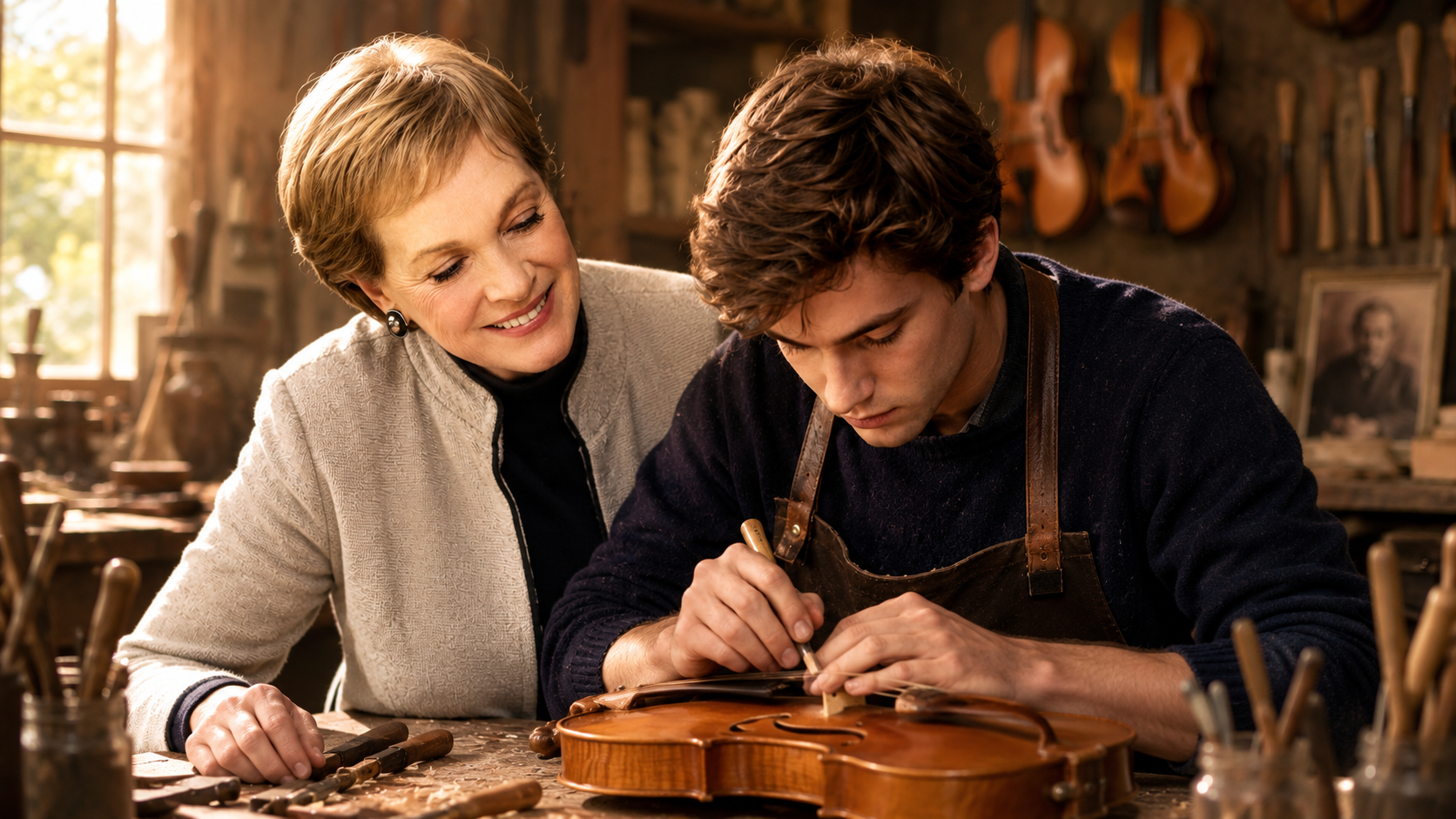
On a quiet autumn morning, Julie Andrews accepted an invitation to visit the small village of Ashbrook, a place known for its centuries-old tradition of handcrafting violins. The streets were peaceful, lined with stone cottages whose windows displayed beautifully carved instruments. Though many workshops had closed over the years, one tiny shop still remained.
Above its weathered wooden door hung a faded sign that read:
“Ellis & Grandson Violin Makers — Since 1958.”
Julie stepped inside and was greeted by the comforting scent of spruce, maple, and freshly polished wood.
The shop was nearly silent.
Rows of chisels, carving knives, and tiny planes rested exactly where they had been left. Half-finished violins hung from the walls like forgotten dreams.
A young man looked up from a cluttered workbench.
“You must be Miss Andrews,” he said nervously. “I’m Noah.”
Julie smiled warmly and shook his hand.
“It’s lovely to meet you, Noah.”
He seemed surprised she had come at all.
“My grandfather admired you,” he said quietly. “He believed music could heal people better than words.”
Julie noticed a framed photograph of an elderly craftsman smiling beside dozens of completed violins.
“He passed away six months ago,” Noah explained.
“I’m so sorry.”
“He was working on one final violin.”
Noah walked to the corner of the workshop and carefully uncovered a velvet cloth.
Beneath it rested an unfinished violin.
Its graceful curves had already been carved.
The maple back shimmered softly in the afternoon light.
But the fingerboard was missing.
The bridge had never been fitted.
The varnish remained unfinished.
“It was supposed to be his masterpiece,” Noah whispered.
Julie reached out carefully, running her fingertips along the smooth wood.
“It already carries great love.”
Noah lowered his head.
“I’ve tried every day to finish it.”
“So why haven’t you?”
He hesitated before answering.
“Because I’m terrified.”
Julie waited patiently.
“What if I ruin the last thing he ever made?”
The words hung heavily in the room.
“My grandfather taught everyone else in town,” Noah continued.
“They all expected me to inherit the workshop.”
“But every time I touch this violin…”
His voice broke.
“…I hear myself asking whether I’m good enough.”
Julie understood that feeling.
“There were moments in my own life,” she said gently, “when I wondered if I could ever live up to the people who inspired me.”
Noah looked surprised.
“You?”
She laughed softly.
“Even those who spend their lives performing still carry doubts.”
They spent the afternoon looking through old notebooks filled with Ellis’s careful sketches.
Each page contained tiny handwritten notes.
“Always carve with patience.”
“The wood already knows what it wants to become.”
“A violin remembers every careful hand that shapes it.”
Julie paused on the final page.
There, written in larger letters than anywhere else, was one sentence.
“If I cannot finish this instrument, let the one who loves music most complete it.”
Noah stared at the words.
“I’ve read these notebooks a hundred times.”
“I’ve never noticed that page.”
“It wasn’t hidden,” Julie said.
“You simply weren’t ready to believe it.”
For the first time in months, Noah smiled.
The next morning, they began working together.
Julie wasn’t an instrument maker, but she happily sanded small pieces of wood, organized tools, and read Ellis’s notes aloud while Noah carefully carved each remaining detail.
Hour after hour, confidence slowly replaced fear.
As they worked, curious villagers began stopping by.
An elderly music teacher offered advice on the bridge.
A retired carpenter repaired an old workbench.
Children swept the workshop floor after school.
Someone brought homemade soup.
Another arrived carrying fresh flowers for Ellis’s photograph.
Without anyone planning it, the lonely workshop slowly came alive again.
Every evening, laughter echoed through the building that had once felt empty.
After nearly three weeks, only one task remained.
The final coat of golden varnish.
Everyone gathered quietly as Noah lifted the brush with trembling hands.
Julie stood beside him.
“You don’t have to make it perfect,” she whispered.
“You only have to finish it with love.”
Noah carefully brushed the warm amber varnish across the maple wood.
As sunlight poured through the workshop window, the violin glowed as though it had been waiting years for that very moment.
The room fell completely silent.
No one spoke.
Then Noah carefully fitted the strings.
He tightened each peg.
He lifted the bow.
His hands trembled as he drew it across the strings for the very first time.
One clear note filled the workshop.
Beautiful.
Warm.
Alive.
Several villagers quietly wiped away tears.
But Julie noticed something else.
Tucked inside the violin, barely visible through one of the f-holes, was a folded piece of paper no one had ever seen before.
Ellis had hidden something inside the instrument.
Julie looked at Noah.
“I don’t think your grandfather left only a violin behind.”
Noah carefully reached toward the opening.
His fingers slowly touched the folded note.
As everyone held their breath, he gently pulled it free…
Part 2: The Song Inside the Wood
Noah unfolded the tiny piece of paper with great care.
The note was fragile and stained with age. His grandfather’s handwriting crossed the page in thin, uneven lines.
Noah began reading aloud.
“My dear boy,
If you are holding this note, then you have finished what I could not.
Do not think of this violin as mine.
It belongs to every person who helped shape your heart.
A fine instrument is not remembered because it is flawless. It is remembered because someone was brave enough to give it a voice.
When you play it for the first time, do not play for me.
Play for the town.
Play for those who are grieving.
Play for those who have forgotten hope.
And most of all, play for yourself.
With all my love,
Grandfather.”
By the time Noah reached the final line, his voice had broken.
The workshop was silent except for the soft creak of the wooden floor.
Julie placed a gentle hand on his shoulder.
“He believed in you,” she said.
Noah looked down at the violin.
“All this time, I thought he was waiting for me to become as skilled as he was.”
“Perhaps,” Julie replied, “he was only waiting for you to trust the skill he had already given you.”
The villagers gathered closer.
The elderly music teacher, Mrs. Harrow, wiped her eyes.
“We should hear it properly,” she said. “Not in this little room.”
Someone suggested the town hall.
Another mentioned the church.
Then a child near the doorway raised her hand.
“What about the old concert garden?”
Everyone turned.
The garden had once been Ashbrook’s favorite gathering place. Decades earlier, musicians had performed there every summer. Families brought picnic baskets. Children danced beneath strings of lanterns.
But after years of neglect, the wooden stage had begun to collapse. Weeds covered the seats. The town had stopped using it long ago.
Noah glanced at Julie.
She smiled.
“It sounds perfect.”
The following morning, the entire town began working.
Carpenters repaired the stage.
Shopkeepers donated paint.
Teenagers cleared the weeds.
Children hung paper lanterns from the trees.
Mrs. Harrow gathered former students who had not played together in years.
At first, people came only to help.
Then they began sharing memories.
One man remembered proposing to his wife beneath the garden’s old oak tree.
An elderly woman recalled hearing Noah’s grandfather perform there when she was a girl.
Another villager brought a faded photograph showing Ellis as a young man, standing on the same stage with his first violin.
The concert quickly became more than a performance.
It became a homecoming.
Noah practiced late into every evening.
The new violin rested beneath his chin, its warm golden surface glowing under the workshop lamps.
Its sound was rich, but Noah struggled with the piece he had chosen.
It was an old melody his grandfather used to hum while carving wood.
Noah knew every note, yet his hands stiffened whenever he imagined the audience watching.
Three days before the concert, Julie found him sitting alone in the darkened workshop.
The violin lay unopened in its case.
“I can’t do it,” he said.
Julie sat beside him.
“What happened?”
“I heard people talking today. They’re calling it my grandfather’s final masterpiece.”
His eyes filled with worry.
“What if the sound disappoints them? What if I disappoint them?”
Julie remained quiet for a moment.
Then she walked to the window and looked out at the lanterns being hung across the village square.
“Do you know what people will remember?” she asked.
“The music?”
“No.”
Noah looked at her.
“They will remember that you stood up even though you were afraid.”
She turned toward him.
“They will remember that grief did not close this workshop forever. They will remember that love brought the town together.”
She gently tapped the violin case.
“The instrument has already done something beautiful, Noah. The concert is simply its chance to speak.”
On the night of the performance, nearly every person in Ashbrook filled the restored garden.
Lanterns glowed among the trees.
Rows of wooden chairs stretched across the grass.
The old stage had been repaired and polished.
At its center stood one simple chair and a music stand.
Julie sat in the front row beside Mrs. Harrow.
When Noah stepped onto the stage, the crowd rose to welcome him.
The applause was warm, but it made his hands tremble.
He looked at the faces before him.
Neighbors.
Teachers.
Friends.
People who had repaired the workshop.
People who had known his grandfather.
Then he saw the children seated near the front, watching with wide, hopeful eyes.
Noah lifted the violin.
For several seconds, he could not move.
The garden became completely still.
Julie met his eyes and placed one hand over her heart.
Noah closed his eyes.
He remembered his grandfather guiding his small hands over a piece of maple wood.
He remembered the smell of varnish.
The sound of gentle laughter.
The final sentence from the hidden note.
Play for yourself.
He drew the bow across the strings.
The first note floated into the night.
It was soft and clear.
Then came another.
And another.
The melody unfolded like a memory returning home.
It carried sorrow, but it also carried warmth.
It sounded like an old workshop in winter.
Like patience.
Like hands passing wisdom from one generation to the next.
As Noah played, several villagers began crying.
Mrs. Harrow closed her eyes.
The elderly woman who had once heard Ellis perform whispered, “It sounds just like him.”
But the music was not exactly like Ellis.
It was gentler in some places.
Braver in others.
It carried Noah’s own heart.
Halfway through the piece, Mrs. Harrow quietly raised her bow.
Her former students joined her from the side of the stage.
One violin became three.
Then six.
Then twelve.
The garden filled with sound.
Julie had arranged the surprise without telling Noah.
The musicians played the harmony his grandfather had written many years earlier but never performed in public.
Noah’s eyes widened.
Then he smiled through his tears and continued.
When the final note faded, the silence lasted several long seconds.
No one wanted to break it.
Then the entire town rose.
The applause came like thunder.
People cried openly.
Some held one another.
Others lifted photographs of loved ones who had once attended concerts in the same garden.
Noah lowered the violin and looked toward the empty chair beside the stage.
For one brief moment, he imagined his grandfather sitting there, smiling.
Julie joined him before the crowd.
“This violin was begun by a master craftsman,” she said, “but it was completed by something even stronger than skill.”
She looked across the audience.
“It was completed by love, courage, and community.”
Noah stepped to the microphone.
“I thought finishing this violin would mean saying goodbye to my grandfather,” he said.
He looked down at the instrument.
“But now I understand.
Some people do not leave us completely.
They remain in the things they teach us.
In the kindness they give us.
And in the courage we pass on.”
The following week, Noah reopened the workshop.
He removed the faded sign and carefully repainted it.
It now read:
“Ellis & Grandson Violin Makers — Instruments Made with Patience, Courage, and Love.”
He also began offering free lessons to local children.
Not only violin lessons.
He taught them how to choose wood.
How to carve slowly.
How to listen.
How to believe that their hands were capable of creating something meaningful.
The finished violin was never sold.
Once a year, Noah carried it to the restored concert garden and played the melody his grandfather had left behind.
Each performance brought the town together again.
And in the workshop, framed beside Ellis’s photograph, hung the hidden note.
Below it, Noah added one line of his own:
“A beautiful legacy is not something we keep.
It is something we finish—and then give away.”
THE END


