Part 1: The Forgotten Melody
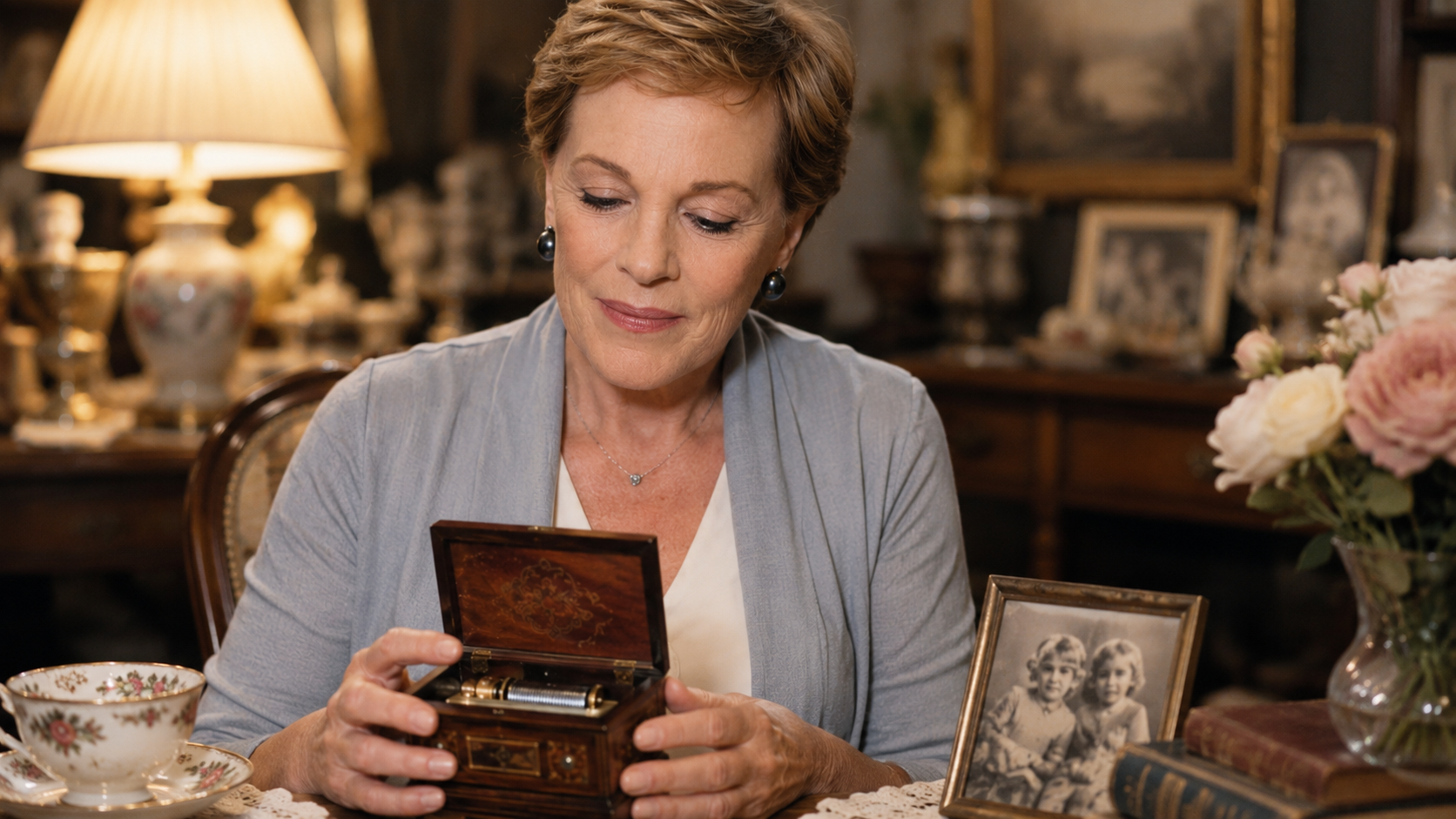
The charity sale was almost over when Julie Andrews noticed the little wooden music box.
It sat alone at the end of a crowded table, half hidden beneath old scarves, chipped teacups, and stacks of faded books. Its dark wood was scratched, one corner was cracked, and a tiny silver bird on the lid had lost one of its wings.
Most people walked past it without looking twice.
But Julie stopped.
There was something about the box that felt strangely sad, as though it had been waiting quietly for someone to remember it.
The sale was being held inside a small village hall in the English countryside. Julie had come to support a local charity that helped elderly residents pay for heating and medicine during the winter.
She had already purchased several books and a hand-knitted blanket when she picked up the music box.
“How much is this?” she asked.
An elderly volunteer named Margaret adjusted her glasses and leaned closer.
“Oh, that old thing?” she said. “Two pounds, perhaps. It was donated yesterday in a box of household items.”
Julie turned the small key on the back.
At first, nothing happened.
Then the mechanism clicked.
A soft, delicate melody filled the hall.
Julie froze.
The tune was simple—only a few gentle notes—but it carried an aching beauty. It sounded like a lullaby someone might sing beside a child’s bed on a rainy night.
Across the room, an elderly woman dropped the cup she was holding.
It shattered on the floor.
Everyone turned.
The woman stood trembling beside the refreshment table, staring at the music box in Julie’s hands.
“Where did you get that?” she whispered.
Her name was Eleanor Price. She was eighty-two years old and had lived alone in the village for more than twenty years.
Margaret hurried to her side.
“Eleanor, are you all right?”
But Eleanor did not answer.
She slowly crossed the room, never taking her eyes from the box.
“That song,” she said. “My mother used to play it.”
Julie gently placed the music box on the table.
“Do you recognize it?”
Eleanor reached toward the lid, but her hand stopped just before touching it.
“There should be a name underneath,” she said.
Julie carefully turned the box over.
Faint letters had been carved into the wood.
For Clara, with all my love.
Always follow the music.
—Mama
Eleanor covered her mouth.
Tears filled her eyes.
“My sister,” she whispered. “Clara was my little sister.”
The room became completely silent.
Julie guided Eleanor to a nearby chair while Margaret brought her some water.
For several moments, Eleanor could not speak. She simply stared at the box as though it had opened a door into a life she had tried to forget.
Finally, she began telling her story.
Eleanor and Clara had grown up in a small house near the coast. Their father repaired boats, and their mother taught piano lessons in the front room.
Every night, before the girls went to sleep, their mother wound the music box and let it play.
“It was our family song,” Eleanor said. “Mother wrote the melody herself.”
Julie listened quietly.
“What happened to Clara?” she asked.
Eleanor’s face tightened.
“Our mother died when Clara was six and I was eleven. Father tried to care for us, but he became ill the following winter.”
The family struggled. Bills went unpaid. Food became scarce.
Then one cold morning, officials arrived and told the girls they would be placed in temporary care.
“They promised we would stay together,” Eleanor said. “But we were sent to different homes.”
She never saw Clara again.
Letters were returned. Addresses changed. Records disappeared.
Their father died two years later.
Eleanor searched for her sister for decades, but every lead ended in silence.
“The last time I saw Clara,” she said, “she was holding this box. She cried and told me the music would help us find each other.”
Julie looked at the tiny silver bird on the lid.
“Do you know how the box reached this sale?”
“No,” Eleanor replied. “But someone must have kept it all these years.”
Margaret brought over the cardboard donation list.
Most items had no names attached, but the box containing the music box had been marked with a single handwritten word:
Rosewood.
Eleanor’s eyes widened.
“That was the name of the children’s home where Clara was sent.”
Julie felt a chill.
Rosewood House had closed nearly forty years earlier.
The next morning, Julie returned to the village hall and asked Margaret to show her everything that had arrived with the music box.
They searched through unopened cartons in a storage room. Most held old curtains, kitchen tools, and dusty ornaments.
At the bottom of one box, Julie found an envelope.
Inside was a black-and-white photograph of two little girls sitting beside a piano.
One girl looked about eleven.
The other held the same music box.
On the back, someone had written:
Eleanor and Clara—summer before everything changed.
Beneath the photograph was a folded note.
The handwriting was weak and uneven.
Julie read it aloud.
“To whoever finds this box, please help me return it to my sister Eleanor. I have searched for her all my life. Tell her I never stopped remembering our song.”
Eleanor began to cry.
“Clara wrote that,” she said. “I know her handwriting.”
But there was no return address.
Only a date from three months earlier.
Julie searched the carton again and found a receipt from a care home called Willow Gardens, more than two hundred miles away.
She called immediately.
A receptionist answered.
Julie explained about the music box and asked whether a woman named Clara had lived there.
There was a long silence.
“Yes,” the receptionist finally said. “Clara Bennett lived here.”
Eleanor grabbed Julie’s hand.
“Is she still there?” Julie asked.
The receptionist hesitated.
“She left suddenly six weeks ago. No one knows exactly where she went.”
“Did she have family?”
“There was one emergency contact,” the woman replied. “A man named Thomas Bennett.”
“Her son?” Eleanor whispered.
Julie asked for his information, but the care home could not release it without permission.
However, the receptionist agreed to contact him.
For three days, there was no answer.
Eleanor barely slept.
Then, late one evening, Julie’s telephone rang.
A man’s voice spoke quietly.
“My name is Thomas Bennett,” he said. “You called about my mother.”
“Yes,” Julie replied. “We found her music box.”
Thomas became silent.
Then he said something Julie had not expected.
“My mother told me that box was destroyed nearly fifty years ago.”
Julie explained everything.
When she mentioned Eleanor, Thomas took a deep breath.
“My mother believed Eleanor had died,” he said. “Someone at Rosewood told her there had been an accident.”
Eleanor heard him through the speaker.
“I’m alive,” she cried. “Tell Clara I’m alive.”
Thomas’s voice broke.
“I wish I could.”
The room went still.
“What do you mean?” Julie asked.
“My mother disappeared six weeks ago,” he said. “She left the care home before sunrise. She took only a coat, an old photograph, and a train timetable.”
“Where was she going?”
Thomas paused.
“We found a note in her room. It said she had finally learned where Eleanor lived.”
Eleanor stood so quickly that her chair fell backward.
Julie gripped the telephone.
“Did the note say anything else?”
“Yes,” Thomas replied. “She wrote that she was going home to play their song one final time.”
At that exact moment, someone knocked at Eleanor’s front door.
Once.
Then twice.
From the other side came the faint sound of a familiar melody.
Part 2: The Song That Brought Them Home
Eleanor stood frozen in the middle of her sitting room.
The melody outside continued softly.
It was faint and uneven, as though played by trembling hands.
Julie moved toward the door.
“Eleanor,” she said gently, “shall I open it?”
Eleanor could not answer.
She simply nodded.
Julie turned the handle.
On the doorstep stood a small elderly woman in a blue coat. Her silver hair was damp from the mist, and one hand rested on a walking cane.
In the other, she held a tiny wind-up music player.
For one long moment, no one spoke.
The woman looked past Julie.
Her eyes found Eleanor.
The music stopped.
“Ellie?” she whispered.
Eleanor gasped.
No one had called her that since childhood.
“Clara?”
The woman dropped her cane.
Eleanor crossed the room as quickly as her legs would carry her.
The sisters fell into each other’s arms.
They held on tightly, both crying, both laughing, both repeating the other’s name as though afraid the moment might disappear.
Julie quietly stepped aside.
Nearly fifty years of sorrow filled that doorway.
So did nearly fifty years of love.
Clara touched Eleanor’s face with both hands.
“You are alive,” she said.
“So are you,” Eleanor replied.
They laughed through their tears.
Thomas arrived the following morning.
He had driven through the night after Julie called him.
When Clara saw her son, her face filled with relief.
“I’m sorry,” she said. “I had to find her.”
Thomas knelt beside her chair.
“You could have told me.”
“I was afraid,” Clara admitted. “Every time I came close to finding Eleanor, something went wrong. I thought hope was dangerous.”
Eleanor took her sister’s hand.
“Hope brought you here.”
Over tea, the truth slowly came together.
The care home had been clearing old storage boxes from Rosewood House. Clara had received a carton containing a few childhood belongings, including the original music box.
She had planned to send it to Eleanor after finally discovering her address.
But before she could, she became ill.
During the confusion of moving rooms, the carton had been mistakenly collected for charity.
Clara believed the box was gone forever.
Then, weeks later, she found a copy of an old village directory and saw Eleanor’s name.
She left before sunrise because she feared that if she waited, she would lose her courage.
“I took the train,” Clara explained. “But I became confused halfway. A kind conductor helped me reach the village.”
The small music player she had used at the door was not the original box.
It was a recording of their mother’s melody.
“I kept it all these years,” Clara said. “I was afraid I would forget the tune.”
Eleanor looked toward the music box on the table.
“You never forgot.”
Neither sister had.
In the days that followed, Julie helped them piece together the missing years.
They shared photographs.
Eleanor learned that Clara had become a school music teacher.
Clara learned that Eleanor had worked as a nurse and had spent years caring for others.
They spoke about marriages, children, grief, birthdays, and all the ordinary moments they should have shared.
There was sadness in those conversations.
But there was no bitterness.
“We lost too much time,” Eleanor said one afternoon.
Clara squeezed her hand.
“Then we must not waste what remains.”
Julie arranged a small gathering at the village hall where the music box had first been found.
Only friends, neighbors, volunteers, and family attended.
The old box rested on a white cloth near the piano.
Julie stood before the room.
“Some songs are not written only in notes,” she said. “They are written in memory, in love, and in the hope that someone we miss may still be listening.”
Then Clara sat at the piano.
Her hands trembled.
Eleanor took the seat beside her.
For the first time in nearly fifty years, the sisters played their mother’s melody together.
The room became completely still.
Some people closed their eyes.
Others wiped away tears.
Thomas stood near the back, holding the childhood photograph of his mother and aunt beside the piano.
When the song ended, no one applauded immediately.
The silence felt sacred.
Then Julie began clapping.
The entire hall rose to its feet.
Clara leaned toward Eleanor.
“We found each other,” she whispered.
Eleanor smiled.
“No,” she replied. “The music found us.”
The sisters spent the next three years together.
Clara moved into a small cottage near Eleanor’s home.
Every Sunday, they had tea.
Every Christmas, they played the family song.
And every spring, they returned to the charity sale to help raise money for people who were lonely, struggling, or afraid they had been forgotten.
The restored music box was placed inside a glass case at the village hall.
Beside it was a small card:
This box reunited two sisters after nearly fifty years apart.
May its song remind us that love can survive distance, silence, and time.
Julie visited them often.
Years later, she would still remember the moment the door opened and two lives began again.
Not because it was dramatic.
Not because a famous person had been present.
But because a simple melody had carried one family across half a century and brought them home.
And whenever the music box played, Eleanor and Clara reached for each other’s hands.
Just as they had when they were little girls.
Just as their mother had hoped they always would.
THE END


