Part 1: A Letter Written with Hope
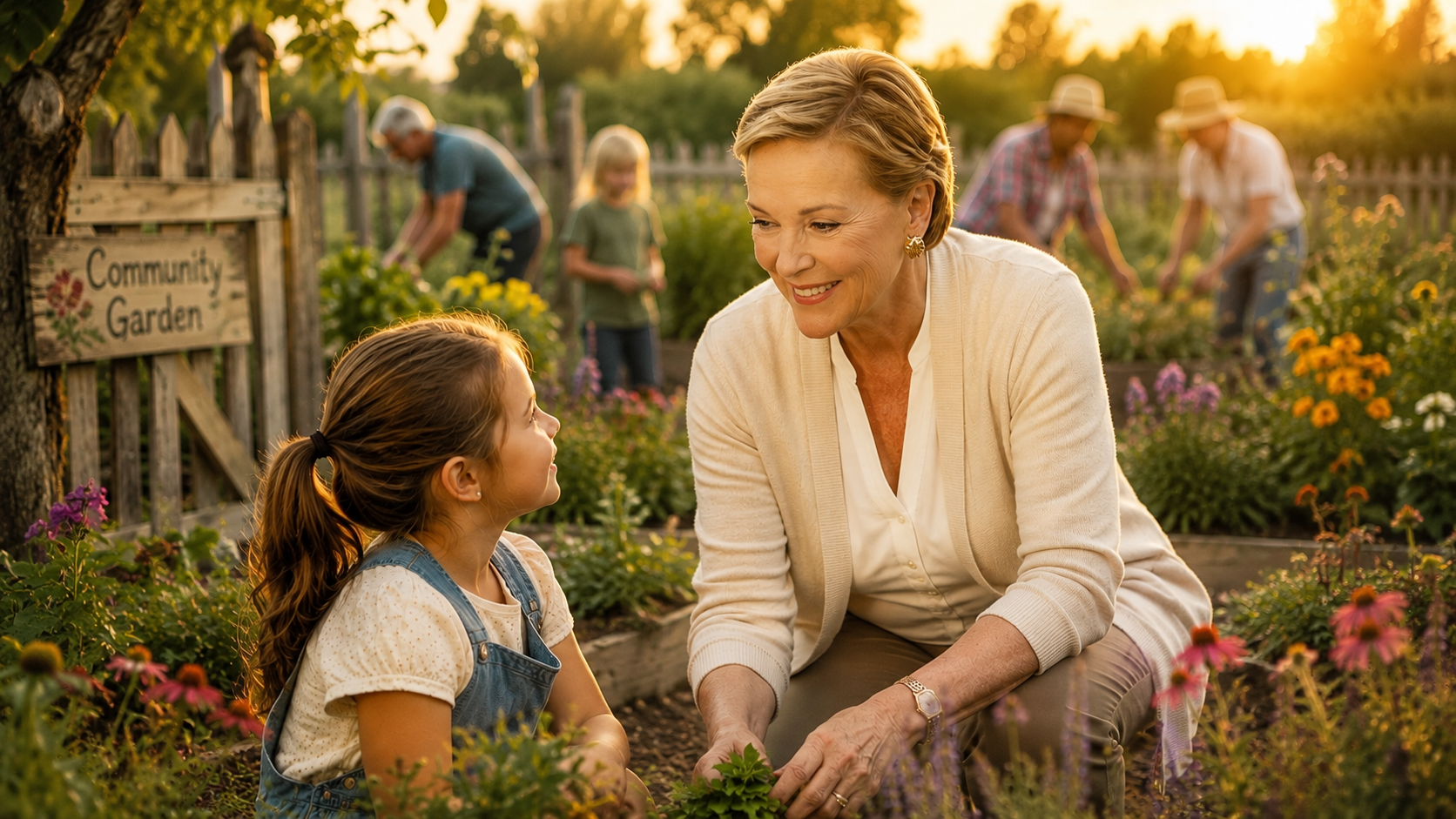
Eight-year-old Lily Carter loved only one place more than her own home—the little community garden at the edge of Willowbrook.
It wasn’t the biggest garden in town.
It didn’t have fancy fountains or colorful signs.
But to Lily, every flower, every tomato vine, and every fruit tree held a memory.
Her grandmother, Margaret, had spent nearly thirty years turning an empty field into a peaceful place where neighbors could grow vegetables, share flowers, and gather for quiet conversations.
Children learned to plant their first seeds there.
New families found friends there.
Older residents found comfort after losing loved ones.
Margaret always said, “A garden grows more than food. It grows people.”
Every Saturday morning, Lily helped water the roses while her grandmother told stories about the first volunteers who had carried buckets of soil with their own hands.
Those mornings became Lily’s favorite memories.
But everything changed one rainy afternoon.
The town council announced plans to sell the land to a construction company.
The company wanted to build a parking lot for a new shopping center.
Many neighbors protested.
Others felt there was nothing they could do.
“We can’t stop progress,” someone sighed.
Margaret tried to stay hopeful, but Lily noticed her grandmother spending longer and longer sitting quietly on the old wooden bench beneath the apple tree.
One evening Lily overheard her grandmother whisper to a friend.
“I don’t mind losing the flowers,” Margaret said softly.
“I just hate losing the place where people learned to care for each other.”
Those words stayed with Lily.
She wanted to help.
But she was only eight years old.
Then one night she watched an old movie starring Julie Andrews.
Her grandmother smiled through the entire film.
After it ended she quietly said,
“She always reminds people that kindness matters.”
Lily couldn’t stop thinking about it.
The next morning she pulled out notebook paper decorated with tiny flowers.
In careful handwriting she wrote:
Dear Ms. Julie Andrews,
My name is Lily.
My grandma built a garden where lonely people become friends.
They want to take it away.
I don’t know how to save it.
Grandma says flowers help people believe tomorrow will be better.
I think she’s right.
If you have time, would you please tell people that little gardens matter?
Love,
Lily
She folded the letter carefully.
Her grandmother never knew it had been mailed.
Weeks passed.
Nothing happened.
Summer arrived.
The garden bloomed as beautifully as ever, but everyone knew the final town meeting was only a month away.
Then one warm Thursday morning, a small envelope appeared in Lily’s mailbox.
Her hands trembled as she opened it.
Inside was a handwritten note.
Dear Lily,
Your grandmother’s garden sounds like one of the most beautiful places in the world.
Not because of the flowers…
But because of the love growing inside it.
I would be honored to visit if you’ll have me.
Warm wishes,
Julie Andrews
Lily gasped so loudly her grandmother came running.
“What happened?”
Without speaking, Lily handed her the letter.
Margaret read every word twice.
Tears quietly filled her eyes.
“I never imagined…” she whispered.
A week later, Julie Andrews arrived without cameras, without reporters, and without fanfare.
She walked slowly through every path of the garden.
She stopped beside children pulling weeds.
She admired elderly volunteers planting herbs.
She listened as neighbors shared stories of weddings, birthdays, and friendships that had begun among the flowers.
Julie didn’t rush.
She simply listened.
Finally, she turned to Margaret.
“You didn’t just grow a garden,” she said gently.
“You grew a family.”
Margaret smiled through tears.
“I was afraid people had forgotten.”
Julie shook her head.
“They haven’t.”
As neighbors quietly gathered around them, Julie looked at Lily and asked,
“What if we give everyone one more reason to believe this place belongs to the whole town?”
Lily’s eyes widened.
“What do you mean?”
Julie smiled.
“I have an idea…”
Part 2: A Garden That Bloomed Beyond Its Borders
The next morning, Julie Andrews arrived carrying a small canvas bag.
Inside were dozens of tiny packets of flower seeds.
Some were sunflowers. Others were wildflowers, lavender, daisies, and forget-me-nots.
She gathered everyone beneath the old apple tree where Margaret had welcomed volunteers for nearly three decades.
“I’ve visited many beautiful places,” Julie said with a warm smile. “But the most beautiful places are never remembered for their buildings. They’re remembered for the kindness people shared there.”
The crowd grew silent.
Julie held up one packet of seeds.
“Today, I’d like each family to take these home. Plant them wherever you can—a yard, a balcony, a window box, even a small flowerpot. As they grow, remember where they came from.”
Lily looked at her grandmother.
“So even if something happens to this garden…”
“The kindness will keep growing,” Margaret whispered.
That weekend, volunteers organized what they called the Garden of Hope Day.
No advertisements.
No celebrities on a stage.
Just neighbors inviting neighbors.
Children painted colorful stones with messages like Be Kind, Share Joy, and Love Grows Here.
Retired musicians played gentle songs beneath the apple tree.
Local bakers donated fresh bread and homemade pies.
Teachers brought students to learn how to plant vegetables.
Parents who had never met before found themselves laughing while pulling weeds together.
By sunset, hundreds of people had visited the garden.
Someone shared photos online.
Then another.
And another.
Soon, people from nearby towns began arriving with flowers, seeds, and handwritten notes thanking Margaret for creating a place they had never even known existed until now.
A local newspaper featured the story.
Then a regional television station.
Instead of asking why the garden should stay, people began asking how they could create gardens like it in their own communities.
The town council noticed.
So did the construction company.
At the final public meeting, the room was filled long before it began.
Lily sat beside her grandmother, nervously holding her hand.
One by one, residents stepped forward.
A firefighter described how the garden had helped his family after losing their home to a fire.
A young mother shared that she had met her closest friends while planting tomatoes there during a lonely first year in town.
An elderly widower spoke quietly.
“After my wife passed away, I came here every morning because it was the only place that didn’t feel empty.”
Even members of the construction company listened without interrupting.
When the final speaker finished, the company president slowly stood.
He looked around the crowded room before speaking.
“We came here expecting to build a parking lot,” he said. “Instead, we found something far more valuable.”
He smiled toward Margaret.
“We’re withdrawing our proposal.”
For a moment, the room was completely still.
Then applause erupted.
Some people laughed.
Others cried openly.
Lily threw her arms around her grandmother.
“We saved it!” she shouted.
Margaret hugged her tightly.
“No,” she said through happy tears. “We all saved it.”
Months later, the garden welcomed more visitors than ever before.
Near the entrance stood a simple wooden sign carved by local volunteers.
It read:
“This garden was preserved by a community that chose kindness over convenience. May every flower remind us that hope grows when people care for one another.”
Beside the sign stood a young sunflower that Lily had planted with Julie Andrews on the day of her visit.
It had grown taller than anyone expected.
Each autumn, children collected seeds from that sunflower and shared them with families across the region.
Within a few years, hundreds of community gardens had been started using those seeds or inspired by the story behind them.
People called them Hope Gardens.
Julie received letters from schools, nursing homes, hospitals, and neighborhoods describing flowers planted in honor of loved ones, strangers becoming friends, and forgotten spaces transformed into places of welcome.
She kept every letter in a small wooden box.
Whenever someone asked what her favorite performance had been, she would smile gently.
“It wasn’t on a stage,” she would say.
“It was in a little garden where a brave girl believed that one act of kindness could change the future.”
And every spring, when the first flowers opened beneath the old apple tree, Lily would remember the letter she had written as an eight-year-old.
She had wished to save one small garden.
Instead, that wish had inspired countless others to plant kindness wherever they lived, proving that the smallest seed, given with love, can grow into hope for generations.
The End.


