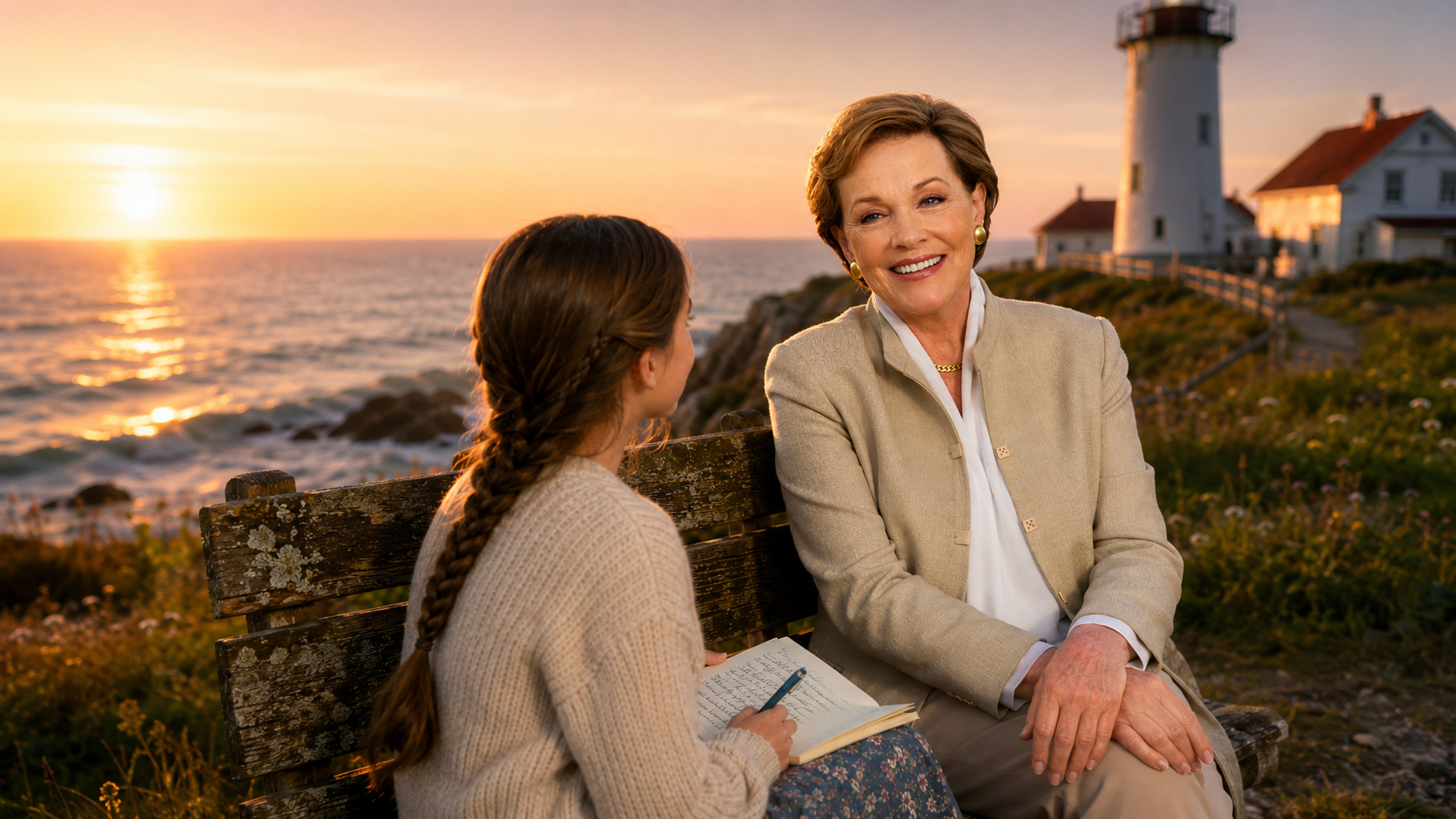
Part 1: The Girl Who Sang to the Sea
In the small seaside village of Bellweather Cove, mornings began with the sound of fishing boats leaving the harbor and gulls calling above the rooftops.
The village was beautiful, but it was also quiet.
Most families had lived there for generations. Children usually grew up to work in the same shops, repair the same boats, or move away in search of opportunities that the village could not offer.
Fourteen-year-old Clara Bennett dreamed of something different.
She wanted to sing.
Every morning before school, Clara walked to a rocky hill overlooking the sea. She carried a worn blue notebook filled with songs she had written herself.
She sang them to the waves because the waves never laughed.
Clara had a gentle voice—clear, warm, and full of feeling. But she was painfully shy. Whenever anyone came near, her voice disappeared.
At school, she barely spoke above a whisper.
During music lessons, she stood in the back row and pretended to sing quietly with the others. Her teacher, Mrs. Ellis, knew Clara had talent, but she also knew how deeply the girl feared being judged.
Clara’s father, Thomas, was a fisherman. Her mother had died when Clara was seven, leaving behind a small wooden music box and a love of old songs.
Thomas cared deeply for his daughter, but life had been difficult since his wife’s passing.
The fishing business was struggling. Their roof leaked during storms, and some evenings, dinner was little more than soup and bread.
There was no money for singing lessons.
There was certainly no money for travel, auditions, or music school.
Still, Clara kept writing.
She wrote songs about the lighthouse keeper who waited for ships in the fog.
She wrote about her father’s tired hands.
She wrote about her mother’s empty chair.
And she wrote about the sea, which seemed to carry every dream beyond the horizon.
One afternoon, Mrs. Ellis stayed behind after class.
“Clara,” she said gently, “the village is holding its summer festival next month.”
Clara immediately looked down.
“I know.”
“There will be a small stage near the harbor.”
Clara gripped the straps of her schoolbag.
“I can’t sing there.”
“You have not even heard what I was going to ask.”
“I know what you were going to ask.”
Mrs. Ellis smiled softly.
“Perhaps I was going to ask you to help arrange the chairs.”
Clara looked up, surprised.
Mrs. Ellis leaned closer.
“But since you mentioned singing…”
Clara shook her head quickly.
“I would forget every word.”
“You wrote the words.”
“I would still forget them.”
“Then bring your notebook.”
“My hands would shake.”
“Then hold it with both hands.”
Clara almost smiled, but the fear in her eyes remained.
That evening, she sat on the rocks above the sea and opened her notebook.
The wind turned the pages.
On the final page was an unfinished song called Follow the Light.
Clara had started writing it after dreaming about her mother standing near the lighthouse.
The song had only one verse.
When the road disappears in the rain,
And your courage feels smaller than pain,
Look beyond every shadow of night,
There is always a reason to follow the light.
Clara had tried many times to finish it, but the rest would not come.
She closed the notebook and whispered, “Maybe some dreams are too big.”
A voice behind her answered, “Or perhaps they simply need time.”
Clara turned around.
An elderly woman stood several steps away, wearing a pale coat and a scarf tied beneath her chin. Her eyes were kind, and her expression held a quiet warmth.
Clara recognized her immediately.
For a moment, she could not breathe.
The woman was Julie Andrews.
Clara had seen her in old films and heard her songs on her mother’s records. Her mother had loved Julie’s voice and often sang along while cooking.
Clara stood so quickly that her notebook slipped from her lap.
Julie picked it up before the wind could carry it away.
“I believe this belongs to you,” she said.
Clara took it with trembling hands.
“Thank you.”
“I hope I did not frighten you.”
“No. I mean, yes. But not in a bad way.”
Julie laughed gently.
“That is a very honest answer.”
Clara looked toward the path, wondering whether a film crew or crowd would appear. But no one else was there.
“Why are you here?” she asked.
Julie looked out at the sea.
“I was invited by an old friend who lives near the lighthouse. I arrived earlier than expected and decided to walk.”
Clara nodded, still unable to believe what was happening.
Julie glanced at the notebook.
“Were you writing a song?”
Clara quickly held it against her chest.
“Just words.”
“Songs often begin that way.”
Clara looked down.
“My mother used to listen to you.”
“That is lovely to hear.”
“She said your voice made people feel brave.”
Julie’s expression softened.
“And what makes you feel brave?”
Clara thought for a moment.
“Being alone.”
Julie did not laugh.
Instead, she sat on the stone beside Clara.
“Sometimes being alone gives us the freedom to discover our voice,” she said. “But eventually, a voice needs someone willing to hear it.”
Clara watched the waves crashing below.
“I don’t think people would want to hear mine.”
“Have they told you that?”
“No.”
“Then perhaps you are answering for them before they have been given the chance.”
The words stayed with Clara.
After a few moments, Julie asked, “Would you sing one line for me?”
Clara’s heart pounded.
“I can’t.”
“You do not have to sing loudly.”
“I still can’t.”
Julie nodded without disappointment.
“Then perhaps another day.”
She stood and brushed the sand from her coat.
Before leaving, she turned back.
“There is a small bench near the lighthouse. I plan to sit there tomorrow morning at ten. Should a song happen to find its way there, I would be delighted to listen.”
Clara watched her walk down the path until she disappeared.
That night, Clara did not sleep much.
She placed her blue notebook beside the music box her mother had left her.
At nine-thirty the next morning, she was still sitting on her bed.
At nine-forty, she put on her shoes.
At nine-fifty, she walked toward the lighthouse.
And at exactly ten o’clock, she found Julie Andrews waiting on the bench.
Clara sat beside her without speaking.
For several minutes, they listened to the sea.
Then Clara opened her notebook.
Her hands shook just as she had feared.
Her voice barely rose above the wind.
But she sang the first verse of Follow the Light.
When she finished, she stared at the ground.
Julie remained silent for a moment.
Clara’s stomach tightened.
Then Julie said, “That was beautiful.”
Clara looked up.
“You don’t have to say that.”
“I never say something simply because I have to.”
Julie asked Clara to sing it again.
The second time, Clara’s voice grew stronger.
The third time, it carried across the rocks.
When the final note faded, Julie had tears in her eyes.
“You wrote this about someone you miss,” she said.
“My mother.”
Julie gently touched Clara’s hand.
“I think she would be very proud.”
Clara swallowed hard.
“The song isn’t finished.”
“Perhaps it has been waiting for you to believe you are allowed to finish it.”
Over the next several days, Julie returned to the lighthouse bench.
She did not give Clara formal lessons. Instead, they talked about fear, courage, and the difference between being perfect and being honest.
Julie taught Clara how to breathe slowly before singing.
She showed her how to look beyond the audience rather than directly at them.
Most importantly, she reminded Clara that a song did not need to impress everyone.
It only needed to reach one heart.
Word slowly spread through the village that Julie Andrews had been seen near the lighthouse.
Children began walking past the area, hoping to catch a glimpse of her. Shopkeepers whispered excitedly. Even fishermen returned early from the harbor.
But Clara told no one about their meetings.
For the first time in her life, she had something that felt too precious to explain.
One morning, Julie brought a small wrapped box.
“This is for you,” she said.
Clara stared at it.
“I can’t accept a gift.”
“You have already given me several songs. Allow me to return the kindness.”
Inside the box was a silver pendant shaped like a tiny lighthouse.
On the back were three engraved words:
Follow Your Light.
Clara pressed the pendant into her palm.
“My mother wore a lighthouse necklace,” she whispered.
Julie looked surprised.
“I did not know that.”
Clara’s eyes filled with tears.
For the first time, she wondered whether the strange meeting on the hill had happened for a reason.
That afternoon, Mrs. Ellis visited Clara’s home with unexpected news.
The singer scheduled to open the village festival had become ill.
The organizers needed someone to perform one song before the children’s choir.
Mrs. Ellis had recommended Clara.
Thomas looked at his daughter with hope.
But Clara’s fear returned instantly.
“No.”
“Clara,” her father said, “you have always dreamed of this.”
“Dreaming is different from standing in front of everyone.”
“You would not be alone.”
“Yes, I would.”
She ran upstairs and locked herself in her room.
For two days, Clara refused to discuss the festival.
She avoided the lighthouse.
She kept the silver pendant hidden beneath her shirt, afraid she had disappointed Julie.
On the third morning, Clara found an envelope pushed beneath the front door.
Inside was a handwritten note.
Dear Clara,
Courage is not the absence of fear. It is choosing to take one small step while fear walks beside you.
The village does not need a perfect performance. It needs the truth in your song.
I will be listening.
Julie
Clara read the note three times.
That evening, she finished Follow the Light.
The final verse came quickly.
When one brave heart begins to sing,
It can awaken another dream.
And the smallest flame, when shared just right,
Can teach a whole world to follow the light.
On the day of the festival, the harbor was decorated with ribbons and lanterns.
Hundreds of people gathered near the wooden stage.
Clara stood behind the curtain, unable to move.
Her name was announced.
Applause rose from the crowd.
Mrs. Ellis squeezed her hand.
“Take one step.”
Clara stepped forward.
Then another.
She walked onto the stage.
The crowd seemed endless.
Her father stood near the front.
Children watched from the harbor wall.
The lighthouse shone behind them.
But Julie Andrews was nowhere to be seen.
Clara’s courage began to disappear.
The pianist waited.
The audience fell silent.
Clara touched the silver pendant at her neck.
Then, just as she prepared to turn and run, she noticed a familiar figure standing quietly beside the old lighthouse keeper.
Julie smiled and placed one hand over her heart.
Clara took a breath.
The first note trembled.
The second was stronger.
By the time she reached the chorus, her voice carried across the harbor and out toward the open sea.
People stopped whispering.
Fishermen removed their caps.
Mrs. Ellis cried openly.
Thomas bowed his head as tears ran down his face.
When Clara sang the final line, the entire village stood.
The applause seemed to shake the harbor.
Clara searched for Julie.
But the place beside the lighthouse keeper was empty.
After the performance, Clara hurried through the crowd.
She found Julie’s friend near the stage and asked where she had gone.
The woman handed Clara another envelope.
“She had to leave sooner than expected,” she explained. “But she asked me to give you this after you sang.”
Clara opened the envelope.
Inside was a letter—and something else.
It was an application form for a respected youth music program in London.
Clara stared at it in disbelief.
At the bottom of the letter, Julie had written:
Your gift should not end at the edge of this village.
But the greatest gift is not the opportunity inside this envelope.
It is what you choose to do after you receive it.
Clara looked toward the crowd.
Several children were standing nearby, watching her with wonder.
One small boy held a homemade flute.
A young girl carried a notebook of poems.
Another child whispered, “Do you think someone like me could sing too?”
Clara looked down at Julie’s letter.
At that moment, she understood that the unexpected gift was not meant for her alone.
And the choice she made next would change Bellweather Cove for generations.
Part 2: The Light That Traveled Beyond the Shore
Clara stood near the harbor stage, holding Julie Andrews’ letter in one hand and the application form in the other.
Around her, the festival continued.
Music played.
Children ran between the lanterns.
Fishermen laughed near the food stalls.
Yet Clara heard only the question from the little girl standing before her.
“Do you think someone like me could sing too?”
The girl looked about eight years old. Her brown hair had been tied back with a faded ribbon, and she held a notebook against her chest.
Clara recognized the fear in her eyes.
It was the same fear Clara had carried for years.
She knelt beside the child.
“What is your name?”
“Annie.”
“Do you write songs, Annie?”
The girl shook her head.
“Poems.”
“Would you read one to me?”
Annie looked toward the crowd and quickly stepped backward.
“Not here.”
Clara smiled.
“I understand.”
She glanced toward the lighthouse, remembering the quiet bench where Julie had first asked her to sing one line.
“Come to the lighthouse tomorrow morning,” Clara said. “Bring your notebook.”
Annie stared at her.
“Will you be there?”
“Yes.”
“Even if my poem is bad?”
Clara remembered Julie’s words.
A voice did not need to impress everyone. It only needed to reach one heart.
“There is no such thing as a bad beginning,” Clara replied.
The next morning, Clara walked to the lighthouse expecting to meet only Annie.
Instead, six children were waiting.
Annie had brought her younger brother.
The boy with the homemade flute had come too.
Two sisters carried an old violin with a broken string.
Another child brought a drum made from a biscuit tin.
The youngest boy had nothing except a song he said his grandmother used to sing.
Clara stopped on the path.
“I didn’t know there would be so many of you.”
Annie smiled nervously.
“I told them you would listen.”
Clara looked at the bench.
She thought of Julie patiently waiting there, never rushing her, never laughing at her fear.
Then she sat down.
“One at a time,” she said.
That morning, Annie read her poem.
The flute player performed a tune that squeaked in the middle.
The sisters played only three notes before the violin string snapped.
The youngest boy forgot half of his grandmother’s song.
No one was perfect.
But no one laughed.
When they finished, Clara clapped for each of them.
The children returned the next day.
Then they returned again.
Within two weeks, Clara had fifteen young dreamers meeting her beside the lighthouse.
Some sang.
Some painted.
Some danced.
Some wrote stories.
A quiet boy named Peter carved small boats from driftwood.
A girl named Rose wanted to become an actress but was afraid to speak in front of anyone.
Clara began calling the meetings The Lighthouse Circle.
There were no auditions.
No fees.
No prizes.
The only rule was simple:
Everyone had to encourage the person who came before them.
At first, the adults in Bellweather Cove treated the circle as a harmless summer activity.
Then something began to change.
Children who had once hidden their talents started sharing them.
Annie’s poems were displayed in the bakery window.
The boy with the flute performed for elderly residents at the village home.
Peter sold his carved boats and used the money to buy new strings for the sisters’ violin.
Parents began attending the Saturday gatherings.
Fishermen repaired old benches near the lighthouse.
The village carpenter built a small wooden platform where the children could perform.
Mrs. Ellis brought sheet music from the school.
Even Thomas helped by hanging lanterns along the path.
Still, Clara had not forgotten the application to the youth music program in London.
The deadline was approaching.
Every evening, she placed the form on the kitchen table.
Every morning, it remained unfinished.
Thomas noticed.
“You should apply,” he said one night.
Clara looked toward the window.
“I can’t leave the children.”
“The program lasts only one year.”
“A year is a long time.”
“It is also the chance you have always wanted.”
Clara folded her hands.
“What if the Lighthouse Circle disappears while I am gone?”
Thomas sat across from her.
“Then perhaps you have not taught them enough.”
Clara looked hurt.
Her father reached across the table.
“I do not mean that unkindly. You have shown those children how to believe in themselves. Now you must trust them to continue without you.”
Clara’s eyes filled with worry.
“What if I fail in London?”
Thomas smiled gently.
“Then you will come home knowing you were brave enough to try.”
Clara looked down at Julie’s letter.
The greatest gift is not the opportunity inside this envelope.
It is what you choose to do after you receive it.
The next morning, Clara gathered the children beside the lighthouse.
“I have something to tell you,” she said.
Annie immediately looked concerned.
“You’re leaving.”
“Only for a while.”
The children became quiet.
Clara explained the music program.
She told them about the application.
She admitted that she was afraid.
Peter raised his hand.
“But you always tell us fear doesn’t mean stop.”
The others nodded.
Clara laughed softly.
“You have been listening.”
Annie opened her notebook.
“We wrote something for you.”
The children stood in a line.
One by one, they read a sentence.
“You listened when we were afraid.”
“You helped us finish what we started.”
“You taught us that small voices still matter.”
“You showed us that dreams do not belong only to rich people or famous people.”
“You told us to follow the light.”
Finally, Annie stepped forward.
“So now you have to follow yours.”
Clara covered her mouth as tears filled her eyes.
That evening, she completed the application.
She included a recording of Follow the Light and a letter describing the Lighthouse Circle.
Several weeks later, an official envelope arrived.
Clara opened it at the kitchen table while her father and Mrs. Ellis watched.
She had been accepted.
Not only that, but the school had awarded her a full scholarship.
Clara read the letter twice before believing it.
Thomas lifted her from the floor and hugged her.
Mrs. Ellis cried.
The children celebrated beside the lighthouse with cake, lanterns, and music.
Before Clara left for London, Annie gave her a new blue notebook.
On the first page, she had written:
For the songs you have not found yet.
London was larger and louder than anything Clara had known.
The music school was filled with gifted students.
Many had trained since childhood.
They understood technical words Clara had never heard.
They performed confidently in front of teachers and judges.
During her first week, Clara felt like an outsider.
Her clothes were simple.
Her accent sounded different.
Her hands still trembled before every performance.
One afternoon, a teacher asked her to sing alone in front of the entire class.
Clara walked to the piano.
For one terrible moment, she forgot how to breathe.
Then her fingers touched the lighthouse pendant.
She pictured Bellweather Cove.
She pictured her father near the harbor.
She pictured Annie reading her first poem.
And she remembered Julie smiling beside the old lighthouse keeper.
Clara began to sing.
Her voice trembled.
But it did not stop.
By the final note, the classroom was silent.
Then the teacher said, “You have something that cannot be taught.”
Clara looked up.
“What is that?”
“You make people feel that the song belongs to them.”
Clara worked harder than she had ever worked before.
She studied music, composition, and performance.
She learned how to control her breathing.
She learned how to stand beneath bright lights without disappearing inside herself.
But she also learned that talent alone was not enough.
Some students were lonely.
Others were exhausted by the pressure to succeed.
A few had forgotten why they loved music in the first place.
Clara began gathering them once a week in an unused practice room.
There were no auditions.
No judges.
No prizes.
The only rule was that everyone had to encourage the person who came before them.
She called it the London Lighthouse Circle.
By the end of the year, it had become one of the school’s most beloved gatherings.
Students shared unfinished songs, poems, fears, and dreams.
One young pianist who had planned to quit found her confidence again.
A boy who was too frightened to perform played his first original piece.
A student from another country sang a folk song from home and made the entire room cry.
Clara realized that Julie’s gift had already traveled far beyond Bellweather Cove.
When she returned home the following summer, the whole village gathered at the harbor.
But the biggest surprise waited near the lighthouse.
The wooden platform had become a small open-air theater.
A painted sign stood beside it:
The Lighthouse House of Dreams
Annie had continued the circle while Clara was gone.
The boy with the flute now taught younger children.
Peter made instruments from driftwood and recycled wood.
Rose had performed in her first school play.
The violin sisters had formed a small village ensemble.
Clara stood before them, overwhelmed.
“You did all this?”
Annie smiled.
“You told us the light had to be shared.”
Years passed.
Clara returned to London to continue studying, but she came home every summer.
The Lighthouse House of Dreams grew.
Villagers donated an old storage building beside the harbor.
Volunteers repaired the roof.
Local artists painted the walls.
Former members returned to teach.
No child was ever charged.
Soon, young people traveled from nearby towns to attend workshops.
Some became musicians.
Some became teachers.
Some became writers, painters, builders, and nurses.
Not everyone followed a career in art.
That was never the point.
The purpose was to help each person discover what made them feel alive—and give them the courage to pursue it.
Clara became a respected singer and songwriter.
She performed in theaters across Britain and later across Europe.
Yet before every major concert, she touched the lighthouse pendant.
She never forgot the quiet woman who had listened to her first trembling song.
For years, Clara wrote letters to Julie.
She described the children.
She sent photographs of the lighthouse theater.
She shared stories of students who had found courage there.
Julie always answered.
Her letters were warm but never long.
She often ended them with the same words:
Keep the light burning.
Twenty-five years after Clara first sang at the harbor festival, Bellweather Cove prepared for a special anniversary celebration.
Hundreds of former members of the Lighthouse Circle returned.
Some brought their own children.
The once-quiet village was filled with music, paintings, stories, and laughter.
The harbor stage had been rebuilt.
Lanterns lined the cliffs.
Annie, now a published poet and schoolteacher, stood beside Clara.
“Do you remember when I asked whether someone like me could sing?”
Clara laughed.
“You never wanted to sing.”
“I was confused.”
They looked across the crowd.
The flute player had become a music therapist.
Peter was now a master craftsman who built instruments for children with disabilities.
Rose directed plays for young people.
The violin sisters performed professionally but still returned every summer.
Clara felt tears in her eyes.
“One kind moment did all this,” she whispered.
Annie shook her head.
“No. One kind moment started it. Thousands of people chose to continue it.”
As sunset approached, Clara walked onto the stage.
The crowd rose to applaud.
She spoke about fear.
She spoke about dreams.
She spoke about the lighthouse bench where someone had once listened without judgment.
Then Clara smiled.
“There is one person we must thank,” she said. “A woman who gave me a small silver pendant, an application form, and the courage to believe that my voice mattered.”
The audience applauded.
Clara looked toward an empty chair near the front of the stage.
Julie had been invited, but her appearance had not been confirmed.
Clara understood.
Many years had passed.
Perhaps the journey was too difficult.
She turned toward the piano.
“Tonight, we will sing the song that began everything.”
She played the opening notes of Follow the Light.
The children’s choir joined her.
Then the former Lighthouse Circle members added their voices.
Soon, the entire harbor was singing.
Halfway through the final verse, the crowd near the back began to move.
People turned.
A pathway opened.
An elderly woman walked slowly toward the stage, supported by a companion.
She wore a pale coat.
Around her neck was a silver lighthouse pendant.
Clara stopped singing.
Her hands fell from the piano.
Julie Andrews looked up at her and smiled.
For a moment, Clara was fourteen again.
She was sitting on a stone above the sea, afraid that no one would ever want to hear her voice.
Clara stepped down from the stage.
Julie opened her arms.
They embraced as the entire village stood in silence.
“You came,” Clara whispered.
“I promised I would listen,” Julie replied.
Clara wiped her tears.
“Look what your gift became.”
Julie looked around the harbor.
She saw children holding instruments.
She saw paintings hanging from the boats.
She saw families singing together.
She saw adults who had once been frightened children now guiding the next generation.
Then she looked back at Clara.
“My dear,” she said softly, “the pendant was only silver. The application was only paper.”
She placed one hand over Clara’s heart.
“The real gift was already here.”
Clara shook her head.
“I might never have found it without you.”
“Perhaps,” Julie replied. “But you could have kept it for yourself. Instead, you gave it away.”
They returned to the stage together.
Clara introduced Julie to the crowd.
The applause lasted for several minutes.
Julie did not give a long speech.
She simply stood beside the children and said, “Every generation needs someone willing to listen before they are ready to speak, and someone willing to believe before they are ready to believe in themselves.”
Then she looked toward Clara.
“One person encouraged you.”
She turned toward the crowd.
“You encouraged thousands.”
As darkness covered Bellweather Cove, every child received a small paper lantern.
One by one, they placed the lanterns along the harbor wall.
From a distance, the lights formed a glowing path from the village to the lighthouse.
Clara and Julie sat together on the old bench above the sea.
The bench had been repaired many times, but it remained in the same place.
Below them, children performed unfinished songs, imperfect dances, and nervous poems.
Julie listened carefully.
Clara smiled.
“Do you think they know how far their dreams might travel?”
“No,” Julie answered. “And that is part of the wonder.”
Years later, Bellweather Cove became known not for its fishing boats or quiet harbor, but for the generations of dreamers who had begun there.
Above the entrance to the Lighthouse House of Dreams, visitors could read three simple words:
Follow Your Light.
Beneath them was a smaller sentence added by Clara:
And when you find it, use it to help someone else discover theirs.
Julie’s unexpected gift had opened one door.
Clara’s courage had opened hundreds more.
And every time a frightened child stepped onto the lighthouse stage, someone waited patiently in the audience—ready to listen, ready to encourage, and ready to keep the light burning.
The End


