Part 1
The rain had just stopped when Julie Andrews stepped out of a small bookshop in the English countryside.
She had spent the afternoon speaking with children about stories, music, and the importance of using their voices with courage. Now the village streets were quiet, shining beneath the pale evening light.
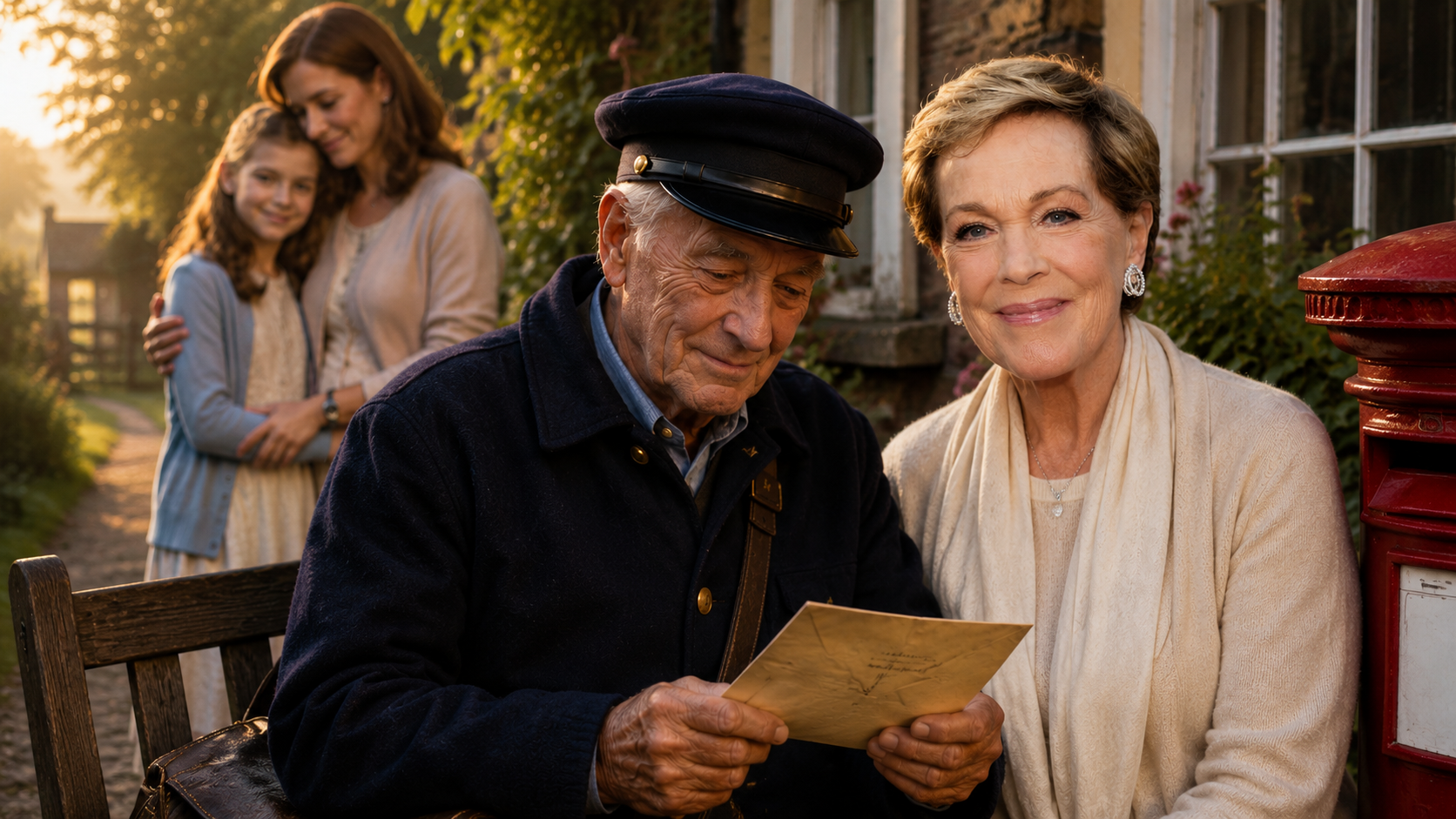
As Julie walked toward her waiting car, she noticed an elderly man sitting alone on a bench beside an old red postbox.
He wore a faded navy coat with brass buttons. A worn leather mailbag rested beside him, though he looked far too old to still be working.
In his hands, he held a yellowed envelope.
He kept turning it over, studying the handwriting as though it contained the answer to a question he had carried for many years.
Julie slowed.
“Are you waiting for someone?” she asked gently.
The man looked up, surprised.
“Oh, no, ma’am,” he said. “I think I’ve been waiting for courage.”
Julie sat beside him.
His name was Arthur Bell.
For forty-three years, Arthur had been the village mail carrier. He had walked every lane, climbed every hill, and knocked on nearly every door in the surrounding countryside.
He had delivered wedding invitations, birthday cards, bills, apologies, and heartbreaking news.
He knew which widows waited by their windows.
He knew which children listened for his bicycle bell before Christmas.
He even knew which envelopes carried happiness before they were opened.
But the letter in his hands was different.
“This is the only letter I never delivered,” Arthur said.
Julie looked at the envelope. The ink had faded, but one name could still be read clearly:
Mr. Thomas Bell.
Arthur’s voice grew quiet.
“Thomas was my younger brother.”
He explained that when they were young men, Arthur and Thomas had been inseparable. They worked together in their father’s small repair shop and dreamed of one day expanding it into a proper family business.
But after their father died, everything changed.
The brothers argued over money, responsibility, and the future of the shop.
Harsh words were spoken.
Thomas left the village without saying goodbye.
For nearly twenty years, Arthur heard nothing from him.
Then, one autumn morning, a letter arrived at the post office addressed to Thomas.
The return address belonged to a woman named Margaret Hale.
Arthur recognized the name immediately.
Margaret had once been Thomas’s closest friend—and the woman everyone believed he would marry.
By then, however, Thomas was gone, and no one knew where he lived.
Arthur placed the letter in the undeliverable box.
He told himself he would find his brother one day.
But days became months.
Months became years.
The post office eventually closed, and Arthur retired.
Somehow, the letter remained in his mailbag.
“I should have returned it,” Arthur admitted. “But every time I tried, I felt that it belonged to Thomas. I kept believing I would find him.”
“Did you?” Julie asked.
Arthur looked down.
“Too late.”
Several years earlier, Arthur had learned that Thomas had died in another part of the country.
He had built a life there, married, and raised a daughter.
Arthur never met Thomas’s wife.
He had never met his niece.
“And Margaret?” Julie asked.
“She passed away last winter,” Arthur said. “The letter has outlived everyone it was meant for.”
Julie studied the sealed envelope.
“Perhaps not everyone,” she said.
Arthur frowned.
Julie pointed to the return address.
“Margaret may have written it to Thomas, but sometimes a letter carries something larger than the name on the front.”
Arthur shook his head.
“I wouldn’t know where to begin.”
“You said Thomas had a daughter.”
“Yes. Her name is Emily. I found an old newspaper notice after his death. I believe she lives somewhere near Bristol.”
“Then perhaps we begin with Emily.”
Arthur looked at Julie as though the idea frightened him.
“What would I say to her? ‘Hello, I’m the uncle who stayed away for half a lifetime’?”
“You could begin with the truth,” Julie replied. “The truth may arrive late, but that does not mean it arrives without purpose.”
The following morning, Julie returned to Arthur’s small cottage.
She found him at the kitchen table surrounded by old photographs, maps, newspaper clippings, and address books.
He had not slept much.
Together, they searched through everything he had kept from his years as a mail carrier.
At last, they found a possible address for Emily Bell.
It was nearly three hours away.
Arthur stared at it for a long time.
“I don’t think I can go alone,” he said.
Julie smiled.
“Then you won’t.”
That afternoon, they set out together.
During the journey, Arthur told Julie stories about Thomas.
Thomas had been the brave one.
He climbed trees Arthur was afraid to climb.
He sang loudly even when he forgot the words.
Once, during a terrible winter, Thomas walked five miles through snow to bring medicine to a sick neighbor.
“He always had a good heart,” Arthur said. “Even when he was angry.”
“People can be hurt and still be good,” Julie replied.
Arthur nodded.
“I wish I had understood that sooner.”
They arrived near sunset.
Emily’s home was a modest brick house at the end of a quiet street. A bicycle leaned against the garden wall, and a child’s yellow raincoat hung near the front door.
Arthur remained inside the car.
His hands trembled around the envelope.
“What if she refuses to see me?”
“Then you will still have honored the journey,” Julie said. “But give her the chance to choose.”
They walked to the door.
Arthur knocked.
A woman in her early forties answered.
She had Thomas’s eyes.
Arthur knew it immediately.
“Emily?” he whispered.
“Yes?”
“My name is Arthur Bell.”
The woman’s expression changed.
“My father’s brother?”
Arthur nodded.
For several seconds, neither of them spoke.
Then Emily looked at the old mailbag, the faded coat, and the envelope in his hand.
“My father said you wanted nothing to do with us,” she said.
Arthur’s face fell.
“I was afraid he believed that.”
“Was it true?”
“No,” Arthur answered. “But I was proud, and pride can look very much like cruelty from a distance.”
Emily folded her arms.
“Why are you here now?”
Arthur held out the letter.
“I came to finish a delivery I should have made many years ago.”
Emily stared at the envelope.
When she saw Margaret Hale’s name on the back, all color left her face.
“Where did you get this?”
“You knew Margaret?” Arthur asked.
Emily slowly opened the door wider.
“She was my mother.”
Arthur nearly dropped the letter.
He had always assumed Thomas had married someone else.
Emily invited them inside.
On the mantel stood a framed photograph of Thomas and Margaret together, smiling beside a baby.
Arthur moved toward it, tears filling his eyes.
“They found each other,” he whispered.
Emily nodded.
“They married quietly. My mother said there were reasons they couldn’t return to the village.”
Arthur looked at the envelope in his hand.
“Then why would she send this letter to him?”
Emily’s eyes remained fixed on it.
“My mother once told me she had written Father a letter before they reunited. She said it contained a truth that could either repair the Bell family or break it forever.”
Arthur sank into a chair.
Emily sat across from him.
For the first time, she noticed Julie standing near the doorway.
Julie introduced herself softly and explained how they had met.
Emily listened, then turned back to Arthur.
“My father died believing you blamed him for what happened to your family,” she said.
“I blamed myself,” Arthur replied. “But I never found the courage to tell him.”
Emily reached for the envelope.
The paper crackled beneath her fingers.
The seal had remained unbroken for more than forty years.
Before opening it, she looked at Arthur.
“Whatever is inside may change what we both believed about my father.”
Arthur nodded.
“That is why it must finally be read.”
Emily carefully lifted the old flap.
Inside was a four-page letter and a small black-and-white photograph.
The moment Arthur saw the photograph, he covered his mouth.
It showed Thomas standing beside their father’s repair shop.
But Thomas was not alone.
Beside him stood Margaret—and a man Arthur recognized from his childhood.
On the back, in Margaret’s handwriting, were six words:
Arthur deserves to know the truth.
Emily unfolded the letter.
Her hands began to shake as she read the first line aloud.
“Dear Thomas, I can no longer remain silent about the night your father died…”
Arthur closed his eyes.
For more than four decades, he had believed his final argument with Thomas had destroyed their family.
Now, as Emily continued reading, he realized the truth was far more complicated—and the undelivered letter had not merely come to reunite an uncle and a niece.
It had come to reveal a sacrifice Thomas had carried to his grave.
Part 2
Emily took a slow breath and continued reading.
“Dear Thomas,
I can no longer remain silent about the night your father died. You have allowed Arthur to believe that your argument caused his collapse, but you and I both know that is not the truth.”
Arthur gripped the edge of the chair.
Emily’s voice trembled.
“Your father had been ill for months. He made you promise not to tell Arthur because Arthur had already given up his apprenticeship to keep the repair shop open. Your father feared that if Arthur knew how serious his condition was, he would sacrifice the rest of his future.”
Arthur stared at the old photograph.
Memories returned with painful clarity.
His father’s tired smile.
The medicine bottles hidden behind the kitchen clock.
Thomas repeatedly asking Arthur to rest while he handled the heavier work.
Arthur had thought Thomas was trying to take control of the shop.
He had never understood that his brother had been trying to protect him.
Emily continued.
“The evening your father died, Arthur accused you of stealing money from the business. You refused to explain that the missing money had paid for your father’s treatment. You kept your promise, even when Arthur called you a thief.”
Arthur lowered his head.
“I said terrible things,” he whispered.
The room became painfully still.
Julie remained beside him, offering no interruption. Some truths needed silence around them.
Emily read the next paragraph.
“After your father collapsed, you blamed yourself for not persuading him to enter the hospital sooner. Arthur blamed you because he did not know the truth. You left the village because you believed your presence would only deepen his anger.”
Arthur wiped his eyes.
“All those years,” he said. “I thought Thomas left because he hated me.”
Emily looked at him sadly.
“My father never hated you.”
She turned the page.
“He kept a photograph of you in his desk,” she said. “When I was young, I asked who you were. He said, ‘That is my brother. He is the best man I ever disappointed.’”
Arthur broke down.
For decades, he had carried bitterness like a stone in his chest. Now the stone had cracked open, revealing grief beneath it.
Julie placed a gentle hand on his shoulder.
“You both lost years to the same misunderstanding,” she said. “But you do not have to lose what remains.”
Emily looked again at the letter.
There was still more.
“Arthur must also know that the repair shop was never meant to belong to only one brother. Your father signed papers dividing it equally between you. The man in the photograph is Mr. Samuel Price, the solicitor who prepared them. I have enclosed his name because he kept a copy.”
Arthur looked at the black-and-white photograph again.
Samuel Price had been a quiet man who often visited the shop. Arthur had assumed he was merely one of his father’s customers.
“What happened to the papers?” Emily asked.
“I never saw them,” Arthur replied.
The family shop had been sold soon after Thomas left. Arthur had used the money to pay outstanding debts, unaware that half the property legally belonged to his brother.
Emily finished the final lines.
“Thomas, you must return and tell Arthur everything. He may be angry, but anger is not the opposite of love. Silence is. Do not let silence become the inheritance you leave your children.
With hope,
Margaret.”
Emily folded the letter carefully.
For a long moment, the only sound in the room was the ticking clock.
Then a little girl appeared in the doorway.
She was perhaps nine years old, with dark curls and curious eyes.
“Mum?” she asked. “Who are they?”
Emily wiped her tears.
“This is Julie,” she said. Then she looked at Arthur. “And this is your great-uncle Arthur.”
The girl stepped closer.
“I didn’t know I had a great-uncle.”
Arthur smiled through his tears.
“I didn’t know I had a great-niece.”
Her name was Sophie.
She sat beside Arthur and asked whether he had really delivered letters for forty-three years.
Arthur nodded.
“Did you ever lose one?”
He glanced at the envelope on the table.
“Only one that mattered.”
Sophie picked up the old photograph.
“Is that Grandad?”
“Yes,” Arthur replied.
“He looks happy.”
“He was,” Emily said softly. “He just carried sadness too.”
That evening, they shared tea and simple sandwiches around Emily’s kitchen table.
Arthur told stories about Thomas as a boy—how he once rescued a lamb from a flooded field, how he sang badly at village festivals, and how he had secretly repaired a widow’s broken heater without charging her.
Emily listened as if she were meeting a part of her father for the first time.
She had known Thomas as a quiet, devoted parent. She had never known the fearless boy he had once been.
Before Arthur left, Emily brought down a wooden box from the attic.
Inside were Thomas’s photographs, notebooks, and unsent birthday cards.
Every card was addressed to Arthur.
None had stamps.
One read:
“Dear Arthur, I nearly came home today.”
Another said:
“I hope one day we can speak without pride standing between us.”
The final card had been written only weeks before Thomas died.
“Brother, I have forgiven everything. I only hope you have too.”
Arthur pressed the card against his heart.
“He was waiting for me.”
“And perhaps you were waiting for him,” Julie said.
Arthur looked at Emily.
“I cannot change what happened,” he said. “But I would like to know you and Sophie, if you will allow it.”
Emily’s eyes filled with tears.
“My father lost his brother,” she replied. “I don’t think he would want me to lose mine before I even had the chance to know him.”
She embraced Arthur.
It was not an embrace that erased forty years.
Nothing could do that.
But it was an embrace that made the future larger than the past.
In the weeks that followed, Arthur returned often.
He taught Sophie how to repair an old music box using tools that had belonged to his father. Emily showed him Thomas’s journals, and together they pieced together the family history that silence had scattered.
Julie stayed in contact, quietly encouraging them.
Arthur later visited the village solicitor’s office. Samuel Price had long since died, but his firm’s archives still held a copy of the original property agreement.
Legally, Emily had a claim to part of the old repair shop’s value.
Arthur insisted on giving her the savings he believed should have belonged to Thomas.
Emily refused at first.
Then she suggested another idea.
Together, they used the money to restore the abandoned village post office.
They transformed it into a small community center called The Bell House, where families could write letters, record memories, and reconnect with loved ones.
One room became a free workshop where Arthur taught children how to repair clocks, radios, and small household treasures.
Another became a reading room named after Margaret.
On the wall near the entrance, they framed the old envelope beside a simple message:
Some letters arrive late.
Some apologies take years.
But love is never wasted when someone is brave enough to deliver it.
On the day The Bell House opened, Julie returned to the village.
The room was filled with neighbors, children, and families. Sophie stood proudly beside Arthur while Emily read Margaret’s final words aloud.
When she finished, there was not a dry eye in the room.
Arthur stepped forward wearing his faded mail carrier’s coat.
“I spent my life believing my duty was to carry letters from one door to another,” he said. “But the most important delivery of my life was not a letter. It was the truth.”
He turned toward Emily and Sophie.
“And the truth gave me back a family I thought I had lost forever.”
Julie smiled from the front row.
Later, as the celebration ended, Sophie handed Arthur a fresh envelope.
His name was written across the front in careful handwriting.
He opened it.
Inside was a drawing of Arthur, Emily, Sophie, and Thomas standing together outside The Bell House.
Underneath, Sophie had written:
“Dear Great-Uncle Arthur,
This letter is not late.
It arrived exactly when our family needed it.”
Arthur held the page close.
For the first time in many years, he no longer thought of the letter he had failed to deliver.
He thought instead of the family it had finally brought home.
And in the quiet village where silence had once separated two brothers, every letter written inside The Bell House became a small act of courage—a reminder that forgiveness may travel slowly, but when it reaches the right heart, it can change a family forever.
THE END


