Part 1: The Letter from Willow Creek
At Willow Creek Primary School, music had always lived in the smallest room.
The music classroom stood at the end of a narrow hallway beside the old library. Its piano was scratched, several keys no longer worked, and the curtains had faded from blue to gray. Yet every afternoon, beautiful voices floated beneath the door.
Those voices belonged to twenty-three children in the Willow Creek Choir.
Their teacher, Miss Clara Bennett, believed music could help children discover courage they did not know they had. She taught them to breathe deeply, stand proudly, and sing as though every word mattered.
Among them was a quiet nine-year-old girl named Lily Carter.
Lily loved music more than anything, but she rarely spoke above a whisper. When other children rushed onto the playground, she often stayed inside, sitting near the piano while Miss Bennett organized sheet music.
Lily’s mother had died two years earlier after a long illness. Since then, Lily lived with her father, Daniel, who worked long hours repairing farm equipment. He loved his daughter deeply, but grief had made their little house painfully quiet.
Music became Lily’s safest place.
Whenever she felt lonely, she listened to old recordings of Julie Andrews singing. Her mother had loved those songs too. On difficult evenings, Lily would sit beside the living-room window, close her eyes, and imagine her mother humming along.
One rainy afternoon, Miss Bennett found Lily writing carefully at a desk.
The other children had already gone home. Rain tapped against the windows as Lily bent over a sheet of pale yellow paper.
“What are you working on?” Miss Bennett asked gently.
Lily covered the page with both hands.
“It’s only a letter.”
“To someone special?”
Lily nodded.
After a long pause, she whispered, “Julie Andrews.”
Miss Bennett smiled. “That sounds very special indeed.”
Lily looked embarrassed.
“She probably gets thousands of letters,” she said. “She might never see mine.”
“Perhaps,” Miss Bennett replied. “But kind words are never wasted, even when we do not know where they will travel.”
That evening, Lily finished the letter at the kitchen table.
She wrote slowly, checking every sentence.
Dear Ms. Andrews,
My name is Lily Carter, and I am nine years old. My mother loved your voice. She used to sing your songs while making breakfast, even when she burned the toast.
She died two years ago, and I miss her every day.
I joined our school choir because singing makes me feel close to her. We are preparing a celebration for our school’s seventy-fifth anniversary, but I am afraid to sing my solo.
My teacher says courage does not mean you are never scared. It means you do something important even while your knees are shaking.
I hope that is true.
Thank you for helping people feel brave through music.
Your friend,
Lily
At the bottom, Lily drew a tiny picture of the school with musical notes floating from its windows.
Daniel found her asleep at the table beside the finished letter.
He read it quietly, then sat down across from her.
For the first time in months, he allowed himself to cry.
The next morning, he helped Lily place the letter in an envelope. Miss Bennett found an address where fan mail could be sent, and the entire choir walked with Lily to the red postbox outside the village shop.
Lily held the envelope for several seconds before letting it fall through the slot.
“There,” said one of her classmates. “Now it’s on its way.”
Lily smiled, but she did not expect an answer.
Weeks passed.
Preparations for Willow Creek’s seventy-fifth anniversary filled the school with excitement. Parents painted signs. Former teachers sent photographs. The children made paper flowers and hung them across the assembly hall.
The choir practiced every afternoon.
Miss Bennett had chosen Lily to sing the opening verse of a gentle song called “Where Hope Begins.” It was a simple melody about finding light after sadness.
During rehearsals, Lily sang perfectly when the room was nearly empty.
But whenever Miss Bennett invited another class to listen, Lily froze.
Her shoulders tightened. Her voice disappeared. Sometimes tears filled her eyes before the first note.
“I cannot do it,” she said one afternoon.
Miss Bennett sat beside her.
“You do not have to become fearless,” she said. “You only have to take one small step while fear is walking beside you.”
Lily stared at the piano.
“What if everyone hears my voice shake?”
“Then they will hear you being brave.”
Meanwhile, hundreds of miles away, Lily’s letter was placed among many others on a desk.
Julie Andrews had always valued handwritten letters, especially those from children. One quiet morning, an assistant handed her Lily’s pale yellow envelope.
“The drawing made me smile,” the assistant said.
Julie opened it.
She read the letter once.
Then she read it again more slowly.
The line about Lily’s mother burning the toast made her laugh softly. The words about grief and courage touched her deeply.
Julie placed the letter beside her teacup.
“When is the school celebration?” she asked.
Her assistant checked the date.
“Three weeks from Saturday.”
Julie looked thoughtful.
“Where is Willow Creek?”
“It is a small village. Rather far from here.”
Julie glanced again at Lily’s drawing of the school.
“Not too far,” she said, “for something important.”
Over the next several days, quiet plans began to form.
Julie asked that no announcement be made. She contacted the school’s headmistress, Mrs. Harper, who nearly dropped the telephone when she heard the voice on the other end.
“This must remain a surprise,” Julie said warmly. “Especially for Lily.”
Mrs. Harper pressed a hand to her heart.
“Of course,” she managed to say.
Only Miss Bennett and Daniel were told.
Daniel listened in complete disbelief as Miss Bennett explained the plan after choir practice.
“Julie Andrews is coming here?” he asked.
Miss Bennett nodded, smiling through tears.
“For Lily.”
Daniel looked through the classroom window. His daughter stood beside the piano, gathering her music.
“She has been so afraid of losing every connection to her mother,” he said. “This letter was one of the first times she spoke openly about it.”
“Perhaps the visit will help her understand that love can keep traveling,” Miss Bennett replied.
As the anniversary approached, the secret became harder to keep.
Mrs. Harper arranged for a simple guest room behind the stage. The caretaker repaired a side entrance. A local florist was quietly asked to prepare a bouquet of white roses and yellow daisies.
Whenever the children asked why the teachers seemed unusually nervous, Miss Bennett blamed the anniversary schedule.
The morning of the celebration arrived bright and clear.
Families filled the school grounds. Former pupils returned carrying old photographs. Tables held cakes, lemonade, and handwritten memories from past decades.
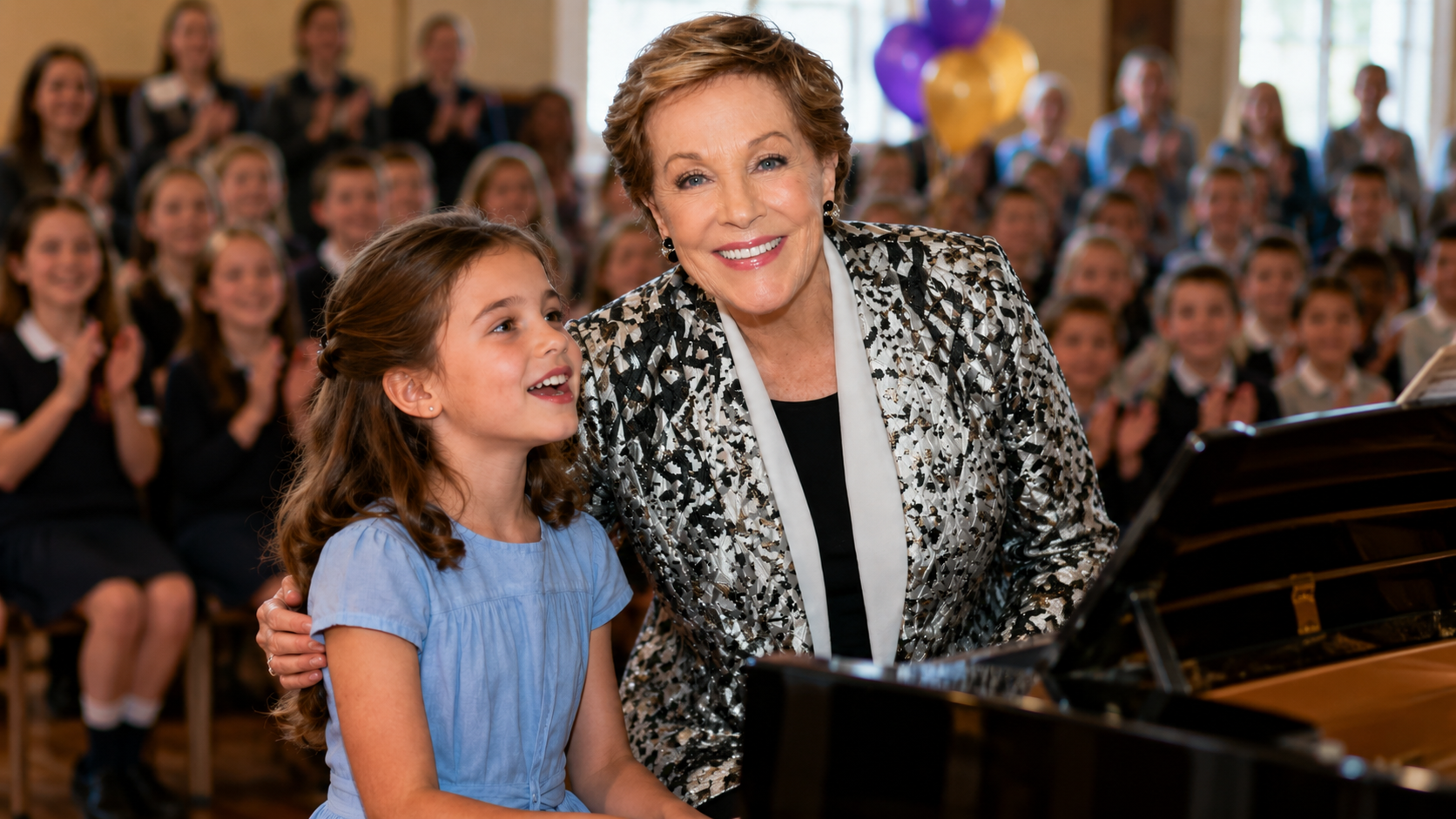
Lily wore a pale blue dress that had belonged to her mother. Daniel had carefully repaired one loose button the night before.
“You look just like her,” he said.
Lily lowered her eyes.
“Do you think she would be proud?”
Daniel knelt in front of her.
“She already was.”
Inside the assembly hall, every seat was taken.
The children waited behind the curtain while Miss Bennett gave last-minute instructions.
Lily stood at the front of the choir. Her hands trembled around the edges of her song sheet.
“I cannot breathe,” she whispered.
Miss Bennett took the paper gently.
“Then do not think about the whole song,” she said. “Think only about the first breath.”
Lily nodded, though fear still filled her face.
On the other side of the building, a dark car stopped beside the private entrance.
Julie Andrews stepped out wearing an elegant cream-colored coat and a soft blue scarf. She carried Lily’s original letter inside a small folder.
Mrs. Harper greeted her with tears already in her eyes.
“I still cannot believe you came.”
Julie smiled.
“A child wrote honestly from her heart. The least I could do was answer honestly with mine.”
They entered through the side door.
From behind the stage, Julie could hear the audience applauding as the headmistress welcomed everyone.
Then came the announcement.
“And now, our Willow Creek Choir will perform a song chosen especially for this anniversary.”
The curtain began to rise.
Lily stared into the crowded hall.
Dozens of faces looked back at her.
Her father sat in the front row.
The piano played the opening notes.
Lily opened her mouth.
Nothing came out.
Miss Bennett watched from the side of the stage, her heart sinking.
The pianist repeated the introduction.
Lily’s eyes filled with panic.
Then, from the shadowed doorway behind the curtain, she heard a calm, familiar voice.
“Begin with one breath, Lily.”
Lily turned slowly.
Standing only a few feet away was the woman whose songs had comforted her through the loneliest nights of her young life.
Julie Andrews smiled and held up the pale yellow letter.
“I received your message,” she said softly. “And I thought I should bring my answer in person.”
Lily stared at her in complete silence.
The choir children covered their mouths in astonishment.
Miss Bennett began to cry.
Julie stepped closer and gently offered Lily her hand.
“Shall we be brave together?”
The hall was still waiting.
The piano began once more.
This time, Lily drew a deep breath.
And with Julie standing beside her, she sang the first note.
Part 2: The Song They Never Forgot
Lily’s first note was soft.
It trembled slightly as it crossed the stage, almost as though it were afraid to travel farther.
But it did.
It reached the front row, where her father sat with both hands clasped tightly together. It reached Miss Bennett, who stood beside the curtain with tears shining in her eyes. It reached every child in the choir waiting behind Lily.
Most importantly, it reached Lily herself.
She heard the note and realized it had not broken.
So she sang the next one.
Julie Andrews remained beside her, not taking over and not drawing attention away. She simply stood close enough for Lily to know she was not alone.
As the melody continued, Lily’s voice grew clearer.
The song spoke of dark roads, small lights, and the quiet courage to keep going. Each line reminded Lily of the evenings when her mother had sung while preparing breakfast, folding laundry, or brushing Lily’s hair before school.
For a moment, Lily no longer saw the crowded hall.
She imagined her mother standing near the old kitchen window, smiling.
Her fear began to loosen.
By the time she reached the final line of the verse, Lily’s voice filled the room.
Then the choir joined her.
Twenty-three children sang together, their voices rising beneath the wooden ceiling of the old school hall. Some parents covered their mouths. Former teachers wiped their eyes. Even the caretaker, who had insisted he never cried, quietly removed his glasses.
When the final note faded, there was a brief silence.
Then the entire hall rose to its feet.
The applause was so powerful that Lily stepped backward in surprise.
Daniel stood in the front row, clapping with tears running freely down his face. Miss Bennett pressed one hand to her heart. The choir children gathered around Lily, laughing and crying at the same time.
Julie leaned toward her.
“You did it,” she said.
Lily shook her head.
“We did it.”
Julie smiled. “You took the first breath. That was the bravest part.”
Mrs. Harper walked onto the stage and tried to speak, but the applause continued. She waited until the room finally grew quiet.
“Today,” she began, “Willow Creek School is celebrating seventy-five years of memories. We expected music, laughter, and perhaps a few tears.”
A gentle ripple of laughter moved through the audience.
“What we did not expect,” she continued, “was a guest who traveled a very long way because one child had the courage to write an honest letter.”
She turned toward Julie.
The audience rose again.
Julie stepped to the center of the stage, still holding Lily’s letter.
“I have received many beautiful letters over the years,” she said. “Some have made me smile. Some have made me think. And some have reminded me why songs matter.”
She looked at Lily.
“This letter did all three.”
Julie opened the folder and read a few lines aloud, including Lily’s memory of her mother burning the toast while singing.
The hall laughed warmly.
Lily smiled through her tears.
Then Julie’s voice became softer.
“Lily wrote that she was afraid to sing her solo. She also wrote that her teacher had told her courage does not mean being unafraid. It means doing something important even while your knees are shaking.”
Julie looked across the room at the children.
“I believe that is true for all of us.”
She spoke about fear, grief, and the small acts of bravery that rarely make headlines. She reminded the students that courage could mean raising a hand in class, sitting beside someone who was lonely, apologizing after making a mistake, or trying again after failure.
“Sometimes,” she said, “the bravest voice in the room is the quietest one.”
Miss Bennett lowered her head as tears fell.
Julie then turned toward Lily.
“Your letter was meant for me, but I believe its message belongs to everyone here.”
She handed the letter back to Lily, now protected inside a clear folder.
“Keep this,” she said. “One day, you may need to remember the girl who was frightened and sang anyway.”
Lily held it carefully against her chest.
The celebration continued outside beneath strings of handmade paper flowers. Julie visited classrooms, studied old school photographs, and listened as former pupils shared memories of Willow Creek.
She never rushed.
She sat with the youngest children while they showed her drawings. She spoke with retired teachers who had worked at the school decades earlier. She laughed when one little boy asked whether famous people still had to tidy their rooms.
“Especially famous people,” she replied.
At lunchtime, Julie sat beside Lily and Daniel at a long wooden table.
For several minutes, Lily was too shy to speak.
Finally, she asked, “Did you really come all this way because of my letter?”
“I did.”
“But you are very busy.”
Julie placed her teacup down.
“People often make time for things that seem urgent,” she said. “We must also make time for things that are meaningful.”
Daniel looked away for a moment, overcome with emotion.
He thanked Julie for coming and explained how much her music had meant to Lily’s mother.
“She would have been standing in the front row today,” he said. “She would have been the loudest person clapping.”
Lily smiled.
“She always clapped too early.”
Daniel laughed.
“Yes, she did.”
Julie reached across the table and gently took Lily’s hand.
“Then perhaps she was early again today.”
Lily’s eyes filled with tears, but this time they did not come only from sadness.
That afternoon, the choir performed once more on the school lawn. This time, Lily did not freeze.
Her hands still shook a little, but she remembered Julie’s words.
One breath.
One note.
One brave step.
When the celebration ended, Julie prepared to leave. Before entering the car, she asked Mrs. Harper and Miss Bennett to join her near the school gate.
“I would like to help with the music room,” she said.
Mrs. Harper looked confused.
Julie explained that she wanted to make a private donation for a new piano, choir materials, and repairs to the classroom. She asked that the gift not be presented as an act of charity, but as support for the school’s future musicians.
“There is too much courage being practiced in that little room,” she said, “for broken keys to stand in the way.”
Several months later, a polished new piano arrived at Willow Creek.
A small silver plate was placed above the keyboard. It did not carry Julie’s name.
Instead, it read:
For Every Voice Waiting to Be Heard.
Lily continued singing.
She still became nervous before performances, but she no longer believed fear was a stop sign. She began helping younger choir members who struggled with confidence. Whenever one of them whispered, “I cannot do it,” Lily would say the words Miss Bennett had once given her.
“You do not need to be fearless. You only need to take the first breath.”
Years passed.
Lily grew from a shy child into a thoughtful young woman. She studied music and later returned to Willow Creek as a teacher.
On her first day in the old music room, she found the clear folder containing her letter inside a wooden box.
The paper had faded slightly, but every word remained.
Lily placed it beside the piano.
Her students often asked about the photograph hanging above her desk. It showed a nine-year-old girl in a pale blue dress standing beside Julie Andrews while an entire school applauded behind them.
Lily never told the story to impress them.
She told it whenever a child felt invisible.
She told it when someone was afraid to perform.
She told it when grief made a young voice go quiet.
And every year, on the anniversary of that unforgettable school celebration, Lily asked her choir to sing “Where Hope Begins.”
Before the first note, she would look at the nervous faces in front of her and say:
“Courage begins with one breath.”
Then the piano would play.
The children would sing.
And the memory of one handwritten letter, one unexpected visit, and one extraordinary act of kindness would fill Willow Creek School all over again.
THE END


