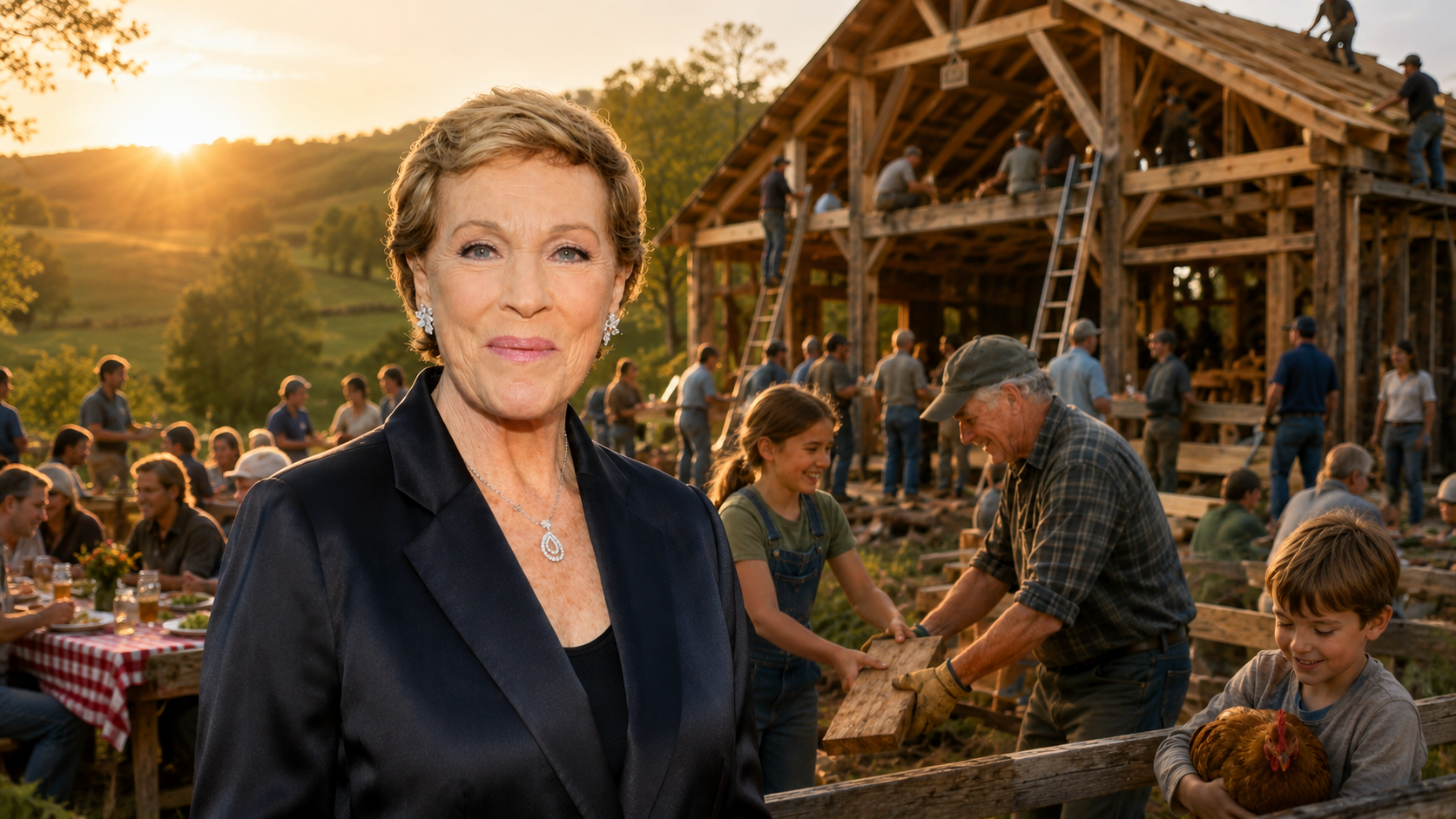
Part 1: The Morning After the Wind
The storm arrived just after midnight.
At first, it sounded like heavy rain tapping against the windows of the Miller family’s farmhouse. Then the wind began to roar across the fields, bending trees and tearing loose pieces of the old barn roof.
Inside the house, Daniel Miller gathered his wife, Emily, and their two children into the hallway.
“Stay close,” he told them, trying to keep his voice calm.
Ten-year-old Sophie held her little brother’s hand. Six-year-old Ben clutched a small wooden horse that their grandfather had carved for him.
The lights flickered once.
Then everything went dark.
For nearly two hours, the family sat together while the storm shook the house. They heard branches snapping, metal crashing, and animals crying outside.
When morning finally came, the silence felt almost frightening.
Daniel opened the front door and stepped onto the porch.
His heart sank.
The storm had destroyed almost everything they had spent years building.
The barn roof had collapsed. Fences were scattered across the fields. Several fruit trees had been pulled from the ground. The chicken coop was gone, and the small greenhouse Emily had built with her own hands was nothing more than broken wood and glass.
Their cows had escaped through a damaged gate.
Rainwater covered the vegetable field.
For a long moment, Daniel said nothing.
The farm had belonged to his family for three generations. His father had worked the land before him, and his grandfather had planted the first apple trees along the eastern fence.
Now much of it was gone in a single night.
Emily came to stand beside him.
“We’ll fix it,” she whispered.
Daniel wanted to believe her, but they had already been struggling.
The farm had suffered through a dry summer. Repairs were expensive, and the family had used most of their savings to keep the business alive.
This storm felt like the final blow.
Behind them, Sophie stepped onto the porch.
“Where will the animals sleep?” she asked.
Daniel looked at the ruined barn.
“I don’t know yet,” he admitted.
The Millers’ farm stood outside a small village called Willowbrook, a quiet place surrounded by green hills and narrow country roads.
Everyone in the village knew the family.
Daniel sold milk and eggs at the Saturday market. Emily baked apple pies for community events. Sophie often helped elderly neighbors carry groceries, while Ben was known for leaving wildflowers on people’s doorsteps.
The Millers did not have much money, but they had always shared what they could.
When the local school needed vegetables for its lunch program, Daniel donated boxes from the farm.
When a widow named Mrs. Harper could no longer care for her garden, Emily visited every Sunday to help her.
And every winter, the family opened their barn for a community Christmas gathering.
Now the family that had helped so many people needed help themselves.
But Daniel was too proud to ask.
By late morning, he and Emily were already clearing broken branches from the yard.
Sophie searched for the missing chickens.
Ben carried small pieces of wood into a pile, though many were almost too heavy for him.
The family worked until their clothes were wet and covered in mud.
Still, the damage seemed endless.
Around noon, an old truck came slowly up the road.
It belonged to Mr. Harris, a retired carpenter who lived two miles away.
He climbed out carrying a toolbox.
“I heard what happened,” he said. “Thought you might need another pair of hands.”
Daniel looked relieved but embarrassed.
“We can’t pay you,” he said.
Mr. Harris frowned.
“Who said anything about paying?”
Before Daniel could answer, another vehicle appeared.
Then another.
Mrs. Harper arrived with sandwiches and hot tea.
The village schoolteacher came with several older students.
Two farmers from nearby properties brought ropes and equipment to search for the missing cows.
By early afternoon, more than twenty people were working across the farm.
Some cleared fallen trees.
Others repaired the fences.
Children collected scattered tools and searched the muddy grass for eggs.
For the first time that day, Daniel felt something other than despair.
He felt hope.
But the barn was still badly damaged, and rebuilding it would require more money and materials than the community could easily provide.
“We can patch part of the roof,” Mr. Harris explained, “but this building isn’t safe. It may need to come down.”
Daniel looked toward the old barn.
His grandfather had built it with local oak nearly seventy years earlier.
Every mark inside told part of the family’s story.
Daniel had learned to milk cows there.
He had proposed to Emily beneath the loft window.
Sophie had taken her first steps across its wooden floor.
Losing it felt like losing a member of the family.
That evening, after the volunteers had gone home, Daniel stood alone beside the ruined structure.
Sophie found him there.
“Are we going to lose the farm?” she asked quietly.
Daniel turned toward her.
He wanted to reassure her, but he could not lie.
“I’m going to do everything I can to stop that from happening.”
Sophie looked at the broken roof.
“Maybe other people will help.”
“People already helped us today.”
“I mean more people,” she said. “People who don’t even know us.”
Daniel gave a tired smile.
“Why would strangers care about our little farm?”
Sophie thought for a moment.
“Because it matters to us.”
Two days later, Sophie sat in her classroom while her teacher, Mrs. Evans, asked the students to write about something they wished they could change.
Some children wrote about protecting animals.
Others wrote about making playgrounds safer or helping homeless families.
Sophie wrote about the farm.
She described the storm, the ruined barn, and her father standing in the rain trying not to cry.
She wrote about how the farm was not only a business.
It was where families came to pick apples.
It was where children learned how food was grown.
It was where lonely neighbors gathered at Christmas.
At the end, Sophie wrote:
“My father says a farm is made of soil, animals, fences, and hard work. But I think a farm is also made of memories. If we lose ours, we will lose a place that belongs to the whole village.”
Mrs. Evans read the page twice.
The next day, she asked Sophie’s permission to share it in the village newsletter.
Sophie agreed.
The story was printed under the title:
A Farm Worth Saving
It soon reached people beyond Willowbrook.
Someone shared it with a local newspaper.
A reporter visited the farm and photographed the collapsed barn.
Then the story was shared online.
Messages began arriving from people across the country.
Some offered small donations.
Others offered tools, timber, animal feed, or building supplies.
One message came from a woman who had visited Willowbrook many years earlier while traveling through the countryside.
She remembered the farm.
She remembered buying apples there.
And she remembered a little girl who had offered her a flower.
That woman was Julie Andrews.
Julie was at home when a friend sent her Sophie’s letter.
She read it slowly.
The simple words touched her deeply.
She understood why places filled with memories mattered.
Throughout her life, she had seen how music, stories, and kindness could bring people together. She also knew that hope often began with one small voice refusing to stay silent.
Julie asked her assistant to contact the family.
At first, Daniel thought the call was a joke.
“Julie Andrews?” he repeated.
Emily covered her mouth in surprise.
Sophie nearly dropped the phone.
Julie spoke warmly to them.
“I read your letter,” she told Sophie. “You reminded many people that saving one small place can sometimes save the heart of an entire community.”
Sophie did not know what to say.
Finally, she whispered, “Do you think the farm can be saved?”
“I think,” Julie replied, “that we should never underestimate what people can do when they choose to care.”
Julie planned to visit Willowbrook quietly.
She did not want a grand celebration.
She simply wanted to see the farm, meet the family, and understand what they needed.
But news of her visit spread.
By the time her car turned onto the country road three days later, the village was waiting.
Children stood near the school holding handmade signs.
Farmers parked tractors along the roadside.
Elderly neighbors waved from garden gates.
Julie stepped from the car wearing a simple blue coat and sturdy boots.
Sophie ran toward her.
Julie knelt and opened her arms.
“Are you the young writer who started all this?” she asked.
Sophie nodded shyly.
“I only wrote what happened.”
“That is often how the most important stories begin,” Julie said.
Daniel and Emily welcomed her near the farmhouse.
Julie listened as they explained the damage.
She walked through the muddy field.
She visited the animals that had been moved into temporary shelters.
Then she stood inside the ruined barn, looking up at the broken beams.
Sunlight shone through the missing roof.
Mr. Harris explained that part of the wood might be saved, but the structure would need major rebuilding.
Julie placed one hand against an old beam.
“There are many years in this wood,” she said.
“Seventy,” Daniel replied. “My grandfather built it.”
Julie turned toward him.
“Then perhaps we should not think only about rebuilding a barn. Perhaps we should think about preserving a story.”
That afternoon, the village gathered in the community hall.
Everyone expected Julie to make a speech.
Instead, she asked Sophie to read her letter aloud.
The girl stood nervously at the front of the room.
Her hands trembled as she held the paper.
Julie sat in the first row and gave her an encouraging smile.
Sophie began to read.
Her voice was soft at first.
But as she continued, it grew stronger.
When she reached the final sentence, the room was silent.
Several people wiped tears from their eyes.
Then Julie stood.
“This child has reminded us of something important,” she said. “A community is not measured by the buildings it owns. It is measured by what people are willing to rebuild together.”
She announced that she would help launch a public campaign to restore the farm.
She would donate the first amount herself, but she made one condition.
“This must not become a story about one person arriving to rescue a village,” she said. “It must become a story about many hands doing what one pair of hands cannot.”
The room erupted in applause.
Daniel lowered his head, overwhelmed.
For the first time since the storm, he truly believed the farm might survive.
But the next morning, Mr. Harris discovered something hidden beneath the damaged barn floor.
It was an old metal box, sealed with rust and buried beneath a loose wooden board.
On its lid were the initials of Daniel’s grandfather.
Inside was a bundle of letters, a faded photograph, and a handwritten plan for a community building that had never been completed.
As Daniel unfolded the final letter, his eyes filled with tears.
His grandfather had dreamed of turning part of the farm into a place where struggling families could learn, work, and begin again.
At the bottom of the page, he had written:
“One day, a storm may take this barn. When it does, do not rebuild it only for us. Rebuild it for everyone.”
Daniel looked across the room at Julie.
Neither of them spoke for several seconds.
Then Julie smiled gently.
“It seems,” she said, “your grandfather has just given us the rest of the plan.”
Part 2: The Barn That Belonged to Everyone
Daniel read his grandfather’s letter again.
Then he read it a third time.
The paper was fragile, and some of the ink had faded, but the final words were still clear:
“One day, a storm may take this barn. When it does, do not rebuild it only for us. Rebuild it for everyone.”
Around the farmhouse table, no one spoke.
Emily held the faded photograph found inside the metal box. It showed Daniel’s grandfather standing beside the barn when it was new. Around him were several families, including children in worn coats and farmers holding tools.
On the back, someone had written:
The day Willowbrook built together.
Mr. Harris unfolded the old building plans.
“This wasn’t meant to be an ordinary barn,” he said.
The drawings showed a large open room, a teaching kitchen, storage areas, and a smaller workshop. Daniel’s grandfather had planned to create a place where struggling families could learn practical skills, share meals, and receive help during difficult seasons.
But the project had never been completed.
Daniel looked toward the ruined barn through the kitchen window.
“My grandfather never told us about this.”
“Perhaps he was waiting for the right moment,” Emily said.
Julie Andrews sat beside Sophie.
“Or perhaps,” she added gently, “he knew the dream would belong to the next generation.”
Sophie studied the plans.
“Can we build it now?”
Daniel hesitated.
Restoring the farm was already a huge challenge. Building something larger seemed impossible.
But Julie leaned closer to the table.
“We do not need to finish everything at once,” she said. “Hope rarely arrives as a completed building. It usually begins with one person deciding to place the first stone.”
Mr. Harris nodded.
“We can save some of the original beams. We can reuse the good timber. With enough help, we can make this happen.”
Daniel looked around the table.
He saw exhaustion.
He saw uncertainty.
But he also saw something that had been missing since the storm.
Purpose.
“All right,” he said. “We rebuild it for everyone.”
The campaign began the next morning.
The village named it The Willowbrook Hope Barn Project.
Sophie’s original letter was shared again, this time beside her great-grandfather’s building plans.
Donations arrived from places the Millers had never heard of.
A sawmill offered timber.
A roofing company donated materials.
A family-owned hardware store sent tools.
A retired electrician volunteered his time.
A group of university students offered to spend their holiday helping with construction.
Some people could not give money, so they sent handwritten letters.
One envelope contained five dollars and a note from an elderly woman:
“I grew up on a farm that was lost after a flood. Please use this to save one memory for another family.”
Another came from a classroom of children who had collected coins in a jar.
Their note read:
“For Sophie, because she was brave enough to tell the truth.”
Daniel kept every letter.
Julie used her public voice carefully. She spoke about the farm during an interview, but she made sure the focus stayed on the community.
“This is not a story about a famous visitor,” she said. “It is about ordinary people discovering that their kindness is not ordinary at all.”
Her words traveled far.
Soon, volunteers were arriving in Willowbrook every weekend.
The village roads filled with trucks carrying supplies.
The community hall became a kitchen where volunteers prepared soup, bread, and tea.
Children painted signs.
Elderly residents sorted nails and screws into boxes.
Farmers repaired damaged fields while builders worked on the barn.
Even people who had once disagreed over fences, land, or village decisions stood beside one another with hammers in their hands.
The storm had broken roofs and trees.
But somehow, it had also broken down old walls between neighbors.
Julie returned often during the rebuilding.
She did not arrive with photographers or reporters.
She wore work gloves, carried water to volunteers, and sat with children during lunch breaks.
One afternoon, Sophie found her brushing dust from an old wooden beam.
“Do you think people will remember this?” Sophie asked.
Julie smiled.
“They may not remember every person who carried every board. But they will remember how the place made them feel.”
Sophie looked around at the volunteers.
“I was scared when I wrote my letter.”
“Courage does not mean you were not scared,” Julie said. “It means you spoke while your hands were still trembling.”
Sophie thought about that.
Then she picked up a small paintbrush and continued working.
The rebuilding was not easy.
Two weeks into the project, heavy rain delayed construction.
Then the cost of repairing the farmhouse roof rose unexpectedly.
A truck carrying donated timber broke down several miles away.
For a moment, Daniel feared the project was becoming too large.
Late one evening, he sat alone beside the foundation of the new barn.
Julie found him there.
“I should have focused only on saving the farm,” he admitted. “Maybe this dream is too big.”
Julie sat beside him on an overturned bucket.
“Large dreams often look foolish in the middle,” she said.
Daniel gave a tired laugh.
“That sounds like something from a story.”
“Stories are full of unfinished middles,” she replied. “That is where people are most tempted to give up.”
Daniel looked toward the half-built walls.
“What if I disappoint everyone?”
“You are not carrying this alone,” Julie said. “That is the lesson your grandfather left you.”
The next morning, Daniel returned to work before sunrise.
When he reached the barn, he found dozens of people already waiting.
Mr. Harris held a hammer.
Mrs. Harper carried a basket of breakfast rolls.
The schoolchildren wore muddy boots and bright smiles.
At the front stood Emily, Sophie, and Ben.
Emily took Daniel’s hand.
“You heard Julie,” she said. “You are not carrying this alone.”
As the weeks passed, the shape of the new building became clear.
The builders reused several beams from the original barn.
One beam still carried the carved initials of Daniel’s grandfather.
It was placed above the main doorway.
The large central room would host community meals, school events, and winter gatherings.
A side room became a workshop where people could learn carpentry and repair skills.
Another was turned into a teaching kitchen.
There would also be shelves for donated food, warm clothing, and emergency supplies.
Emily suggested creating a small garden classroom for children.
Daniel added a tool-sharing area for local farmers.
Sophie asked for a quiet reading corner.
Ben wanted a place for rescued animals.
Everyone laughed, but a small animal shelter was added near the back.
The Hope Barn was becoming more than a rebuilding project.
It was becoming a promise.
Three months after the storm, the work was finally complete.
The morning of the opening ceremony was clear and bright.
Fresh grass had begun to grow where the floodwater had once stood.
The repaired fences stretched across the fields.
New apple trees had been planted beside the old ones.
The barn stood strong against the blue sky.
Its shape was new, but its heart remained old.
Above the entrance, a wooden sign read:
THE WILLOWBROOK HOPE BARN
Below it, in smaller letters:
Built by many hands. Open to every heart.
Hundreds of people gathered for the ceremony.
Some had traveled for hours.
Others had helped from far away and came to see what their support had created.
Tables were filled with bread, soup, pies, and fresh fruit.
Children ran between the trees.
Music played near the barn doors.
Daniel stood beside Emily and their children.
He looked across the farm and remembered the morning after the storm.
Back then, he had seen only loss.
Now he saw neighbors.
Friends.
Strangers who no longer felt like strangers.
Julie arrived without ceremony.
Sophie met her near the gate and handed her a small bouquet of wildflowers.
“These are from the field,” she said.
Julie accepted them with a warm smile.
“The same field that looked ruined?”
Sophie nodded.
“It grew back.”
Julie looked toward the new barn.
“Yes,” she said softly. “Many things do.”
During the opening ceremony, Daniel stepped onto a small platform.
He unfolded his grandfather’s letter.
His voice shook as he read the final lines aloud.
When he finished, he looked at the crowd.
“This barn carries my family’s name,” he said. “But it no longer belongs only to my family. It belongs to every person who helped build it, and to every person who will walk through its doors needing hope.”
Then he turned to Julie.
“You reminded us not to rebuild only what the storm destroyed. You reminded us to build what had always been missing.”
Julie joined him on the platform.
She looked at Sophie.
“I believe the first thanks belongs to a young girl who wrote what was in her heart.”
The crowd applauded.
Sophie’s face turned red.
She slowly stepped forward.
Julie handed her the ribbon-cutting scissors.
“You began this story,” Julie said. “You should open its next chapter.”
Sophie cut the ribbon.
The barn doors opened.
Inside, sunlight fell across the restored beams.
On one wall hung the old photograph of Daniel’s grandfather.
Beside it was Sophie’s letter.
And beneath both was a simple message:
Hope grows when it is shared.
The Hope Barn soon became the heart of Willowbrook.
Families gathered there for meals.
Children learned how to plant vegetables and care for animals.
Unemployed workers attended free repair and carpentry classes.
Farmers borrowed tools during difficult seasons.
When another village suffered flooding the following year, Willowbrook filled the barn with donated supplies and sent help immediately.
The kindness continued to travel.
One generous act became another.
One rescued farm helped rescue others.
And Sophie kept writing.
She wrote about the volunteers.
She wrote about the old beams.
She wrote about the flowers that returned after the storm.
Years later, her first published book would tell the story of the Hope Barn.
On the opening page, she wrote:
“When I was ten years old, I thought hope meant waiting for someone to save us. Then a storm taught me the truth. Hope is what happens when people stand beside one another and begin rebuilding.”
She sent the first copy to Julie.
Inside, Sophie added a handwritten note:
“Thank you for teaching me that a small voice can call a whole community home.”
Julie kept the book beside the wildflower Sophie had once given her, now carefully pressed between two pages.
Whenever someone asked why the story of one small farm had touched so many people, Julie always gave the same answer.
“Because all of us face storms,” she said. “And all of us hope that when the morning comes, someone will still be standing beside us.”
The storm had taken the old barn.
But in its place, the people of Willowbrook built something stronger.
They built shelter.
They built friendship.
They built a place where no one had to face hardship alone.
Most of all, they built a living reminder that even after the darkest night, hope can rise from the broken ground—especially when many hands lift it together.
The End


