Part 1: The Music He Could Not Sing
The rain had been falling all morning when Julie Andrews arrived at a small community theater in the English countryside.
She had been invited to visit a youth music program that gave free lessons to children who could not afford them. The building was old, the seats were worn, and the piano in the rehearsal room had several chipped keys.
But the moment Julie stepped inside, she felt warmth.
Children were singing in the hallway. Volunteers carried costumes between rooms. A music teacher stood near the stage, gently helping a nervous girl remember her lines.
Julie smiled.
“This place has a great deal of heart,” she said.
The program director, Mrs. Evelyn Clarke, welcomed her with a grateful hug.
“We do what we can,” Evelyn said. “Some of these children have been through very difficult things. Music gives them somewhere safe to place their feelings.”
Julie understood.
Music had always been more than entertainment to her. It could hold joy, grief, courage, and memory—all within a few simple notes.
As Evelyn led her through the theater, Julie noticed a boy sitting alone in the last row.
He looked about twelve years old. His brown hair fell across his forehead, and a battered notebook rested on his knees.
While the other children rehearsed, he quietly wrote.
“Who is that?” Julie asked.
Evelyn’s expression softened.
“His name is Daniel Harper. He joined us six months ago, but he has never performed.”
“Does he play an instrument?”
“Piano. Beautifully. He also writes songs.”
Julie glanced toward the boy.
“Why does he not perform?”
Evelyn hesitated.
“Daniel lost his mother last year. She was the only person he ever played for.”
Julie looked again.
Daniel had stopped writing. He was staring at the empty stage as though he could see someone standing there.
Later that afternoon, Julie found him in a small practice room.
He sat at the piano, pressing the keys so softly that the sound was barely louder than the rain against the window.
Julie did not interrupt.
She stood by the door and listened.
The melody was simple, but it carried a deep sadness. It rose gently, almost hopefully, then fell into silence before it could fully resolve.
Daniel noticed her and immediately closed the piano lid.
“I’m sorry,” he said.
“There is nothing to apologize for,” Julie replied. “That was lovely.”
“It wasn’t finished.”
“Sometimes unfinished music can still say something important.”
Daniel looked down at his notebook.
Julie sat in the chair beside the piano.
“Did you write it?”
He nodded.
“What is it called?”
He hesitated before answering.
“Where the Light Goes.”
Julie waited.
After a long silence, Daniel opened his notebook. The pages were filled with handwritten lyrics, crossed-out words, and small musical notes.
“I started writing songs when my mother got sick,” he said. “She couldn’t sleep at night, so I played for her.”
Julie listened quietly.
“She said my music made the room feel less frightening,” Daniel continued. “After she died, I kept writing. But I can’t sing the songs. It feels wrong.”
“Why does it feel wrong?”
“Because she is not here to hear them.”
Julie’s eyes filled with compassion.
“Perhaps part of her still can.”
Daniel frowned.
“I don’t mean in a way that anyone can prove,” Julie said gently. “But love does not disappear simply because someone is no longer beside us. It changes shape. Sometimes it becomes memory. Sometimes it becomes courage. And sometimes it becomes a song.”
Daniel stared at the notebook.
“My father won’t listen to them,” he whispered.
Julie paused.
“Has he told you why?”
“He leaves the room whenever I play. I think the songs make him angry.”
That evening, Julie spoke with Daniel’s father.
Thomas Harper was a quiet man with tired eyes and hands roughened by years of carpentry work. He had come to collect Daniel after rehearsal.
When Julie mentioned the songs, Thomas lowered his head.
“I know I should listen,” he said. “But every melody sounds like her. I hear my wife in every note, and it takes me back to the hospital. I don’t know how to bear it.”
“Daniel believes you are angry with him,” Julie said.
Thomas looked shocked.
“Never.”
“He does not know that.”
Thomas sat heavily in one of the theater seats.
“I’ve been so busy trying not to fall apart that I didn’t notice he was carrying everything alone.”
Julie sat beside him.
“Grief can make people close doors they do not mean to close.”
Thomas wiped his eyes.
“What should I do?”
“Listen,” Julie said. “Not when you feel completely ready. You may never feel ready. Listen because your son needs to know that his love for his mother is not something he must hide.”
The next day, the theater prepared for its annual community concert.
Every seat had been sold. The event would raise enough money to keep the youth program open for another year.
But hours before the performance, the lead singer became ill.
Evelyn hurried backstage in a panic.
Without that final song, the concert would end twenty minutes early. Worse, the missing performance had been the centerpiece of the evening.
The children gathered in worried silence.
Julie looked toward Daniel.
He stood near the curtain, clutching his notebook.
“What about your song?” she asked softly.
Daniel’s face turned pale.
“I can’t.”
“You do not have to,” Julie said. “But perhaps tonight the song could help more people than you realize.”
Daniel shook his head.
“I’ve never sung in front of anyone.”
“You would not be alone.”
He looked at her.
Julie smiled.
“I could stand beside you.”
Daniel looked toward the audience.
Then he saw his father enter and take a seat near the back.
For several long seconds, the boy did not move.
Finally, he opened his notebook.
“I want to sing ‘Where the Light Goes,’” he whispered.
Evelyn placed a hand over her heart.
“Are you certain?”
Daniel’s hands trembled.
“No,” he admitted. “But I want to try.”
As the final performance approached, Julie waited with him beside the stage.
“You do not need to sing perfectly,” she told him. “You only need to sing honestly.”
Daniel nodded.
Then the curtain opened.
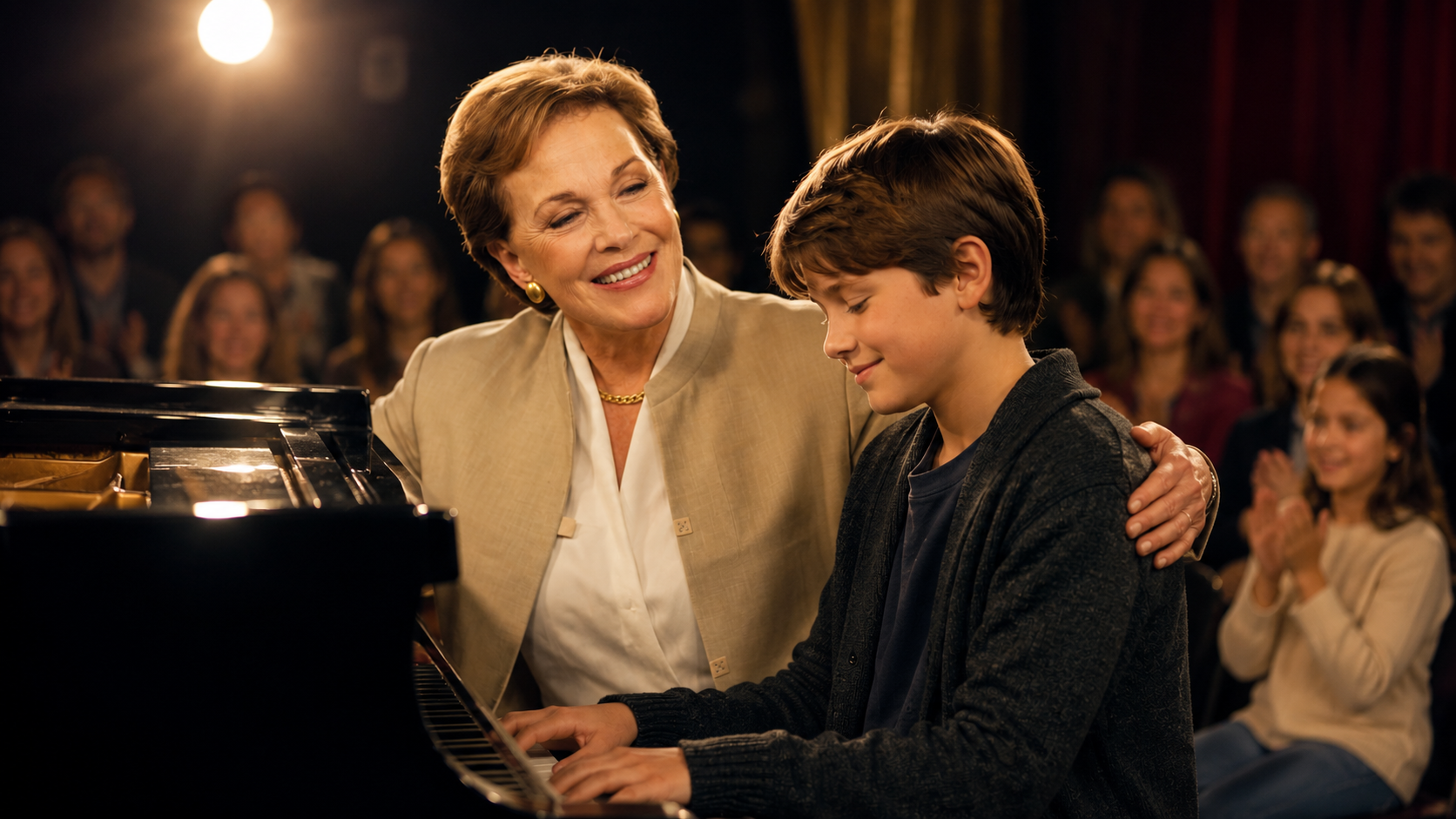
A single spotlight shone on the old piano.
The audience grew silent as Daniel walked onto the stage.
Julie followed and stood beside him.
In the last row, Thomas Harper leaned forward.
Daniel sat at the piano and placed his fingers over the keys.
But before he played the first note, he looked toward his father.
“This song is for my mother,” he said, his voice shaking. “And for anyone who misses someone they still love.”
Then he began to play.
Part 2: Where the Light Goes
The first notes were quiet and uncertain.
Daniel’s fingers trembled over the piano keys, but Julie remained beside him, calm and reassuring.
She did not take over.
She simply gave him the courage to continue.
The melody slowly filled the theater.
Daniel began to sing.
His voice was not powerful, but it was clear and sincere.
He sang about a kitchen light left glowing after midnight. He sang about a mother humming while she folded clothes. He sang about warm hands, bedtime stories, and the fear of forgetting the sound of someone’s laughter.
The audience sat completely still.
Daniel’s father covered his mouth with one hand.
Then the song reached the verse Daniel had never been able to finish.
His voice cracked.
He stopped playing.
For one painful moment, the theater fell silent.
Daniel stared down at the keys.
“I’m sorry,” he whispered.
Julie leaned closer.
“She would be proud of you,” she said.
Daniel closed his eyes.
Then he looked toward his father.
Thomas was crying openly now.
But he did not leave.
Instead, he stood.
“Keep going, son,” he called from the back of the theater. “Please.”
Daniel’s face crumpled.
For months, he had believed his music caused his father pain.
Now, for the first time, he understood that the pain came from love.
He placed his hands back on the piano.
This time, he played with greater strength.
Julie joined him softly on the final chorus.
Their voices blended as the song changed from grief into hope.
Daniel sang that perhaps light did not vanish when a person left the world. Perhaps it moved into the lives they had touched. Perhaps it remained in every kindness, every memory, and every song shared in their name.
When the final note faded, nobody moved.
Then Thomas began to clap.
One by one, the entire audience rose.
The applause grew until it filled every corner of the old theater.
Daniel stood beside the piano, overwhelmed.
Julie placed an arm around his shoulders.
“You gave them something beautiful,” she said.
Daniel looked toward his father.
Thomas hurried down the aisle and climbed onto the stage.
He wrapped his son in his arms.
“I am so sorry,” Thomas whispered. “I should have listened sooner.”
Daniel held him tightly.
“I thought you hated the songs.”
“I hated how much I missed her,” Thomas said. “But I could never hate anything you created for her.”
The audience watched quietly as father and son cried together.
It was not a perfect ending to their grief.
Grief rarely ended in a single moment.
But something had opened between them.
A door that had been closed for too long was finally unlocked.
After the concert, people gathered in the lobby.
Several audience members told Daniel that his song reminded them of someone they had lost.
An elderly woman said it made her think of her husband.
A young nurse said she planned to play the melody for patients who felt afraid at night.
A little girl handed Daniel a folded piece of paper.
“My brother died when I was six,” she said. “I thought I was the only person who still talked to someone who wasn’t here.”
Daniel knelt beside her.
“You’re not the only one,” he said.
The concert raised more money than expected. Enough donations came in to repair the theater roof, tune the piano, and provide music lessons for another year.
But something even more meaningful happened.
A recording of Daniel’s performance was shared with local schools and hospitals. Soon, people began sending letters to the theater.
They wrote about mothers, fathers, children, friends, and partners they had lost.
They wrote about the songs that helped them remember.
Daniel read every letter.
For the first time since his mother’s death, he no longer felt alone.
Julie stayed in touch with him after that evening.
She encouraged him to keep writing, not because every song needed an audience, but because every honest feeling deserved a place to live.
Months later, Daniel completed a small collection of songs called Where the Light Goes.
The youth music program performed them at a special concert dedicated to families experiencing grief.
Thomas sat in the front row.
This time, he did not look away.
He listened to every word.
At the end of the performance, Daniel placed a framed photograph of his mother on the piano.
In the picture, she was smiling beside him while he sat at the keys.
Julie stood at the edge of the stage and watched the boy bow.
He was still grieving.
But he was no longer hiding.
Afterward, Daniel found Julie in the quiet hallway behind the theater.
“Do you think my mother heard the song?” he asked.
Julie considered the question.
“I think love listens in ways we may never fully understand,” she said.
Daniel smiled.
“My father says she would have asked me to play it again because she always wanted an encore.”
Julie laughed softly.
“That sounds like a mother who knew a good song when she heard one.”
Years later, Daniel became a music teacher.
He worked with children who had experienced loss, fear, and loneliness.
Whenever a student was too nervous to perform, he told them about the night he almost walked away from the piano.
He never claimed that music could erase sorrow.
Instead, he taught that music could carry sorrow until the heart became strong enough to carry it too.
Above the piano in his classroom hung one sentence:
Love does not disappear. Sometimes, it becomes a song.
And every year, on his mother’s birthday, Daniel performed “Where the Light Goes.”
His father always sat in the front row.
And somewhere in the room, surrounded by music, memory, and hope, the light of the woman they loved continued to shine.
THE END


