Part 1
The first snow of December settled softly over the tiny village of Ashbrook, covering rooftops, fences, and narrow lanes in white. Christmas lights twinkled in a few windows, but they seemed dimmer than they had in years past. Something precious had quietly disappeared from the village—not the decorations, not the holiday traditions, but hope itself.
For generations, Ashbrook had welcomed Christmas with a concert in its centuries-old stone chapel. The village choir filled the sanctuary with joyful songs that brought neighbors together regardless of age or circumstance.
But this year was different.
Many longtime choir members had grown too frail to sing. Younger families had moved away in search of work. Donations had nearly vanished, leaving the chapel roof leaking and the old piano badly out of tune.
Only eleven singers remained.
Their choir director, Margaret Ellis, had devoted thirty-five years to the village choir. Though her smile never faded, she knew this might be their final Christmas performance.
One rainy evening after rehearsal, Margaret quietly folded the music sheets and whispered to herself.
“Perhaps it’s time to let this tradition rest.”
She didn’t realize twelve-year-old Emma Collins was standing just outside the chapel door.
Emma had joined the choir after losing her father the previous winter. Singing had become the one place where she felt close to him again. Hearing Margaret’s words broke her heart.
“No,” Emma whispered. “Christmas can’t end like this.”
The next morning, Emma gathered every remaining choir member in the chapel.
“What if we invite someone special?” she asked.
The adults exchanged uncertain glances.
“Who would come all the way to our little village?”
Emma reached into her backpack and carefully unfolded an old magazine featuring Julie Andrews.
“My father loved her songs,” Emma said softly. “He said her voice made people believe that kindness could still change the world.”
The room fell silent.
Margaret smiled kindly.
“Oh, Emma… someone like Julie Andrews must receive thousands of letters.”
“But maybe she’ll read one more.”
The choir members spent the afternoon writing.
Instead of asking for fame or publicity, they simply shared their story.
They wrote about lonely widowers who only left home for choir practice.
About children learning songs their grandparents once sang.
About neighbors bringing homemade soup to elderly singers during winter.
About a village trying very hard not to lose its heart.
Emma added only one sentence at the end.
“If you cannot come, we understand. But thank you for helping my father smile through your music.”
The letter was mailed.
Days passed.
Then weeks.
Snow grew deeper.
No reply arrived.
Despite the disappointment, Margaret insisted rehearsals continue.
“If this truly is our last Christmas,” she said gently, “let us make every note count.”
The singers practiced beneath buckets catching rainwater dripping from the chapel ceiling.
Their worn piano missed half its notes.
Some evenings only six people managed to attend because icy roads kept others home.
Still, they sang.
One afternoon, an elderly man named Thomas quietly confessed to Margaret that he might stop coming.
“My hearing isn’t what it used to be,” he said sadly.
Margaret squeezed his hand.
“You don’t sing because your ears are perfect.”
“You sing because your heart remembers.”
He smiled through tears.
Elsewhere, Emma continued checking the village mailbox every afternoon.
Nothing.
Christmas Eve was only four days away.
Finally, she accepted that no answer would come.
“It’s alright,” she whispered to herself.
“We’ll still sing.”
On the morning before the final rehearsal, heavy snow began falling.
Margaret unlocked the chapel expecting another quiet practice.
Instead, she found someone standing near the old piano.
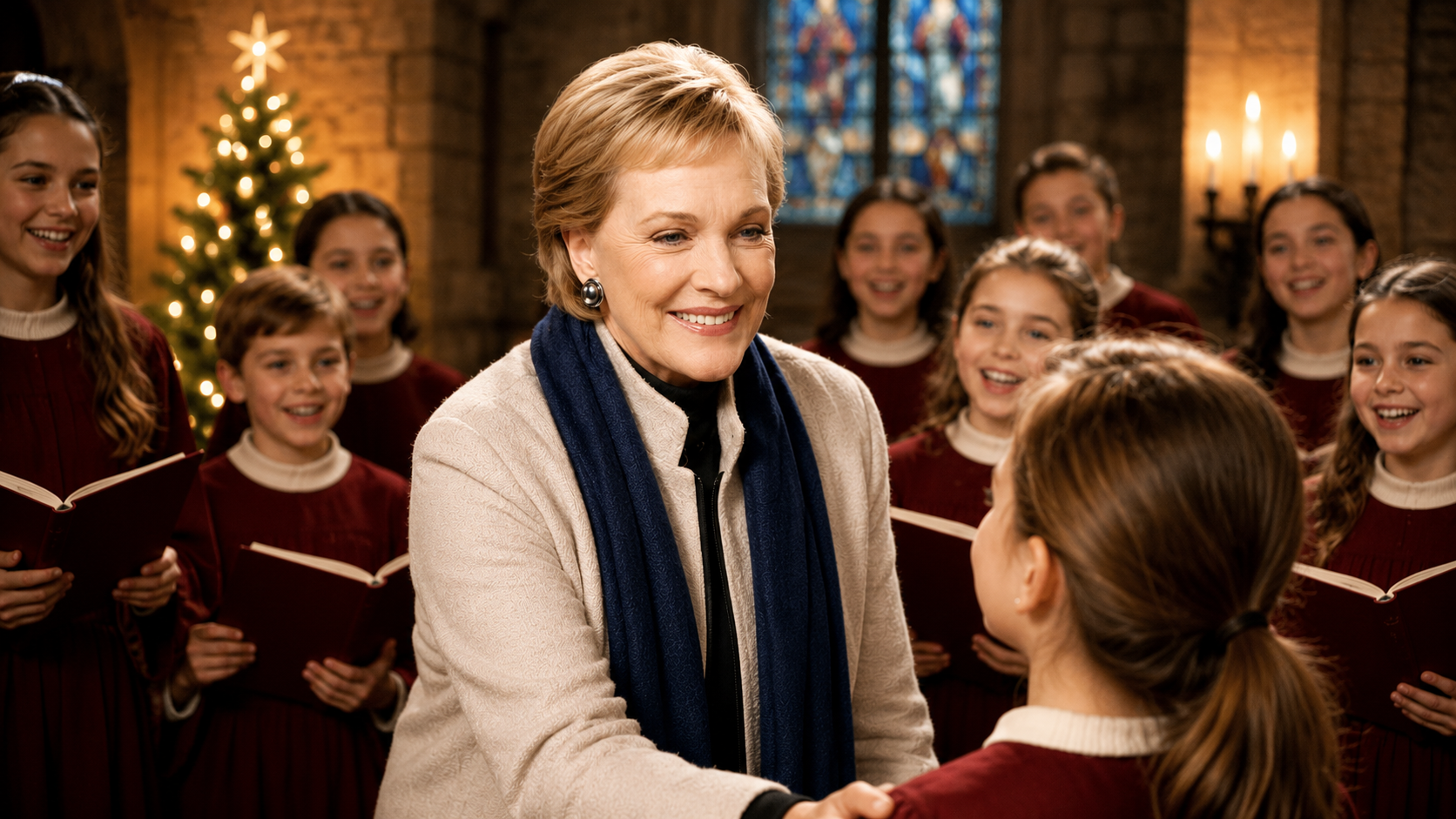
Wrapped in a long winter coat and blue scarf was a graceful woman with silver hair and kind eyes.
Julie Andrews.
For several seconds, no one spoke.
Emma dropped the stack of music books she had been carrying.
Margaret covered her mouth in disbelief.
Julie smiled warmly.
“I hope I’m not too late to join your rehearsal.”
Tears appeared almost instantly throughout the chapel.
Emma slowly walked forward.
“You… you came.”
Julie knelt gently beside her.
“I read every word of your letter.”
“And I couldn’t imagine spending Christmas anywhere else.”
The choir members surrounded her, unable to believe what they were seeing.
Julie looked around at the cracked walls, the worn wooden pews, and the aging piano.
“What a beautiful place,” she whispered.
Margaret apologized.
“I’m afraid our chapel isn’t what it once was.”
Julie smiled.
“Neither are many of us.”
“But hearts like yours never grow old.”
She asked for the choir’s music.
Without ceremony or photographers, she stood among them—not in front of them.
“As one voice,” she said.
The pianist struck the first uncertain notes.
Julie listened quietly.
Then, with gentle confidence, she began to sing.
One simple melody floated through the chapel.
It wasn’t loud.
It wasn’t complicated.
But somehow, every frightened heart inside the room remembered what hope sounded like.
None of them noticed the chapel door quietly opening.
Or the first villagers gathering outside to listen.
Part 2 – One Simple Melody Rekindled Faith in Hearts That Had Almost Given Up
The first notes drifted through the cold winter air like tiny sparks of light.
Villagers walking home paused in the snow.
A baker carrying fresh bread stopped outside the chapel.
Children building snowmen fell silent.
Even old Mr. Harris, who had not entered the church since losing his wife five years earlier, found himself standing near the doorway, listening with tears in his eyes.
Inside, Julie Andrews sang gently beside the village choir, never trying to outshine them. Instead, she encouraged each voice to grow stronger, smiling whenever someone gained confidence.
“You already have everything this song needs,” she said when the melody ended.
“You have love for one another.”
The choir members smiled through tears.
For the first time in years, they believed their little choir still mattered.
Word spread quickly throughout Ashbrook.
By evening, neighbors began arriving at the chapel carrying candles, blankets, and homemade treats.
The carpenter offered to repair the broken pews.
The village roofer quietly inspected the leaking ceiling and promised to fix it after Christmas.
A local music teacher donated sheet music.
Someone arranged for the old piano to be restored.
Without anyone asking, the entire community began rebuilding the place that had quietly held so many of their memories.
On Christmas Eve, every seat inside the chapel was filled. When no space remained, families stood along the walls, while others gathered outside beneath softly falling snow. Warm lanterns lined the pathway, casting a golden glow across the white ground.
Julie insisted that Margaret conduct the performance.
“This choir belongs to you,” she said with a smile. “I’m simply grateful to sing beside you.”
As the concert began, the voices were stronger than they had been in years. Young children sang beside elderly neighbors. Parents who had not spoken for months exchanged warm greetings. Friends embraced, and strangers smiled as though they had known one another forever.
Then came the final song.
Julie stepped back.
She nodded toward Emma.
“I think this melody belongs to you.”
Emma’s heart raced. She glanced at Margaret, who gave her an encouraging smile.
Taking a deep breath, Emma sang the opening line alone.
Her clear, gentle voice filled the chapel.
One by one, the choir joined her.
Then the audience quietly added their voices.
Soon every person inside—and many standing outside—was singing together.
No one cared who sang perfectly.
What mattered was that everyone sang.
When the last note faded, the chapel remained silent for several beautiful moments.
Not because the concert had ended.
Because no one wanted the feeling to disappear.
At last, applause echoed through the old stone walls, followed by laughter and joyful tears.
Mr. Harris walked to the front of the chapel carrying a small envelope.
“I’ve spent years saving money for no particular reason,” he said softly. “Now I know why.”
He placed it into Margaret’s hands.
Others followed.
Some gave money.
Some offered time.
Some promised materials or volunteer work.
By New Year’s Day, enough support had been gathered to restore the chapel completely.
The choir was no longer disappearing.
It was growing.
Before leaving the village, Julie thanked every volunteer personally.
When Emma asked why she had traveled so far for people she had never met, Julie smiled warmly.
“I came because your letter reminded me that music isn’t measured by famous stages or large audiences.”
She looked around at the joyful faces filling the chapel.
“It’s measured by the hope it awakens in ordinary hearts.”
Years later, visitors to Ashbrook often admired the beautifully restored chapel and its Christmas concerts, now attended by families from neighboring towns.
Near the entrance stood a small wooden plaque, carved by the village carpenter.
It read:
“One Christmas, a simple melody reminded us that faith grows strongest when shared. May every voice that enters here leave with hope.”
Emma eventually became the choir’s director, just as Margaret had once been.
Each Christmas Eve, before the first song began, she shared the same gentle reminder with every new singer.
“You never know whose heart is waiting to hear your voice.”
And somewhere in every note, every smile, and every act of kindness, the spirit of that unforgettable Christmas continued to live on—proving that even the simplest melody can rekindle faith in hearts that had almost given up.
The End.


