Part 1: The Girl Who Stopped Singing
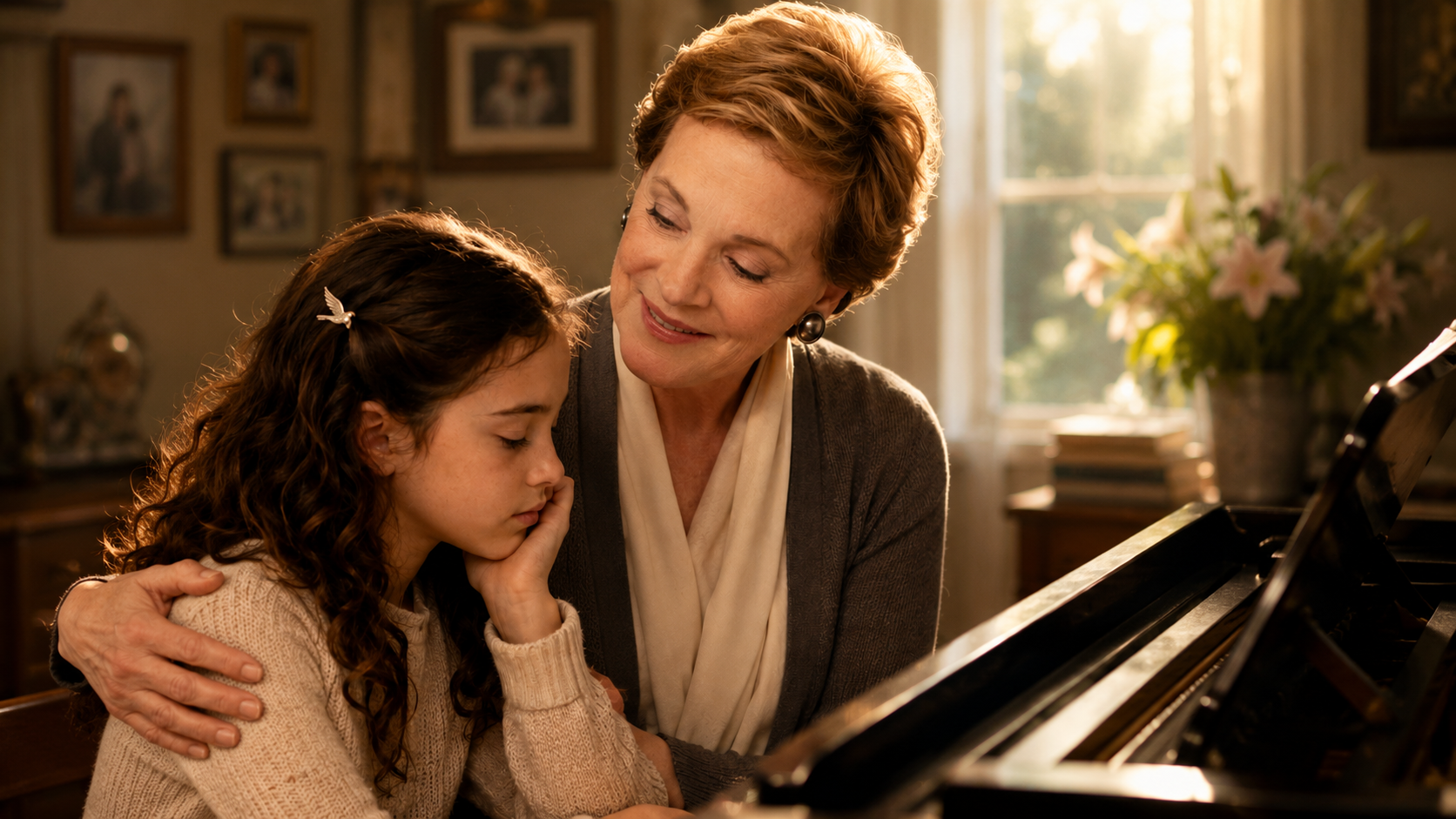
The rain had been falling over Willowmere for three straight days when Julie Andrews arrived at the small town library.
She had agreed to read stories at a children’s charity event, but the storm had kept many families at home. Only a handful of children sat inside the warm reading room, wrapped in coats and holding paper cups of hot chocolate.
Near the back sat a girl named Clara Bennett.
She was eleven years old, with dark curls, watchful brown eyes, and a small silver bird pinned to her sweater.
Unlike the other children, Clara did not whisper, laugh, or answer questions.
She simply watched.
Julie noticed her almost immediately.
When the reading ended, the children gathered around for photographs and autographs. Clara remained in her chair until her mother gently encouraged her forward.
“This is Clara,” her mother said. “She used to sing all the time.”
Clara looked down.
Her mother’s smile trembled.
“Last year, her father died suddenly. Since then, she hasn’t been able to sing. Some days, she can barely speak.”
Clara’s fingers tightened around the silver bird.
Julie did not ask the girl to talk. She did not tell her to be brave or promise that everything would soon be fine.
Instead, she sat beside her.
For a while, they listened to the rain tapping against the windows.
Julie noticed that Clara was holding a worn music notebook.
“May I see it?” she asked softly.
Clara hesitated, then handed it over.
Inside were songs written in a child’s careful handwriting. Some had titles. Others were only unfinished lines.
On the first page was a drawing of Clara standing beside her father beneath a large oak tree.
Underneath, she had written:
Our song belongs to the sky.
Julie looked at her.
“Did your father sing with you?”
Clara nodded.
Her eyes filled with tears.
Her father, Daniel, had been the music teacher at Willowmere Primary School. He had taught Clara to sing before she could read. Every evening, they stood beside the piano in their living room and practiced together.
But after his death, music had become too painful.
Whenever Clara tried to sing, her throat closed. Her breath shook. No sound came.
Children at school began asking questions.
Some tried to help.
Others whispered that Clara had lost her talent.
Eventually, she stopped speaking in class.
Julie closed the notebook carefully.
“You haven’t lost your voice,” she said. “It may simply be resting while your heart learns how to carry something heavy.”
Clara looked up for the first time.
Julie continued, “A voice is more than sound. It is truth, kindness, memory, and courage. Sometimes we find it in words. Sometimes in music. Sometimes in silence.”
Clara’s eyes remained fixed on hers.
Julie reached into her handbag and found a small cream-colored card.
She wrote a message and placed it inside the notebook.
“Keep writing,” she said. “You do not have to sing today. But please don’t stop listening for the song inside you.”
Clara did not answer.
But before leaving, she gave Julie the smallest nod.
That evening, Clara opened the card beneath the lamp in her bedroom.
It read:
Dear Clara,
Your voice is still yours.
Give it time. Give it kindness.
And when it returns, let it carry love instead of fear.
—Julie
Clara kept the card beside her bed.
Weeks passed.
She still could not sing, but she began writing again.
She wrote about the rain.
She wrote about her mother making soup on lonely evenings.
She wrote about the empty chair beside the piano.
She wrote about the oak tree where her father used to lift her onto his shoulders.
Then one afternoon, while alone in her room, Clara whispered a single note.
It was weak and shaky.
She immediately covered her mouth.
But the note had been real.
The next day, she tried again.
Some days, nothing came.
Other days, she could hum for a few seconds before grief tightened her throat.
Her mother never pushed her.
She simply sat nearby and listened.
Over the following years, Clara slowly found pieces of her voice.
She joined the school choir but stood in the back row.
She sang quietly enough that no one could hear her.
At sixteen, she performed one line during a school concert. Her knees shook so badly that she had to hold the piano for support.
But she finished the line.
Afterward, she went backstage and cried—not from sadness, but relief.
She had not failed.
She had stayed.
Clara later studied music therapy, hoping to help children who carried pain they could not explain.
She worked with shy students, grieving families, and patients recovering from illness.
She often told them, “You do not have to make a beautiful sound. You only have to make an honest one.”
Yet there was still one thing Clara had never done.
She had never sung her father’s unfinished song.
The song was called “Where the Light Begins.”
Daniel Bennett had written the first verse before he died. Clara had spent years finishing it, but every time she tried to perform it, her voice disappeared.
Then, almost fourteen years after the rainy afternoon at the library, Willowmere faced a terrible loss.
A fire destroyed the town’s old community hall.
The hall had hosted weddings, school plays, holiday meals, choir rehearsals, and memorial services for nearly a century.
No one was injured, but the building was gone.
The town council organized a benefit concert to help rebuild it.
Clara was asked to perform.
At first, she refused.
Then she walked past the blackened remains of the hall and saw children placing handmade paper flowers along the fence.
One little girl stood apart from the others.
She wore a silver bird pinned to her coat.
Clara stared at it.
That evening, she opened her old music notebook.
Julie’s cream-colored card was still inside.
Your voice is still yours.
Clara sat at the piano and placed her father’s unfinished song on the stand.
For the first time in years, she whispered the opening words without stopping.
The benefit concert was only three weeks away.
Clara decided she would sing.
But she told no one which song she had chosen.
And as the night of the concert approached, the fear she thought she had conquered began returning stronger than ever.
Part 2: The Song the Town Never Forgot
The Willowmere benefit concert was held beneath a large white tent in the town square.
Cold wind moved through the streets, but nearly every family attended. Lanterns hung from wooden poles, and rows of folding chairs filled the square.
Photographs of the old community hall were displayed near the stage.
There were wedding pictures, school performances, choir groups, birthday parties, and town celebrations stretching back through generations.
Clara stood behind the curtain with her hands pressed together.
She could hear the audience talking.
She could hear children laughing.
She could hear the piano being tuned.
But beneath every sound, she heard the old fear.
What if nothing came out?
What if grief closed her throat again?
What if the whole town watched her fail?
Her mother, now silver-haired, approached and took her hand.
“You don’t have to prove anything,” she said.
Clara nodded, but her eyes stayed on the stage.
“I’m not trying to prove I can sing,” Clara whispered. “I’m trying to show them that broken things can still carry music.”
Her mother hugged her.
Then the concert organizer stepped backstage holding a phone.
“Clara,” he said, “there is someone who would like to speak with you.”
Confused, Clara accepted the phone.
A familiar voice greeted her.
“Hello, Clara.”
Clara froze.
It was Julie Andrews.
Years had passed, but Clara recognized the warmth immediately.
Julie had heard about the fire and the benefit concert through a former librarian from Willowmere. When she learned that Clara Bennett would be singing, she asked to call.
“I still have your card,” Clara said, her voice trembling.
“And I still remember the girl with the music notebook,” Julie replied.
Clara closed her eyes.
“I’m frightened.”
“That is all right.”
“What if my voice disappears?”
“Then take a breath.”
“And if it doesn’t return?”
“Take another.”
Clara smiled through her tears.
Julie continued, “Courage is not a voice that never trembles. Courage is a trembling voice that chooses to speak anyway.”
Clara looked toward the stage curtain.
“I’m singing my father’s song.”
There was a gentle pause.
“Then do not sing only for the people waiting outside,” Julie said. “Sing for the child you once were. Sing for your mother. Sing for your father. And sing for anyone who believes silence means their story is over.”
The stage manager raised three fingers.
Three minutes.
Clara tightened her hold on the phone.
“Thank you for sitting beside me that day.”
“You found your way forward,” Julie replied. “I only reminded you that the path was still there.”
When the call ended, Clara placed the silver bird pin on her dress.
It had belonged to her father.
Then she stepped onto the stage.
The crowd applauded warmly.
Clara sat at the piano.
For several seconds, she said nothing.
The wind moved the tent fabric above her.
Somewhere in the audience, a baby began to cry and was gently comforted.
Clara looked at the photographs of the old hall.
Then she spoke.
“When I was eleven, I stopped singing after my father died. I believed grief had taken my voice. But someone kind told me that my voice was only resting while my heart learned to carry something heavy.”
The audience became still.
“My father began writing this song, but he never finished it. I spent many years believing I had to sing it perfectly. Tonight, I understand that I only have to sing it honestly.”
She placed her fingers on the piano keys.
The first notes were soft.
Then Clara began.
Her voice trembled on the opening line.
A few people leaned forward.
She continued.
The song told of walking through darkness while remembering that morning still existed. It spoke of empty chairs, unfinished goodbyes, and love that remained after loss.
By the second verse, Clara’s voice grew stronger.
She sang about the oak tree.
She sang about rain on library windows.
She sang about a child waiting patiently for her own courage.
Then she reached the final verse—the one she had written herself.
Her voice cracked.
She stopped.
The entire town held its breath.
Clara looked down at her hands.
For one terrible moment, she was eleven years old again.
Then she saw the little girl with the silver bird standing near the front row.
The child was silently mouthing the words printed in the program.
Clara took a breath.
Then another.
And she began the final verse again.
This time, she did not try to hide the break in her voice.
She let the tears come.
She let the sound be imperfect.
She let it be true.
Her voice rose across the square:
Where the light begins, I will meet you there,
Beyond every sorrow, beyond every fear.
Though the night may take what our hands cannot hold,
Love leaves a song that will never grow old.
People began crying quietly.
Clara’s mother covered her mouth with both hands.
The town’s elderly choir director bowed his head.
Men who had helped build the old hall wiped their eyes.
Children held their parents more tightly.
When Clara sang the final note, there was no immediate applause.
Only silence.
Not empty silence.
Full silence.
The kind that comes when people have been given something too precious to interrupt.
Then the entire audience rose.
The applause seemed to shake the tent.
Clara stood beside the piano, tears running down her face.
For the first time, she did not feel embarrassed by them.
She felt free.
The performance was recorded and shared far beyond Willowmere. Donations arrived from nearby villages, former residents, musicians, schools, and strangers who had heard Clara’s story.
Within eight months, the community hall was rebuilt.
The new building included a music room named after Daniel Bennett.
Above the door was a small silver bird.
At the opening ceremony, Clara invited local children to sing with her.
The little girl from the concert stood beside her in the front row.
Before the music began, the child whispered, “I get scared when people listen to me.”
Clara knelt beside her.
“So do I,” she said.
“Even now?”
“Even now.”
The girl looked surprised.
Clara smiled.
“Being brave does not mean the fear is gone. It means the song matters more.”
Together, they walked onto the stage.
Years later, Clara became known not for having the strongest voice, but for helping others discover theirs.
She opened a small center inside the rebuilt hall where children could sing, write, paint, or simply sit quietly until they felt ready.
Julie visited Willowmere once more during a private trip.
Clara met her beneath the old oak tree where she had sung with her father as a child.
“You were right,” Clara said. “My voice was still there.”
Julie smiled.
“It always was.”
Clara handed her a copy of the finished song.
On the cover was a handwritten dedication:
For everyone who thought silence was the end of their story.
Julie read the words and held the pages close to her heart.
That evening, bells rang from the rebuilt hall as families gathered for another community concert.
Clara stood near the entrance, welcoming each child by name.
Before going inside, she looked up at the evening sky.
For a moment, the wind moved through the oak leaves like distant music.
Clara touched the silver bird pinned to her coat.
Then she heard her father’s words in her memory.
Our song belongs to the sky.
She smiled and entered the hall, where dozens of young voices were waiting—not to be perfect, but to be heard.


