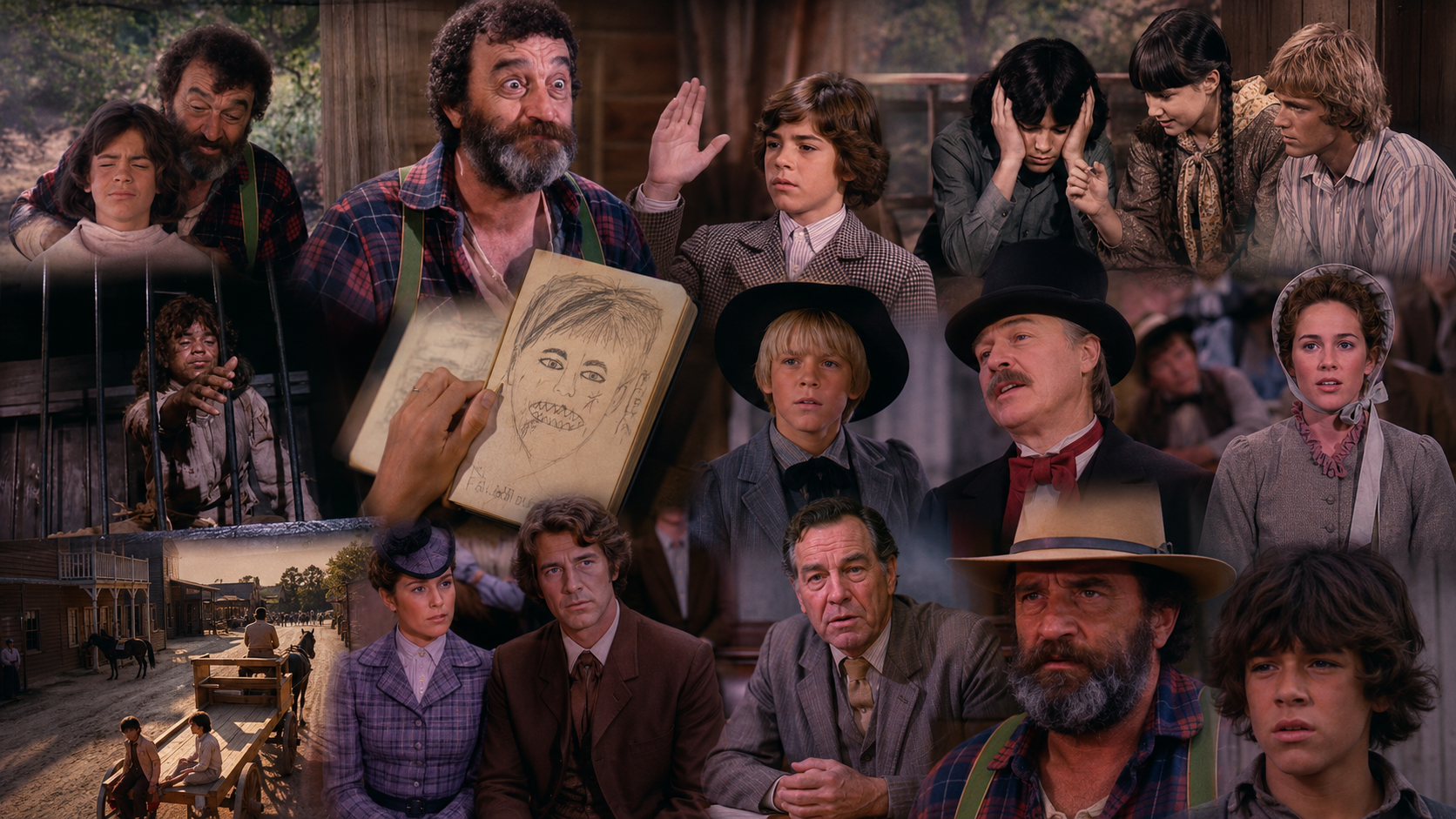
Walnut Grove had seen many strangers pass through town, but few arrived with a story as heartbreaking as the young boy everyone soon called Matthew.
The trouble began when a traveling show came to the area. Its owner, Dr. Joshua McQueen, promised excitement, mystery, and sights that ordinary people had never seen before. Among his attractions was a frightened boy displayed as a “wild child.”
McQueen treated Matthew like an animal instead of a human being.
The boy was kept locked inside a cage, hidden from the world except when paying crowds gathered to stare at him. McQueen claimed Matthew had been raised in the wilderness and could not speak or live among civilized people.
But Mr. Edwards quickly sensed that something was wrong.
When he looked into Matthew’s eyes, he did not see a dangerous creature. He saw fear, loneliness, and pain.
Matthew flinched whenever McQueen came near. He made strange sounds instead of words, and he struggled to communicate, but his behavior suggested that he understood far more than people believed.
Mr. Edwards could not ignore what he saw.
He began watching McQueen carefully and soon discovered the truth behind the showman’s cruel treatment. Matthew was not wild. He had been abused, neglected, and forced to perform for money. McQueen had taken away the boy’s dignity and convinced others that he was less than human.
The more Mr. Edwards learned, the angrier he became.
He confronted McQueen and demanded that Matthew be released. McQueen refused. To him, Matthew was not a child in need of help. He was property—a valuable attraction who brought in paying customers.
Mr. Edwards knew that arguing would not be enough.
Risking serious consequences, he helped Matthew escape.
For the first time in years, the boy was free.
But freedom frightened Matthew almost as much as captivity. He had spent so long being punished and controlled that he did not know whom to trust. Sudden movements made him panic. Loud voices caused him to hide. Even simple kindness seemed unfamiliar.
Mr. Edwards brought Matthew home and tried to make him feel safe.
At first, Matthew resisted everything.
He would not sleep comfortably in a bed. He watched doors and windows as though expecting someone to capture him. He ate quickly, protecting his food as if it might be taken away. He avoided strangers and struggled to understand the routines of family life.
Still, Mr. Edwards refused to give up.
He gave Matthew space when the boy was afraid and stayed close when he needed comfort. He spoke gently, even though Matthew could not answer with words. He showed him that food would always be available and that no one would strike him for making a mistake.
Slowly, Matthew began to respond.
A small moment of trust appeared when he accepted food without fear. Later, he allowed Mr. Edwards to come closer without pulling away. These steps seemed tiny to others, but to Mr. Edwards they were signs that the boy’s wounded heart was beginning to open.
The people of Walnut Grove had mixed reactions.
Some felt compassion for Matthew. Others were nervous because of the frightening stories McQueen had spread. They had been told the boy was dangerous, and fear was easier for some to believe than the truth.
Mr. Edwards defended Matthew fiercely.
He reminded everyone that the boy had never been given a fair chance. Matthew’s silence and unusual behavior were not signs of evil. They were the result of suffering.
Meanwhile, McQueen was determined to get Matthew back.
Without the boy, his traveling show would lose its biggest attraction. He began searching for him, using lies and threats to convince people that Matthew belonged in his custody.
Mr. Edwards knew the danger was not over.
He wanted Matthew to remain safe, but he also understood that McQueen could use the law against them. Without proof of the abuse, authorities might see Mr. Edwards as a man who had stolen a child from his legal guardian.
As Matthew slowly adjusted to his new surroundings, another important truth became clear.
He was intelligent.
Though he could not speak, he observed everything. He learned by watching. He understood kindness, anger, danger, and affection. His inability to talk did not mean he lacked thoughts or feelings.
Mr. Edwards began teaching him simple ways to communicate.
He pointed to objects and repeated their names. He encouraged Matthew to use gestures. Each small response filled him with hope.
For Matthew, the greatest lesson was not learning words.
It was learning that he mattered.
He began to understand that he was no longer an exhibit in a cage. He was a boy who deserved clothes, food, protection, friendship, and love.
But just as Matthew started to feel safe, McQueen’s search came closer to Walnut Grove.
The cruel showman had no intention of losing the child who had made him money. He was prepared to use fear, deception, and the law to regain control.
Mr. Edwards faced an impossible choice.
If he surrendered Matthew, the boy would return to a life of abuse.
If he refused, he could be arrested and Matthew might be taken by force.
As danger closed in, Matthew looked to Mr. Edwards with the fragile trust he had only just learned to give.
Mr. Edwards silently made him a promise.
He would not let anyone put him back in a cage.
But protecting Matthew would require more than courage. It would require proof, sacrifice, and the support of people willing to see the boy not as a curiosity, but as a human being.
And with McQueen approaching, time was running out.
To be continued in “The Wild Boy, Part Two.”
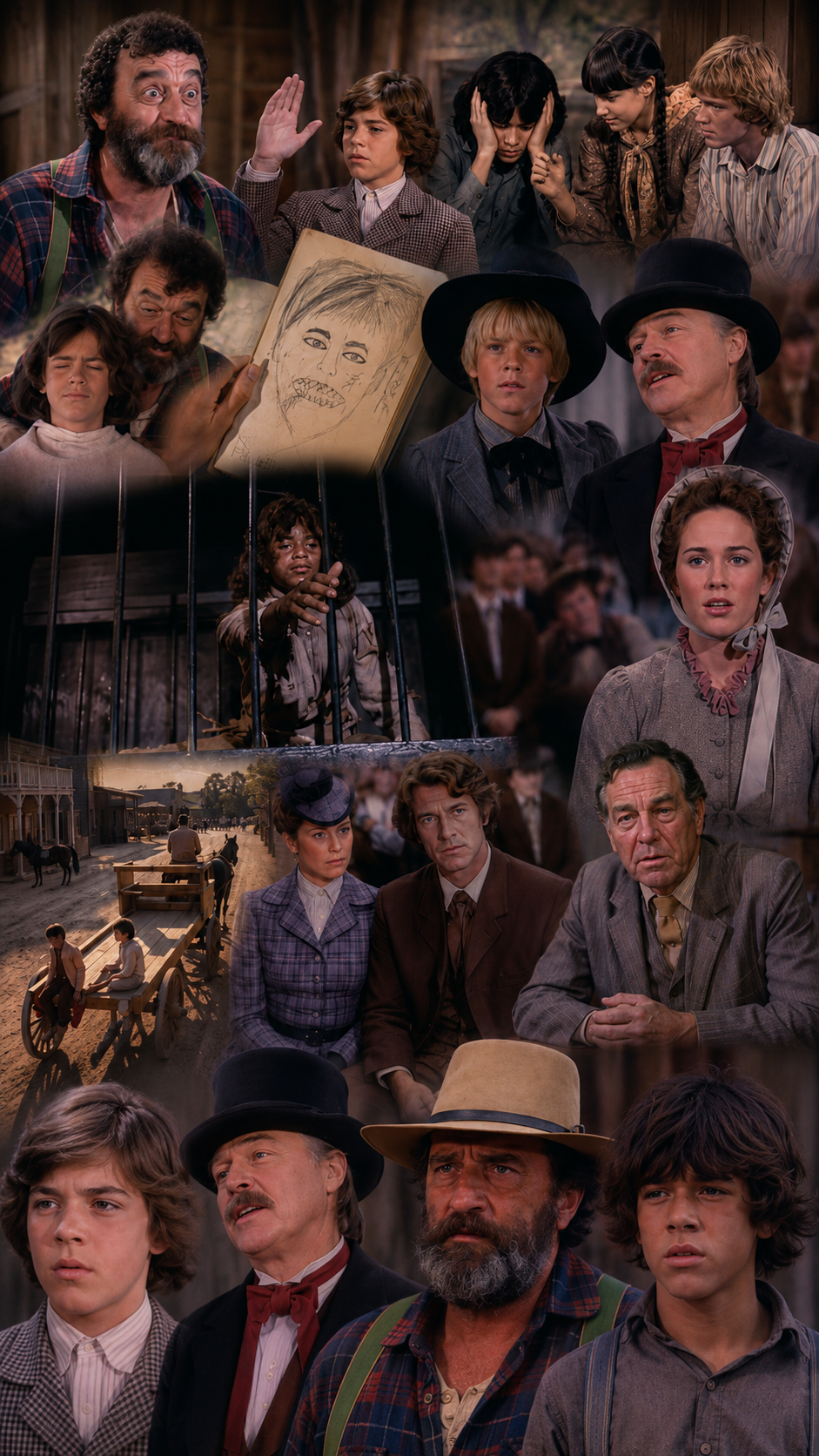
Season 9, Episode 7 — “The Wild Boy, Part Two”
After being found living in a traveling sideshow, the young boy named Matthew finally begins to experience kindness in Walnut Grove.
For years, Matthew has been treated as if he were an animal. Because he cannot speak and behaves differently from other children, people have stared at him, mocked him, and even locked him inside a cage. His cruel guardian, Dr. McQueen, used Matthew’s suffering to make money, displaying him before crowds as “the wild boy.”
But Isaiah Edwards sees something in Matthew that others have ignored.
He sees a frightened child.
Edwards takes Matthew into his home and patiently tries to earn his trust. At first, Matthew remains nervous and withdrawn. Sudden movements frighten him. Loud voices cause him to hide. He has learned through painful experience that adults often bring punishment instead of comfort.
Edwards refuses to give up.
He gives Matthew food, clean clothes, and a safe place to sleep. More importantly, he gives him time. He does not demand that Matthew change immediately. He simply stays near him, speaks gently, and allows the boy to understand that no one is going to hurt him.
Slowly, Matthew begins to respond.
He watches Edwards carefully and starts copying small actions. He becomes curious about ordinary life in Walnut Grove. For the first time, he is surrounded by people who see him as a human being rather than a strange attraction.
Laura and Almanzo Wilder also treat Matthew with compassion. Laura understands that education must begin with trust. She tries to communicate with him through simple signs, pictures, and patient gestures.
Although Matthew cannot speak, it soon becomes clear that he understands far more than people assumed. He is intelligent, observant, and eager to learn. His silence is not proof that he has no thoughts or feelings. It is only a barrier that others have never taken the time to understand.
As Matthew grows more comfortable, Edwards becomes deeply attached to him.
Edwards has known loneliness, loss, and regret. Caring for Matthew awakens something inside him. He begins to feel needed again. Matthew also starts seeing Edwards as the first real father figure he has ever known.
Their relationship brings healing to both of them.
However, their peaceful life does not last.
Dr. McQueen returns to Walnut Grove, determined to take Matthew back. He does not care about the boy’s happiness or safety. To him, Matthew is still property—someone he can use to attract crowds and earn money.
McQueen argues that he has legal authority over the boy. He claims that Matthew belongs with him and insists that Edwards has no right to keep him.
The people of Walnut Grove are horrified.
They know that returning Matthew to McQueen would mean sending him back to a life of cruelty, fear, and humiliation. Edwards refuses to allow it. He has seen Matthew begin to smile, learn, and trust. He cannot bear the thought of the boy being placed in a cage again.
But McQueen uses the law to his advantage.
Because Edwards is not Matthew’s legal guardian, he has little power to stop him. The situation becomes more painful when officials become involved. McQueen pretends to be a responsible caretaker, hiding the truth about how he treated Matthew.
Edwards loses his temper and confronts him.
He wants to protect Matthew, but anger alone cannot solve the problem. The law appears ready to return the boy to the man who abused him.
Matthew senses the danger.
Although he cannot fully explain his fear, his reaction says everything. He becomes terrified whenever McQueen comes near him. He hides behind Edwards and desperately resists being taken away.
For Edwards, this is proof enough.
A child should not be forced to return to someone he fears so deeply.
The community begins searching for a way to expose McQueen. They need evidence that Matthew was mistreated and that McQueen is unfit to care for him.
As the conflict grows, McQueen becomes increasingly impatient and cruel. His true nature begins to show. He is not concerned about Matthew’s future. He is worried only about losing the income the boy once provided.
Eventually, the truth becomes impossible to hide.
McQueen’s treatment of Matthew is revealed, and the people around him finally see that his claim of guardianship is based on greed, not love. Matthew is no longer viewed as a possession or sideshow attraction.
He is recognized as a child who deserves protection.
Edwards is given the chance to provide Matthew with the home he has always needed.
The decision brings enormous relief.
Matthew remains with Edwards, safe from the cage and the cruel life he once knew. He continues learning how to communicate and live among people who care for him.
One of the episode’s most touching moments comes when Matthew finally finds a way to express what Edwards means to him.
For so long, Matthew has been silent. He has had feelings but no safe way to share them. Now, through trust and affection, he begins to communicate.
He shows Edwards that he sees him not simply as a guardian, but as family.
Edwards is overwhelmed.
He has spent much of his life believing that he had failed the people he loved. But Matthew’s trust reminds him that a person’s past does not have to decide their future. By saving Matthew, Edwards also begins saving himself.
Walnut Grove changes Matthew’s life because its people choose compassion over fear.
At first, many saw only a strange, silent boy who behaved differently. But once they took the time to know him, they discovered a gentle child with intelligence, courage, and a deep need to belong.
Matthew’s story reminds everyone that being unable to speak does not mean being unable to feel.
It also shows how dangerous it can be when society treats someone as less than human simply because they are different.
Edwards does not rescue Matthew through wealth, education, or power.
He rescues him through patience.
He sits beside him.
He protects him.
He believes in him.
And little by little, a frightened boy who had known only cages begins to understand the meaning of home.
“The Wild Boy, Part Two” is a powerful story about dignity, acceptance, and the healing strength of unconditional love. It reminds us that every child deserves safety, respect, and someone willing to look beyond appearances.
Matthew had been called wild because no one had shown him kindness.
But when kindness finally entered his life, the truth became clear.
He was never wild.
He was wounded.
And with Edwards beside him, he finally began to heal.


