Part 1: The Theater Time Forgot
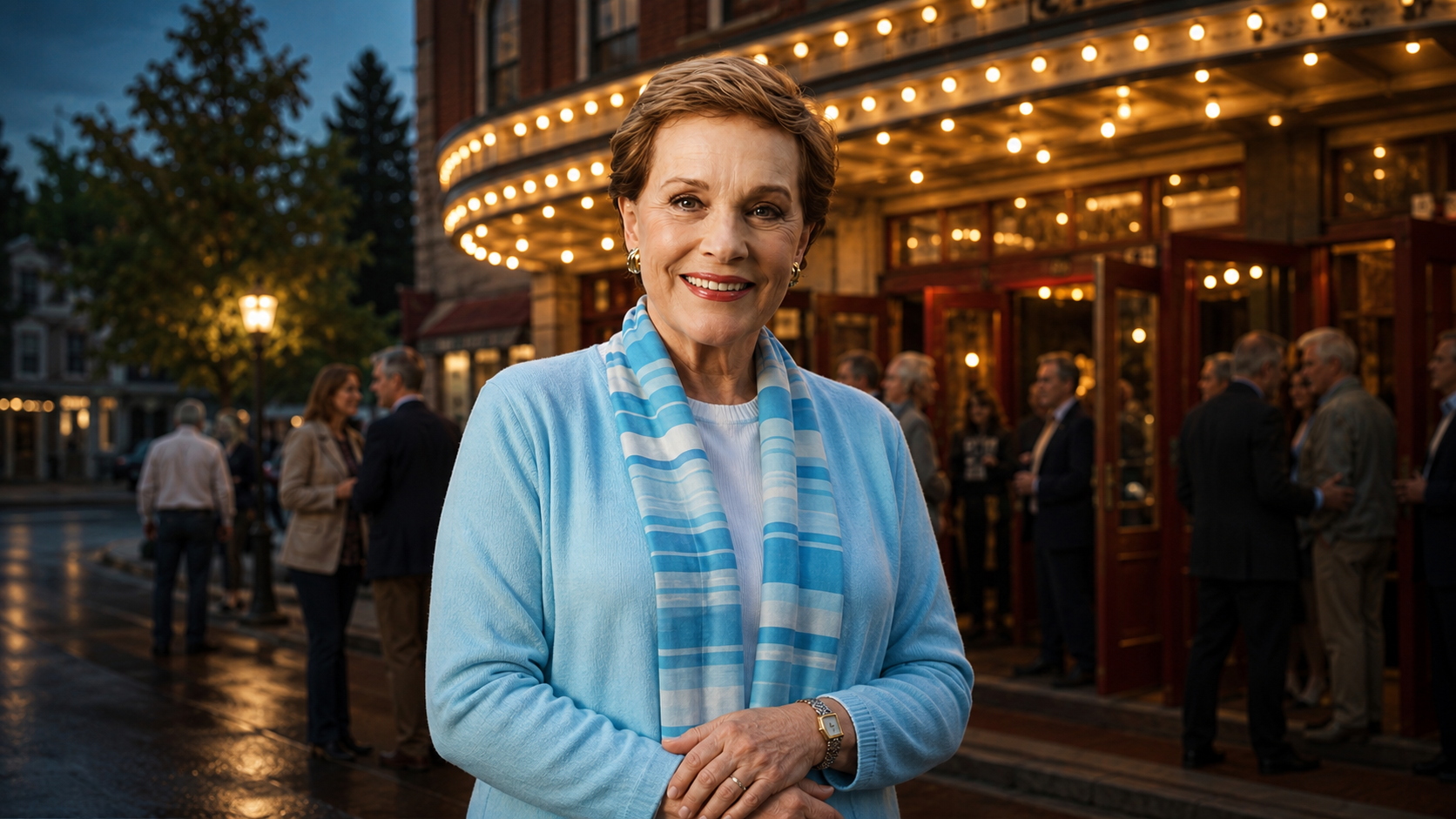
On a quiet street in the small town of Bellweather stood an old brick building with a faded sign above its doors:
The Starlight Community Theater
Once, the theater had been the heart of the town.
Children performed their first school plays there. Young couples shared nervous first dates in the back row. Local musicians played beneath its warm stage lights, and families gathered every December for the annual holiday show.
But time had not been kind to the Starlight.
Its roof leaked. Its red velvet seats were torn and dusty. The curtains had faded from deep crimson to a tired brown. Most of the lightbulbs around the old marquee had gone dark.
For nearly fifteen years, the doors had remained locked.
People passed the building every day, but few stopped to look at it anymore.
Then Julie Andrews came to Bellweather.
She had been invited to speak at a nearby arts fundraiser. After the event, a gentle rain began to fall, and Julie decided to walk back to her hotel instead of taking the waiting car.
That was when she noticed the theater.
She paused beneath the broken marquee and looked through the dusty glass doors.
Inside, she could just make out the shape of the ticket booth and the long aisle leading toward the stage.
An elderly man was standing nearby, sweeping rainwater away from the entrance.
“Was this once a theater?” Julie asked.
The man looked up.
“The finest little theater in the county,” he replied. “At least, we thought so.”
His name was Thomas Reed. He had worked at the Starlight since he was sixteen—first as an usher, later as a stagehand, and finally as its manager.
“Why did it close?” Julie asked.
Thomas leaned on his broom.
“Money, mostly. And disagreements. The town committee fell apart. People who had built this place together stopped speaking to one another.”
There was sadness in his voice.
He unlocked the door and invited Julie inside.
The lobby smelled of dust, old wood, and rain.
Julie walked slowly through the silent theater. Her footsteps echoed between the rows of empty seats.
On the walls hung framed photographs of past productions.
There were children dressed as pirates. Teenagers performing Shakespeare. Families singing together in holiday concerts.
One photograph caught Julie’s attention.
It showed two young women standing arm in arm beneath the stage lights. One held a script. The other held a paintbrush.
“Who are they?” Julie asked.
Thomas looked at the picture for a long moment.
“Eleanor Price and Margaret Bell,” he said. “Best friends once. Eleanor directed the plays. Margaret designed the sets.”
“What happened?”
Thomas sighed.
“When the theater ran into trouble, they disagreed about how to save it. Harsh words were spoken. Pride took over. They haven’t spoken in twenty-seven years.”
Julie looked toward the dark stage.
“A theater is built for voices,” she said softly. “It seems a shame for silence to have the final word.”
The next morning, Julie asked Thomas to meet her at the theater.
She had already spoken with the arts foundation that invited her to town. She had also called several local business owners, teachers, and former performers.
“I cannot restore this place alone,” Julie told them. “But perhaps the town can.”
At first, people were uncertain.
The work was enormous. The building needed repairs, new wiring, fresh paint, and hundreds of hours of careful cleaning.
But then Thomas opened an old storage room and found boxes filled with programs, photographs, costumes, and handwritten notes from former performers.
Memories began to return.
A retired teacher remembered directing her first play there.
A baker remembered proposing to his wife backstage.
A mechanic remembered building a wooden moon for a school production when he was seventeen.
Slowly, volunteers began to arrive.
They swept the aisles, repaired the seats, washed the windows, and cleared years of dust from the stage.
Julie worked beside them.
She polished brass handles, sorted old costumes, and read faded playbills aloud during lunch breaks.
Her presence encouraged people, but she never acted as though the project belonged to her.
“This theater is yours,” she often reminded them. “I am only helping you remember.”
Within weeks, the Starlight began to change.
The marquee glowed again.
The walls were painted warm cream and gold.
The old red curtains were carefully repaired instead of replaced.
But one problem remained.
They needed someone to design the set for the reopening performance.
Thomas quietly suggested Margaret Bell.
Julie visited Margaret at her small art studio on the edge of town.
Margaret was now seventy-six, with silver hair and paint on her sleeves.
When Julie explained the project, Margaret’s expression hardened.
“I have not stepped inside that theater in nearly thirty years,” she said.
“Perhaps that is exactly why you should,” Julie replied gently.
Margaret shook her head.
“Eleanor will be there.”
“Then perhaps there is something unfinished between you.”
Margaret looked away.
“Some things cannot be repaired.”
Julie glanced at the half-finished landscape on the easel.
“Sets are repaired. Buildings are repaired. Music is rewritten. Friendships may be more difficult—but not always impossible.”
Margaret said nothing.
Two days later, Eleanor Price arrived at the theater.
Thomas had asked her to direct the reopening show.
Eleanor, now seventy-eight, carried herself with quiet dignity. She still wore a red scarf around her neck, just as she had in the old photographs.
When she learned that Margaret had been invited to design the set, she nearly left.
“I cannot work with her,” Eleanor said.
Julie did not argue.
Instead, she handed Eleanor an old photograph she had found backstage.
It showed Eleanor and Margaret sitting on the edge of the stage as young women, laughing so hard that neither was looking at the camera.
On the back, someone had written:
Whatever happens, we will always meet beneath the lights.
Eleanor’s eyes filled with tears.
“She wrote that,” she whispered.
That evening, just before sunset, the theater doors opened.
Margaret stepped inside.
She carried a wooden box filled with paintbrushes.
Eleanor was standing alone on the stage.
For a long moment, neither woman spoke.
Then Margaret looked up at the dark ceiling.
“The lights seem smaller than I remember,” she said.
Eleanor swallowed.
“We were younger then.”
Margaret placed the box on the floor.
“I came to work,” she said quietly. “Nothing more.”
Eleanor nodded.
“Nothing more.”
Julie watched from the back row.
She knew the theater had begun to heal.
But the oldest wound in the building was still waiting to be touched.
Part 2: Beneath the Lights Again
The weeks before opening night were filled with movement.
Hammers echoed through the lobby. Music drifted from the rehearsal room. Children ran across the stage carrying costumes and paper stars.
Eleanor directed the new production—a celebration of Bellweather’s history told through songs, short scenes, and memories from the townspeople.
Margaret designed the set.
At first, she and Eleanor spoke only when necessary.
“The window needs to move two feet left.”
“The actors enter from the other side.”
“That shade of blue is too dark.”
Their words were polite but cold.
Julie never pushed them.
She simply made sure they worked near each other.
One afternoon, a storm swept through Bellweather.
Rain hammered the roof while Eleanor rehearsed a group of children in the final scene.
Suddenly, part of the newly painted backdrop tore loose and collapsed.
No one was hurt, but the set was badly damaged.
Margaret stared at the torn canvas.
“We will never finish in time,” she said.
The opening was only three days away.
Eleanor stepped onto the stage and examined the damage.
Years earlier, an accident like this would have led to blame and anger.
But this time, Eleanor quietly picked up a fallen paintbrush.
“Tell me what to do,” she said.
Margaret looked at her in surprise.
“You never liked painting.”
“I still don’t.”
A small smile touched Margaret’s face.
“You always held the brush too tightly.”
“And you always gave too many instructions.”
For the first time in decades, they laughed together.
It was a small sound, but everyone in the theater stopped to listen.
That evening, the two women stayed after the volunteers left.
Julie returned later with tea and found them sitting on the stage beneath a single work light.
Between them lay the old photograph.
“I believed you wanted control of the theater,” Margaret said quietly.
“I believed you were willing to abandon it,” Eleanor replied.
“I left because you said the Starlight would be better without me.”
Eleanor closed her eyes.
“I said that in anger. I regretted it before the night was over.”
“Then why didn’t you call?”
“Because I was ashamed.”
Margaret’s voice trembled.
“I waited for you.”
“And I waited for you.”
Twenty-seven years of silence settled between them.
Julie placed the tea beside them.
“Sometimes,” she said gently, “people lose years waiting for the other person to take the first step.”
Eleanor turned toward Margaret.
“I should have taken it.”
Margaret’s eyes filled with tears.
“So should I.”
Eleanor held out her hand.
Margaret looked at it for a long moment before placing her own hand in Eleanor’s.
“I missed you,” Eleanor whispered.
Margaret nodded.
“I missed you too.”
Three days later, opening night arrived.
The restored marquee shone brightly over the street.
People lined up around the block.
Former performers returned from distant cities. Families brought old photographs and programs. Elderly couples sat in the same seats where they had first met many years before.
Thomas stood in the lobby wearing his original usher’s jacket.
It was tight across the shoulders, but he refused to wear anything else.
Julie greeted guests quietly near the entrance.
She had been asked to take the stage before the performance, but she requested that Thomas speak instead.
“This night belongs to the people who kept the memory of this place alive,” she said.
When the house lights dimmed, Thomas walked onto the stage.
He looked at the full theater and struggled to speak.
“For fifteen years,” he finally said, “I thought this building was finished. Tonight, I understand that a place is never truly lost while someone still remembers what it meant.”
The audience applauded.
The performance began.
Children sang songs once performed by their grandparents.
Local actors recreated scenes from old productions.
Photographs from the theater’s history appeared across Margaret’s painted backdrop.
Then came the final scene.
Two young actresses entered the stage dressed as Eleanor and Margaret had been in their first production together.
One carried a script.
The other carried a paintbrush.
They stood beneath the lights and said:
“Whatever happens, we will always meet here again.”
The audience grew silent.
In the front row, Eleanor reached for Margaret’s hand.
Margaret held it tightly.
Julie watched from the wings.
She saw tears in their eyes, but she also saw something brighter—the joy of finding a friendship they had believed was gone forever.
When the curtain fell, the audience rose to its feet.
The applause continued for several minutes.
Eleanor and Margaret were invited onto the stage.
At first, they hesitated.
Then they walked forward together.
The moment the audience saw them holding hands, the applause grew louder.
Thomas covered his face and wept.
After the performance, people remained in the lobby long past midnight.
Old friends found one another.
Former cast members shared stories.
A father showed his daughter the corner where he had once forgotten every line in a school play.
A widow sat quietly in the seat where she and her husband had spent their first date.
The Starlight was no longer simply a restored building.
It had become a place where the town could remember, forgive, and begin again.
Before Julie left Bellweather, the community gathered outside the theater to thank her.
But she shook her head.
“You did this,” she told them. “You restored more than walls and seats. You restored the courage to return to one another.”
Margaret and Eleanor stood together beneath the glowing marquee.
“We lost twenty-seven years,” Margaret said.
Eleanor squeezed her hand.
“Then we should make good use of the years we still have.”
They went on to lead a children’s theater program together.
Margaret taught painting and set design. Eleanor taught acting and storytelling.
They still disagreed often.
But now, they laughed before pride could turn disagreement into distance.
Above the theater entrance, a new plaque was placed.
It read:
The Starlight Community Theater
Restored by a town that remembered no friendship is too old for a new beginning.
Years later, people still spoke of that opening night.
They remembered the music, the lights, and the beautiful painted set.
But most of all, they remembered two old friends walking onto the stage hand in hand.
And they remembered the lesson Julie had quietly helped the whole town understand:
Sometimes the places we save become the places that save us.
The End