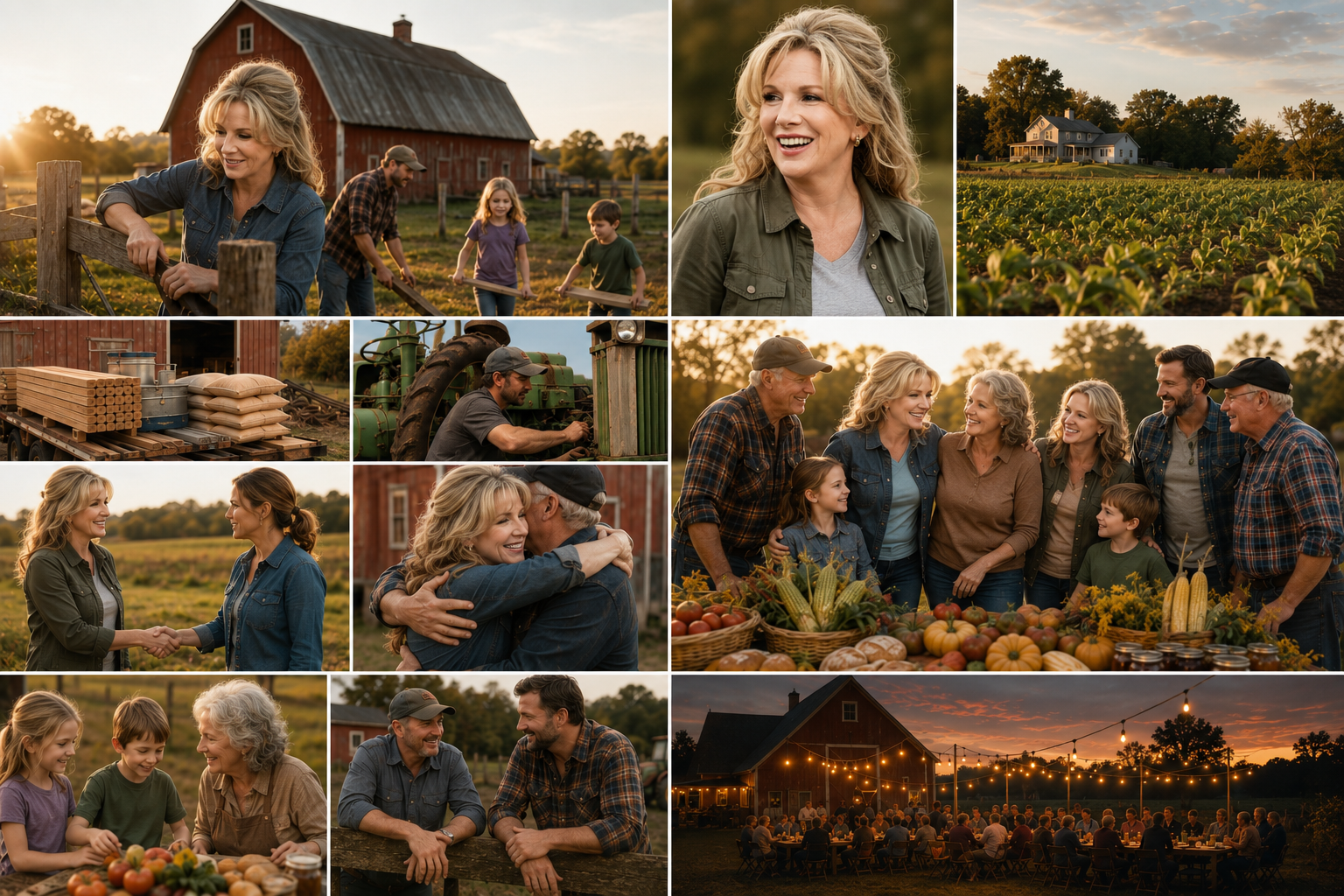
 The old Miller family farm had stood on the edge of a quiet valley for nearly eighty years. Its faded red barn, weathered fence posts, and golden fields had once been the pride of the community. Every autumn, neighbors gathered there for harvest festivals filled with music, laughter, and homemade pies.
But those joyful days had slowly disappeared.
After Robert and Helen Miller passed away within a year of each other, their children moved to different cities in search of work. The farmhouse became silent. The fields grew wild with weeds, and the once-busy barn echoed only with the sound of the wind.
Only Emily, the youngest granddaughter, refused to give up.
At twenty-eight, she left her office job and returned home, hoping to save the family farm. Her husband, Daniel, believed in her dream, but dreams could not pay overdue bills or repair broken tractors.
Every morning before sunrise, the couple worked until dark. They patched leaking roofs, repaired fences one board at a time, and planted crops with equipment older than they were.
Still, the numbers never worked.
One evening Emily quietly spread the unpaid invoices across the kitchen table.
“We have enough money for another month,” she whispered.
Daniel looked toward the fields outside the window.
“I don’t know what else we can do.”
Their two children overheard the conversation from the hallway. Eleven-year-old Lucy hugged her little brother Ben, pretending everything would somehow be okay.
The following week, Emily listed part of the farmland for sale.
It was the hardest decision she had ever made.
“If we lose half,” she told Daniel through tears, “maybe we can save the rest.”
Unknown to the family, someone else had seen the listing.
Melissa Gilbert had been traveling through the countryside while supporting several local agricultural charities. She stopped at a nearby farmers’ market and heard people quietly talking about the Millers.
“They’re good people,” one elderly vendor said. “That farm has been in their family for generations. It would break everyone’s heart to see it disappear.”
Melissa asked a few gentle questions but never introduced herself beyond a friendly smile.
Later that afternoon, she drove past the farm.
She saw Emily repairing a fence while Daniel struggled to restart an ancient tractor. Their children collected loose boards instead of playing.
The sight reminded Melissa of stories she had always loved—families refusing to surrender despite impossible odds.
Instead of offering publicity or attention, she chose something different.
She contacted a trusted nonprofit that specialized in preserving family farms.
“Please don’t tell them where the help comes from,” she requested. “If we’re going to do this, let them keep their dignity.”
Within two weeks, mysterious deliveries began arriving.
Bundles of lumber.
New fencing supplies.
Fresh seed.
Animal feed.
A local mechanic appeared one morning and simply said, “Someone already covered the repair costs.”
Emily stared in disbelief.
“There has to be some mistake.”
“There isn’t,” the mechanic smiled.
“Someone believes this farm deserves another chance.”
The family searched everywhere for the anonymous donor, but no one seemed to know anything.
Slowly, hope returned.
The repaired tractor finally roared to life.
Neighbors who had almost forgotten the old Miller farm started stopping by to lend a hand.
One brought paint.
Another donated fruit trees.
Several teenagers volunteered their weekends to repair the weathered barn.
For the first time in years, laughter drifted across the fields again.
Yet despite everyone’s kindness, one enormous challenge remained.
The coming harvest would determine everything.
If the crops failed, the farm would still be lost.
As the first golden stalks swayed beneath the autumn sun, Emily stood in the field, praying silently for one final miracle.
She had no idea that someone very special was already planning to be there on harvest day.
One Harvest Brought Three Generations Together Again
Harvest morning arrived beneath a clear golden sky.
Emily stood at the edge of the field, holding her grandfather’s old work gloves. The leather was cracked and faded, but she still remembered the way he used to wear them while teaching her how to gather corn without damaging the stalks.
For a moment, she could almost hear his voice.
“A farm survives because people care for one another.”
Daniel walked toward her from the barn.
“The tractor is ready,” he said. “And half the town is already here.”
Emily turned and saw trucks lining the narrow road. Neighbors climbed out carrying baskets, tools, water jugs, and homemade food. Some had known her grandparents for decades. Others had never met them but had heard about the struggling farm and wanted to help.
Then a familiar-looking woman stepped from a modest vehicle near the gate.
Emily stared for several seconds before recognizing her.
“Melissa Gilbert?”
Melissa smiled warmly.
“I hope you do not mind one more pair of hands.”
Emily was too surprised to speak.
Daniel removed his cap, equally stunned.
Melissa walked closer and looked across the field.
“This place reminds people of something important,” she said. “It reminds them that family, hard work, and kindness are still worth protecting.”
Emily’s eyes filled with tears.
“Were you the one who sent the supplies?”
Melissa hesitated, then gave a gentle nod.
“But I was not the only one,” she said. “Once people learned that the farm had a chance, they wanted to become part of that chance.”
Emily covered her mouth.
She had imagined a wealthy investor or a government program. She had never expected someone to help quietly, without asking for attention or praise.
“Why did you keep it secret?” she asked.
Melissa looked toward the old farmhouse.
“Because help should never make someone feel small.”
Before Emily could answer, another vehicle appeared at the end of the road.
It was an old blue station wagon.
Emily froze.
Her mother, Margaret, stepped from the passenger side. Her uncle Thomas climbed out behind her. The brother and sister had barely spoken in seven years after a bitter disagreement over what should happen to the farm.
Emily had invited them many times, but neither had returned.
Now they stood together near the gate.
Margaret looked across the fields and began to cry.
“It looks like home again,” she whispered.
Thomas walked slowly toward the barn. He touched the freshly painted wood and glanced at the weather vane their father had installed when they were children.
“I thought coming back would hurt too much,” he admitted.
Margaret looked at him.
“Maybe staying away hurt more.”
For a long moment, neither moved.
Then Thomas opened his arms.
Margaret stepped forward, and the two embraced beneath the same maple tree where they had once played as children.
Emily watched through tears as years of silence finally began to disappear.
By midmorning, three generations of the Miller family were working side by side.
Margaret showed Lucy how to sort vegetables just as Helen had once taught her.
Thomas climbed onto the tractor beside Daniel and repaired a loose belt without needing instructions.
Little Ben carried ears of corn in a basket that was almost too large for him.
Melissa worked among the volunteers, tying bundles, passing water, and listening to stories about Robert and Helen.
The harvest became more than work.
It became a celebration.
People sang old songs across the rows. Children chased one another near the orchard. Long tables were placed beside the barn and covered with pies, bread, soup, and jars of preserves.
By sunset, the final wagon rolled into the barn.
The harvest was the largest the Miller farm had produced in nearly twenty years.
Emily stood before the crowd, holding her grandfather’s gloves in both hands.
“We thought we were saving a farm,” she said. “But all of you helped save our family.”
She turned toward her mother and uncle.
Margaret took Thomas’s hand.
This time, neither let go.
Then Emily looked at Melissa.
“I do not know how we can ever repay you.”
Melissa shook her head.
“Keep the farm alive,” she said. “Help someone else when they need it. That will be enough.”
Months later, the Miller family withdrew the land from sale.
Margaret moved back into the farmhouse and began teaching the children old family recipes. Thomas returned every weekend to help repair equipment and manage the orchard. Emily and Daniel opened a small farm shop inside the restored barn.
Above the entrance, they hung a wooden sign.
It read:
“Three Generations Farm — Grown with Hope.”
Every autumn after that, the family held a community harvest day. No one was charged for food. Families facing difficult times were quietly given baskets filled with fresh produce, bread, and preserves.
Melissa never asked for her name to appear anywhere.
But inside the barn, beside an old photograph of Robert and Helen, Emily placed a small framed message:
“Kindness planted in silence can feed generations.”
Years later, Lucy would take over the farm.
Whenever visitors asked how her family had managed to save it, she always told them the same thing.
“The crops brought us back to the land. But kindness brought us back to one another.”
And each autumn, when the fields turned gold beneath the evening sun, Emily would stand beside her mother, her uncle, her husband, and her children.
The farm was no longer simply a place inherited from the past.
It had become a promise to the future.
A promise that no family is truly lost while love still leaves a door open.
A promise that one helping hand can restore more than a building.
And a promise that when people come together, even the most forgotten field can bloom again.
The End


