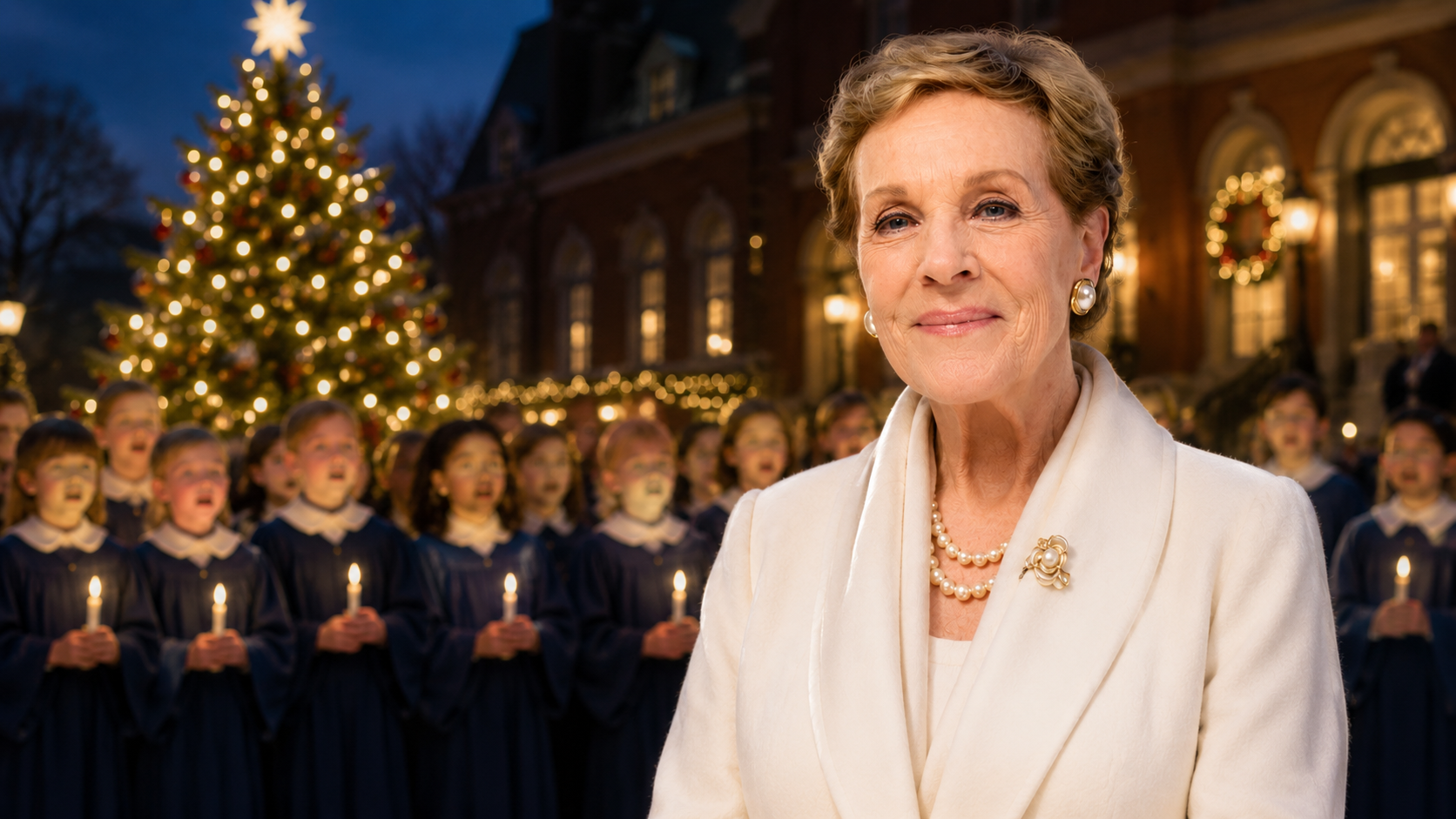
Part 1: The Choir That Was Almost Silenced
Snow had begun falling over the little town of Bellweather long before anyone expected it.
By the first week of December, white drifts rested along the sidewalks, wreaths hung from shop doors, and strings of colored lights glowed above Main Street. From a distance, the town looked peaceful and full of Christmas cheer.
But behind the bright windows, many families were struggling.
The old paper mill had closed in the autumn, leaving dozens of people without work. The bakery had reduced its hours. The hardware store was preparing to close after forty-three years. Even the church food pantry had nearly empty shelves.
Bellweather still had lights.
It still had snow.
But its people were beginning to lose hope.
At the center of town stood Bellweather Elementary School, a small brick building with a leaking roof, faded curtains, and a music room that had not been renovated in decades.
That room belonged to Miss Clara Bennett.
Clara was thirty-six years old, with warm brown eyes and a gentle voice that made even the shyest child feel heard. She had taught music at the school for eleven years, and she believed every child carried a song inside them.
Some songs were loud and joyful.
Others were hidden beneath fear, sadness, or loneliness.
Her job, Clara often said, was not to create the music.
It was to help children find it.
That year, she had formed a small children’s choir called the Bellweather Starlight Singers.
There were twenty-three children in the group.
Some came from families who could afford music lessons and warm winter coats. Others came to rehearsal wearing hand-me-down sweaters and shoes held together with glue.
But when they sang, none of that mattered.
Their voices rose together as one.
Among them was nine-year-old Lily Carter, whose father had lost his job at the mill. Lily rarely spoke in class, but when she sang, her voice was clear and bright.
There was also twelve-year-old Noah Green, who cared for his younger sister while their mother worked evening shifts at the hospital.
And there was eight-year-old Benji Morris, who had struggled with a stutter since preschool. He found speaking difficult, but singing came naturally.
Clara had planned a Christmas concert for December 23.
She called it “A Light for Bellweather.”
The performance was supposed to bring the town together and raise money for the local food pantry. The children had practiced for months. They had learned carols, simple harmonies, and one special original song Clara had written called “Carry the Light.”
For the first time in weeks, people in Bellweather had something to look forward to.
Then, on a cold Monday morning, Clara was called into the principal’s office.
Mr. Harris sat behind his desk with both hands folded.
His expression told her the news before he spoke.
“I’m sorry, Clara,” he said. “The district has cut the winter arts budget.”
Clara stared at him.
“How much?”
“All of it.”
The room went quiet.
“What does that mean for the concert?”
Mr. Harris looked down.
“We cannot pay for the theater rental, transportation, costumes, or sound equipment. The school insurance also will not cover an off-site performance without the proper funding.”
Clara felt as if the air had left the room.
“The children have worked since September.”
“I know.”
“The entire town is counting on this.”
“I know,” he repeated softly.
Clara stood and walked toward the window. Outside, snow covered the playground. Several children were building a lopsided snowman near the fence.
“How much would we need?” she asked.
Mr. Harris sighed.
“At least twelve thousand dollars.”
Clara turned around.
Twelve thousand dollars might as well have been a million.
Most families in Bellweather were saving every coin for food, heating, and rent. Local businesses were barely surviving.
Still, Clara refused to give up.
That afternoon, she told the choir rehearsal would end early.
The children immediately sensed something was wrong.
“Is the concert canceled?” Lily asked.
Clara looked at their hopeful faces.
Benji clutched his music folder tightly.
Noah stared at the floor.
Clara forced a smile.
“Not yet.”
That single word became her promise.
Not yet.
Over the next three days, Clara visited every business in town.
The bakery donated twenty dollars.
The barber gave ten.
Mrs. Dalton, who ran the antique shop, emptied the coins from a jar beside her cash register.
The parents held a bake sale in the school gym, but the snowy weather kept most people away.
By Friday, they had raised only six hundred and forty-three dollars.
Clara went home exhausted.
Her apartment was small and quiet, with a tiny Christmas tree glowing beside the window. She sat at her kitchen table, surrounded by bills, donation forms, and handwritten notes from the children.
One note was from Benji.
Dear Miss Bennett,
Thank you for helping me sing when I cannot always talk. I hope the concert happens because my grandma is coming. She has never heard me sing before.
Clara pressed the note to her heart.
Then she cried.
Not loudly.
Just the silent tears of someone who had tried everything and feared it still would not be enough.
Across the ocean, in a quiet home in England, Julie Andrews was sorting through a stack of letters.
Most had been sent by fans.
Some thanked her for songs, films, or performances that had brought joy to their lives. Others contained memories of parents, children, and grandparents.
Julie read as many as she could.
One envelope looked different.
It was pale blue and covered with small silver stars. The handwriting was uneven, and the return address read:
Bellweather Elementary School
Bellweather, Vermont
Inside was a letter written by Lily Carter.
Dear Ms. Andrews,
My name is Lily and I am nine years old. Our music teacher says songs can help people remember they are not alone.
Our town is having a hard time because many parents lost their jobs.
We made a Christmas choir to help everyone feel happy again and raise food money, but now our concert might not happen.
Miss Bennett says we should not give up.
You probably get many letters, but I wanted to tell you because your singing makes my grandmother smile even when she feels sad.
I hope someday I can sing with courage like you.
Merry Christmas.
From Lily
Julie read the letter twice.
Then she noticed something taped to the back.
It was a photograph of the choir standing in the music room. Their uniforms did not match. Some children wore sweaters, others wore school shirts, and Benji stood in the front holding a cardboard star.
Behind them was a hand-painted sign:
A LIGHT FOR BELLWEATHER
Julie studied every face.
She had spent much of her life seeing what music could do. It could comfort people through grief. It could give courage to the frightened. It could bring strangers together.
She knew this choir was about more than a concert.
It was a lifeline.
The next morning, Julie made several phone calls.
She contacted a trusted assistant and asked her to learn everything she could about Bellweather, the school, and the choir.
By evening, the facts had been confirmed.
The town was struggling.
The budget had been cut.
The concert was days away from cancellation.
Julie sat quietly for a moment.
Then she said, “Let us help them.”
Her assistant asked whether the donation should be made in Julie’s name.
Julie shook her head.
“No. Not yet.”
“Why not?”
“Because this should belong to the children and their town. I do not want attention to become the story.”
Julie agreed to cover the full cost of the concert.
She also paid for choir robes, transportation, sound equipment, theater repairs, and enough food to restock the community pantry.
But she had one condition.
No one was to reveal who had given the money.
Two days later, Principal Harris received a phone call.
He listened in stunned silence.
“Are you certain?” he asked.
The voice on the line confirmed it.
An anonymous donor had paid every expense.
Not only could the concert continue, but the choir would perform in the town’s historic Bellweather Theater, which had been closed for nearly five years.
Mr. Harris hurried to the music room.
Clara was leading the children through “Silent Night” when he burst through the door.
Everyone stopped singing.
“Clara,” he said breathlessly. “The concert is happening.”
For one second, no one moved.
Then the room exploded with cheers.
Lily hugged Noah.
Benji jumped so quickly that his music folder fell open on the floor.
Clara covered her mouth with both hands.
“How?” she asked.
“An anonymous donor.”
“Who?”
“I do not know.”
The children began talking at once.
“Maybe it was Santa!”
“Maybe it was the mayor!”
“Maybe someone won the lottery!”
Clara smiled through tears.
“Whoever it was,” she said, “we will thank them by giving the best performance we can.”
News spread through Bellweather.
Volunteers arrived to clean the old theater. Carpenters repaired the loose stage boards. Parents washed the dusty red curtains. The bakery donated cookies. The hardware store provided paint.
People who had hardly spoken to one another in months worked side by side.
The town began changing.
Not because its problems had disappeared, but because everyone had been reminded that they still had one another.
Meanwhile, boxes began arriving at the school.
Inside were deep blue choir robes with silver trim.
There were new music folders, warm scarves, and small star-shaped pins for every child.
One package contained a handwritten note.
Sing with courage.
Sing for those who need hope.
And remember that the smallest light can brighten the darkest room.
There was no signature.
Clara read the message aloud.
Lily looked at the handwriting and felt something familiar, although she could not explain why.
As the concert approached, rehearsals became more serious.
The children practiced after school and sometimes on Saturdays. Clara taught them to breathe together, listen to one another, and trust their voices.
Benji had been chosen to sing the first line of “Carry the Light” alone.
But during rehearsal, he froze.
His lips moved, but no sound came out.
The other children waited.
Benji’s eyes filled with tears.
“I c-can’t,” he whispered.
Clara knelt beside him.
“You do not have to be perfect.”
“What if everyone laughs?”
“They will not.”
“What if my voice stops?”
“Then the choir will carry the song until you find it again.”
Benji looked toward the other children.
Lily nodded.
Noah placed a hand over his heart.
One by one, the choir began humming the melody.
Benji closed his eyes.
Then he sang.
His first note trembled.
The second became stronger.
By the time he reached the end of the line, his voice filled the room.
Clara smiled.
“That,” she said, “is courage.”
Three days before Christmas, Julie Andrews boarded a flight to the United States.
She had told no reporters.
No photographers were waiting.
She planned to sit quietly in the back of the Bellweather Theater and watch the children perform without anyone knowing she was there.
But the journey did not go as planned.
A winter storm moved across Vermont.
Roads closed.
Flights were delayed.
By the afternoon of December 23, heavy snow was falling over Bellweather.
The children gathered backstage in their new robes while families filled the theater.
Clara stood near the curtain, trying not to show her worry.
The weather was worsening by the minute.
Some families had not arrived.
Several choir members were missing.
Then the electricity flickered.
Once.
Twice.
And suddenly, the entire theater went dark.
A frightened murmur rose from the audience.
Backstage, one of the children began to cry.
Mr. Harris rushed toward Clara with a flashlight.
“The power line is down,” he said. “The repair crew may not reach us tonight.”
Clara looked at the children.
They had worked for months.
The town had filled every seat.
The food pantry donations were waiting in the lobby.
And now, only minutes before the performance, the miracle seemed to be slipping away.
Outside, through the thick snow, a dark car stopped near the theater.
The door opened.
A woman stepped out, wrapped in a long winter coat.
She looked toward the dark building, heard the wind howling through the street, and hurried toward the entrance.
Inside, Clara gathered the choir around her.
“We may not have lights,” she said. “We may not have microphones. But we still have our voices.”
Then the theater doors opened.
A quiet figure entered from the storm.
Lily turned toward the sound.
And when the woman lowered her hood, Lily’s eyes grew wide.
She recognized her immediately.
But before she could speak, Julie Andrews gently raised one finger to her lips.
Then she whispered, “Let us help them find the light.”
Part 2: The Light They Carried Together
For several seconds, Lily could not move.
The woman standing near the theater doors was the same woman whose songs her grandmother played every Christmas morning.
Julie Andrews.
There she was, brushing snow from her coat, her cheeks pink from the cold.
Lily looked toward Miss Bennett, but Clara had not yet noticed who had arrived. She was busy calming the younger children while Principal Harris tried to learn whether the electricity could be restored.
Julie stepped closer and smiled at Lily.
“May I see your music teacher?” she whispered.
Lily nodded quickly.
“Miss Bennett,” she called. “Someone is here.”
Clara turned.
At first, she saw only an older woman in a dark coat standing beside the open door.
Then the woman lowered her scarf.
Clara stared.
Her eyes widened with disbelief.
“Ms. Andrews?”
Julie offered a warm smile.
“Please call me Julie.”
Clara stepped forward, still too stunned to speak.
“What are you doing here?”
“I came to hear a certain choir.”
Behind Clara, the children had grown completely silent.
One by one, they recognized their visitor.
Noah’s mouth fell open.
Benji gripped Lily’s sleeve.
A little girl near the back whispered, “Is this real?”
Julie looked across the group.
“It is very real,” she said. “And I believe you have a concert to give.”
Clara glanced toward the dark stage.
“The power is out. We have no microphones, no lights, and no instruments.”
Julie looked around the theater.
Several audience members had switched on the lights from their phones. Small points of white glowed throughout the room.
Outside, snow continued striking the windows.
Inside, no one was leaving.
Julie studied the children for a moment.
“Then perhaps,” she said, “this is the perfect time to remember what music truly needs.”
Benji looked up at her.
“What does it need?”
“A voice,” Julie answered. “A little courage. And someone willing to listen.”
The children looked toward the audience.
Clara understood immediately.
She gathered the choir close.
“We will sing without music,” she said. “No speakers. No stage lights. Just us.”
One of the younger boys raised his hand.
“What if nobody can hear?”
Julie smiled.
“Then sing for the person closest to you. The song will travel from heart to heart.”
Principal Harris found several boxes of candles in a storage room. Volunteers placed them safely along the front of the stage and in glass jars beside the aisles.
Parents lifted their phone lights.
The dark theater slowly filled with a soft golden glow.
It was not bright.
But it was enough.
The audience fell quiet as the children walked onto the stage.
Their deep blue robes moved gently as they took their places. The silver trim reflected the candlelight like tiny stars.
Julie remained near the curtain.
She did not want to take attention away from them.
This was their night.
Clara stepped before the choir and lifted her hands.
The first song was “Silent Night.”
Without a piano, the opening felt fragile.
The children took one breath together.
Then they began.
Their voices rose softly into the darkness.
“Silent night, holy night…”
The theater became still.
Every breath, every note, every small tremble could be heard.
The lack of microphones made the performance feel closer and more honest. It was as though the children were not singing to a crowd, but to each person individually.
People who had spent months worrying about jobs, bills, and uncertain futures listened with tears in their eyes.
Mr. Dalton, the hardware store owner, stood beside his wife near the back. He had planned to announce the closing of his shop after Christmas.
But as the children sang, he remembered his own father opening the store many years before. He remembered neighbors helping them through hard seasons.
He reached for his wife’s hand.
Across the aisle, two former friends who had stopped speaking after a business disagreement quietly nodded to one another.
Near the front, Lily’s father sat with his head bowed.
Since losing his job at the mill, he had felt ashamed. He had stopped attending church events and avoided old friends because he feared their questions.
Now he watched his daughter sing.
She looked brave.
Braver than he felt.
And for the first time in months, he allowed himself to believe that losing a job did not mean losing his worth.
The choir finished the song.
No one applauded immediately.
The silence that followed felt too meaningful to break.
Then one person began clapping.
Another joined.
Within seconds, the theater filled with applause.
The children smiled.
Clara turned to Benji.
It was time for “Carry the Light.”
Benji’s face went pale.
He had practiced the opening line many times, but now the audience seemed enormous.
His grandmother sat in the second row, wrapped in a red scarf. She looked at him with tears in her eyes.
Benji stepped forward.
He opened his mouth.
Nothing came out.
His hands began trembling.
The audience waited.
Clara gave him a gentle nod.
Behind the curtain, Julie placed one hand over her heart.
Benji looked toward her.
Julie mouthed two words.
Take your time.
Benji closed his eyes.
Then the choir began humming softly behind him.
Just as they had during rehearsal.
Lily hummed.
Noah hummed.
Every child carried the melody until Benji found his place within it.
He took a breath.
Then he sang.
“When the road is cold and long…”
His first words were quiet.
But they were clear.
His grandmother covered her mouth.
Benji continued.
“And the night has hidden dawn…”
His voice became stronger.
By the final word of the verse, it filled the entire theater.
The choir joined him.
“We will carry the light,
We will carry it far,
Through the darkest of nights,
Like the glow of a star.”
The song was simple.
But its message belonged to everyone in Bellweather.
It spoke of neighbors sharing what little they had.
It spoke of courage that did not need to be loud.
It spoke of holding hope for someone who could no longer hold it alone.
As the children reached the final chorus, the audience began singing with them.
At first, only a few voices joined.
Then dozens.
Then nearly everyone in the theater.
The room trembled with sound.
Outside, the storm raged.
Inside, Bellweather sang together.
Julie watched from the side of the stage, her eyes shining.
She had heard some of the greatest voices in the world.
She had performed in famous theaters before thousands of people.
But few moments had ever moved her as deeply as this one.
When the final note faded, the audience rose to its feet.
The applause seemed endless.
Benji ran into his grandmother’s arms.
“You heard me,” he said.
“I heard every word,” she replied.
Clara turned toward Julie.
“Would you come out?” she asked.
Julie hesitated.
“This evening belongs to the children.”
“It does,” Clara said. “But I think they would like to thank you.”
Before Julie could answer, Lily stepped forward.
She had been holding something behind her back.
It was the pale blue envelope covered with silver stars.
The same kind of envelope she had mailed weeks before.
“You got my letter,” Lily said.
Julie smiled.
“Yes, I did.”
A quiet murmur moved through the choir.
Clara looked from Lily to Julie.
Then she understood.
“You were the anonymous donor.”
Julie did not answer immediately.
She looked at the children.
“I only opened a door,” she said. “You were the ones brave enough to walk through it.”
The news moved quickly through the theater.
Whispers became gasps.
Principal Harris stared in amazement.
The children gathered around Julie.
“Was it really you?” Noah asked.
“You paid for the robes?”
“And the theater?”
“And the food pantry?”
Julie nodded.
“But I had hoped to remain anonymous.”
“Why?” Lily asked.
“Because kindness should not always need applause,” Julie said. “Sometimes the most beautiful gift is the one that allows someone else to shine.”
Clara took Julie’s hand.
“You gave this town more than a concert.”
Julie looked toward the audience.
“No,” she said softly. “The town gave itself that gift. Everyone who cleaned this theater, baked cookies, repaired the stage, moved chairs, donated food, or encouraged a child helped make tonight possible.”
The audience became quiet.
Julie continued.
“One person may light a candle. But a community can brighten an entire town.”
The people of Bellweather stood once more.
This time, the applause was not only for Julie.
It was for the choir.
For Clara.
For the parents.
For the volunteers.
And for every person who had chosen to help when hope seemed thin.
Then something unexpected happened.
Mr. Dalton, the hardware store owner, walked onto the stage.
He removed his hat and faced the audience.
“I was going to close my store next week,” he said. “Business has been bad, and I thought no one needed it anymore.”
His voice shook.
“But tonight reminded me that this town has carried my family before. I want to carry someone else now.”
He announced that the store would remain open.
He would reduce his own hours and turn part of the building into a shared workshop where unemployed residents could repair furniture, build items to sell, and learn new skills.
The audience applauded.
Then Mrs. Rivera, the bakery owner, stood.
She offered to provide free bread twice a week to families affected by the mill closure.
A retired accountant volunteered to help families with job applications and financial planning.
The church offered its meeting hall for community classes.
A nurse from the local clinic promised free health screenings for anyone who had lost workplace insurance.
One promise led to another.
By the end of the evening, Bellweather had created a community support group, a job-sharing network, and a winter meal program.
The concert had raised money for the food pantry.
But more importantly, it had awakened something that hardship had nearly buried.
Trust.
No one in Bellweather believed the road ahead would be easy.
The mill would not reopen overnight.
Bills would still arrive.
Some families would still struggle.
But no one had to struggle alone.
After the audience left, Julie remained with the children.
They sat in a circle on the stage while candles burned low.
Lily asked what made someone a great singer.
“Perfect notes?” Noah guessed.
“A loud voice?” another child asked.
Julie shook her head.
“A great singer makes someone feel less alone.”
Benji thought about that.
“Even if the singer is scared?”
“Especially then,” Julie said. “Courage is not the absence of fear. It is sharing your gift even while your knees are shaking.”
Clara handed Julie a small package.
The children had prepared it during rehearsal.
Inside was a wooden star painted blue and silver. Every choir member had signed the back.
Across the front were the words:
THANK YOU FOR HELPING US CARRY THE LIGHT
Julie held it carefully.
“This is one of the loveliest gifts I have ever received.”
“You can keep it forever,” Lily said.
“I intend to.”
Before leaving, Julie asked Clara one final question.
“What will happen to the choir after Christmas?”
Clara looked at the children.
“We hope to continue, but the school’s arts funding is still uncertain.”
Julie smiled.
“Then perhaps the Starlight Singers need a permanent music fund.”
Several months later, the Bellweather School Board announced the creation of the Starlight Arts Foundation.
The foundation provided music lessons, instruments, choir uniforms, and performance opportunities for children whose families could not afford them.
Julie contributed the first donation.
But she was not the only one.
People from across the country heard about the Christmas concert and sent small gifts.
Five dollars.
Ten dollars.
Sometimes only a handwritten note.
Former residents of Bellweather returned to help.
Local businesses recovered slowly as the town created new projects and supported one another.
Mr. Dalton’s shared workshop became successful. Families built toys, birdhouses, and furniture to sell at regional markets.
Lily’s father found work there and eventually became its manager.
Noah’s mother received help from the community meal program, allowing her to spend more evenings at home with her children.
Benji began taking private singing lessons through the foundation.
Two years later, he performed his first solo at a statewide music festival.
His stutter never disappeared completely.
But he no longer believed it made his voice less valuable.
Each Christmas, the Bellweather Starlight Singers returned to the old theater.
They performed by candlelight, even after the electricity had been fully repaired.
It became a tradition.
At the beginning of every concert, one child stepped forward and told the story of the storm, the darkness, and the night an entire town discovered that hope could be shared.
Julie visited whenever she could.
She always sat quietly near the back.
And every year, the children ended with “Carry the Light.”
Many years later, Lily became the music teacher at Bellweather Elementary School.
On her first day, she found an old wooden star hanging above the piano.
Julie had returned it to the school with a note.
Dear Lily,
This light was never mine to keep.
It belongs to every child who needs courage, every teacher who refuses to give up, and every community willing to believe in one another.
Please pass it on.
Lily placed the note inside the piano bench.
Whenever a child felt frightened before a performance, she showed them the star.
Then she told them about a snowy Christmas when the power failed, a choir sang in the darkness, and a quiet act of kindness helped an entire town remember who they were.
Not rich.
Not powerful.
Not free from hardship.
But together.
And sometimes, together was enough to create a miracle.
The End


