Part 1
The little bell above the shop door gave a soft ring every morning at exactly nine o’clock.
Emily Carter always smiled when she heard it, even though almost no one walked through the door anymore.
At twenty-six, Emily had become the youngest librarian the small town of Willow Creek had ever hired. She loved books more than anything. Their pages carried adventures, friendships, hope, and lessons that could outlive generations.
But across the street from the library stood Hartwell Books, the oldest bookshop in town.
It had once been the heart of Willow Creek.
Children gathered there after school.
Grandparents found stories to read to their grandchildren.
Teachers searched its shelves for forgotten classics.
Neighbors met over warm tea while discussing their favorite authors.
Now dust covered the windows.
Many shelves sat half empty.
The reading chairs remained untouched for weeks.
People ordered books online instead.
The old shop had slowly become invisible.
Its owner, eighty-year-old Mr. Samuel Hartwell, refused to complain.
“I’ve had sixty wonderful years,” he often said with a gentle smile.
“If this is the end, then I’m grateful for every page.”
Emily admired his kindness.
But every evening she saw him quietly switch off the lights earlier than the day before.
She knew business was failing.
One rainy afternoon she crossed the street carrying homemade soup.
Mr. Hartwell sat behind the counter reading a worn copy of Treasure Island.
“You shouldn’t spoil an old man,” he laughed.
“You’ve spoiled this town with stories for decades,” Emily replied.
He smiled softly.
“I suppose we’re even.”
As they talked, Emily noticed a cardboard box near the register.
A handwritten sign rested on top.
FINAL WEEK BEFORE CLOSING
Her heart sank.
“You’ve decided?”
Mr. Hartwell nodded.
“The rent keeps rising.”
“My savings are nearly gone.”
“There just aren’t enough customers anymore.”
Emily tried to think of something hopeful.
Instead she whispered,
“I’m so sorry.”
That evening she couldn’t stop thinking about the empty bookstore.
At the library, children still loved story hour.
Parents still searched for books.
Readers still existed.
Somehow the connection between people and Hartwell Books had simply disappeared.
Emily wished she knew how to change that.
The next morning she found an unusual letter waiting on her library desk.
It had been forwarded from another librarian.
Inside was a handwritten note.
“Dear Emily,
I recently heard about your work encouraging young readers. I’ll be visiting nearby for a quiet holiday next week. If there’s anything I can do to support local libraries or bookshops, I’d be delighted to help.
Warm wishes,
Julie Andrews.”
Emily stared at the signature.
Surely it couldn’t be real.
She called the number written beneath the letter.
To her amazement, a warm voice answered.
“Good afternoon.”
“This is Julie.”
Emily nearly dropped the phone.
After introducing herself, she nervously explained Hartwell Books and its struggling future.
Julie listened without interrupting.
Finally she said,
“Bookshops are more than stores.”
“They’re places where strangers become neighbors.”
“I’d love to visit.”
Three days later, an ordinary gray sedan quietly stopped outside the little bookstore.
No cameras.
No reporters.
No announcements.
Julie Andrews stepped inside wearing a simple blue coat and carrying a canvas bag filled with books.
Mr. Hartwell looked up.
For a long moment he simply blinked.
Then he laughed.
“I believe my eyesight has finally failed.”
Julie smiled warmly.
“I hope not.”
“I’ve been looking forward to meeting you.”
Emily watched as the two book lovers immediately began talking about classic novels, poetry, children’s stories, and forgotten authors.
It felt as though old friends had reunited.
Julie wandered through every aisle.
She gently touched worn book covers.
She admired handwritten recommendations taped beside favorite novels.
She even noticed a shelf filled with books donated by townspeople decades earlier.
“This place has a soul,” she whispered.
“It deserves another chapter.”
Before leaving, Julie had an idea.
“What if we held a community reading?”
Emily hesitated.
“I don’t think many people would come.”
Julie smiled.
“They might surprise you.”
Together they created handwritten posters.
ONE NIGHT ONLY
A Community Story Evening at Hartwell Books
Everyone Welcome
No admission.
No speeches.
Only stories.
Children could read.
Parents could read.
Grandparents could share memories.
Anyone could participate.
Emily and Julie spent the next several days visiting schools, cafés, retirement homes, and neighborhood clubs.
Some people politely declined.
Others smiled but made no promises.
A few quietly admitted they hadn’t stepped inside the old bookstore in years.
Still, Julie remained hopeful.
“Sometimes people simply need an invitation.”
The evening finally arrived.
Emily looked nervously through the shop window.
Only six folding chairs had been filled.
She tried not to show her disappointment.
Mr. Hartwell gently patted her shoulder.
“We tried.”
Julie looked toward the door.
“Let’s wait a little longer.”
Five minutes later the bell rang.
A young father entered carrying his daughter.
Then came two teachers.
A retired firefighter.
Several teenagers.
An elderly couple holding hands.
Within twenty minutes every chair had filled.
People lined the walls.
Others stood outside listening through the open windows.
Emily couldn’t believe her eyes.
The little bookstore felt alive again.
Julie opened the evening with a gentle smile.
“Every great town,” she said,
“has a place where stories live.”
“But stories only survive when people gather to share them.”
The audience applauded warmly.
Then the readings began.
A little boy stumbled through Charlotte’s Web.
Everyone encouraged him.
An elderly woman read a poem her late husband had written fifty years earlier.
Several listeners quietly wiped away tears.
Teenagers performed scenes from Anne of Green Gables.
Parents laughed together.
Children listened with wide eyes.
Even neighbors who hadn’t spoken in years found themselves smiling across crowded shelves.
For the first time in a long while, Willow Creek sounded like one family again.
Near the end of the evening, Julie noticed an old wooden box beneath the checkout counter.
“What is that?” she asked.
Mr. Hartwell smiled.
“I haven’t opened it in over thirty years.”
Emily carefully lifted the dusty lid.
Inside were hundreds of handwritten letters.
Every one had been left by customers over six decades.
Thank-you notes.
Favorite book recommendations.
Childhood memories.
Letters written by people who had long since moved away—or passed on.
Julie picked up one faded envelope.
Then she looked at Emily with quiet wonder.
“I think,” she whispered,
“this little bookshop has one more beautiful story waiting to be told.”
Part 2: The Letters That Brought Willow Creek Home
Julie Andrews held the faded envelope carefully, as though it contained something fragile and alive.
The bookstore had grown completely quiet.
Even the children stopped whispering.
Mr. Hartwell stood behind the counter, staring at the wooden box with a mixture of surprise and sadness.
“I had almost forgotten about those,” he said.
Emily looked inside again.
There were hundreds of letters, postcards, drawings, and folded pieces of paper. Some were written in careful handwriting. Others were covered with colorful pencil marks from children.
“Why did people leave them here?” Emily asked.
Mr. Hartwell slowly lowered himself into his old chair.
“It began during the winter of 1968,” he explained. “A terrible snowstorm trapped half the town indoors for nearly a week. People came here because the shop had a fireplace. We shared food, read stories, and waited for the roads to open.”
He smiled at the memory.
“One little girl wrote a note about the book that helped her feel less afraid. She placed it in a wooden box beside the register. After that, other people began leaving messages too.”
“What did they write about?” asked a young boy sitting near the front.
“Anything,” Mr. Hartwell replied. “Books they loved. People they missed. Dreams they were too shy to say aloud.”
Julie looked around at the crowded shop.
“Perhaps we should read a few,” she suggested.
Mr. Hartwell hesitated.
Some of the letters were deeply personal.
But then he nodded.
“Only the ones without sealed envelopes,” he said. “Those were meant to be shared.”
Emily reached into the box and selected a small yellow card.
The writing had faded, but she could still read it.
She stood beneath the warm hanging lamp and began.
“Dear Mr. Hartwell,
When I was nine, my father lost his job. We had very little money, and I was embarrassed because I could not buy a birthday present for my mother.
You gave me a book of poems and told me to pay for it someday when I was able.
I never forgot.
My mother read that book every night until she died.
Today, I finally have enough money to repay you.
Thank you for trusting a frightened little girl.
With love,
Margaret Lewis.”
A woman near the back suddenly covered her mouth.
Everyone turned toward her.
She was in her seventies, with silver hair and a green scarf.
“That was me,” she whispered.
Mr. Hartwell stared at her.
“Margaret?”
She nodded through her tears.
“I moved away after college,” she said. “I returned to Willow Creek last year, but I was too ashamed to come inside. I thought you would not remember me.”
Mr. Hartwell walked slowly around the counter.
“My dear,” he said, “I never expected repayment.”
Margaret crossed the room and hugged him.
The crowd applauded softly.
Julie smiled.
“That is what books often do,” she said. “They carry love from one moment of our lives into another.”
Emily selected another note.
This one had been written by a child.
“Dear Bookshop,
One day I am going to become a teacher.
I will read stories to children who think they are not smart.
I will tell them that books are doors, and everyone deserves a key.
Signed,
Thomas Reed, age eleven.”
A middle-aged man standing beside the history shelves began to laugh.
“That is mine,” he said.
Several children recognized him immediately.
“Mr. Reed!” they shouted.
Thomas Reed was now the principal of Willow Creek Elementary School.
He looked at the note in disbelief.
“I had forgotten I wrote that.”
A little girl raised her hand.
“You did become a teacher.”
He smiled.
“Yes,” he said. “I suppose the boy who wrote this kept his promise.”
One by one, the letters opened doors into the town’s past.
A baker had written about meeting his future wife in the mystery section.
A nurse had thanked Mr. Hartwell for delivering books to her during a long hospital stay.
A lonely teenager had written that the bookstore was the only place where no one laughed at him.
A mother had described reading the same bedtime story to all four of her children.
Some letters made people laugh.
Others brought tears.
But every message reminded the town that Hartwell Books had never been only a business.
It had been a shelter.
A meeting place.
A classroom.
A place where people found courage when life felt uncertain.
As the evening continued, more people arrived.
The crowd spilled onto the pavement outside.
Someone from the café brought hot chocolate.
The bakery delivered trays of warm bread.
Teenagers carried extra chairs from the community hall.
People who had not spoken to one another for years stood side by side, sharing memories.
Emily watched from behind the counter.
She had always thought of herself as shy.
At the library, she could speak to children easily because books gave her something to hide behind.
But standing inside the crowded shop, she realized that books had not hidden her.
They had taught her how to connect with people.
Julie noticed her quiet expression.
“What are you thinking?” she asked.
Emily looked around.
“I thought we were trying to save a building,” she said. “But maybe we were trying to remind people what they still had.”
Julie nodded.
“Communities are not held together by roads or buildings,” she replied. “They are held together by the stories people share.”
Near the end of the evening, Mr. Hartwell reached into the bottom of the box.
He found a sealed envelope marked with his own name.
His hands began to tremble.
“I know this handwriting,” he whispered.
The room fell silent again.
“Who wrote it?” Emily asked.
Mr. Hartwell looked toward the old photograph hanging behind the counter.
It showed a smiling young woman standing beside him on the bookstore’s opening day.
“My wife, Eleanor.”
Many people in town remembered Eleanor Hartwell.
She had helped run the shop for nearly forty years before passing away.
“She must have placed this here before she became ill,” Mr. Hartwell said.
He carefully opened the envelope.
Inside was a single folded page.
He tried to read it aloud, but his voice broke after the first sentence.
Julie gently asked, “Would you like me to read it?”
He nodded.
Julie unfolded the letter.
“My dearest Samuel,
You have always worried that one day this little shop will be forgotten.
But a place built with love is never truly forgotten.
Even when the shelves become dusty and the bell stops ringing, the kindness given here will continue inside the people who received it.
One day, you may believe the story is over.
When that day comes, look around.
Someone will be waiting to begin the next chapter.
Do not be afraid to let them.
With all my love,
Eleanor.”
No one moved.
Mr. Hartwell lowered his head.
Emily placed her hand gently on his shoulder.
After a moment, he looked at her.
“Perhaps Eleanor was right,” he said.
Emily did not understand.
Mr. Hartwell reached beneath the counter and removed a small brass key.
“I have been looking for someone who loves this place for what it truly is,” he said.
He placed the key in Emily’s hand.
Her eyes widened.
“I can’t accept this.”
“You are not accepting it for yourself,” he replied. “You are accepting it for the town.”
Emily stared at the key.
“I don’t have enough money to buy the shop.”
Mr. Hartwell smiled.
“I am not selling it to you.”
A murmur passed through the crowd.
“I own the building,” he explained. “The rent was never the real problem. The shop was losing money, and I no longer had the strength to keep it open alone.”
He looked around at the people filling every corner.
“But tonight, I see that I was never meant to carry it alone.”
The mayor stepped forward.
“We can form a community trust,” she said. “The town can help protect the building.”
Principal Reed raised his hand.
“The school will hold reading events here every month.”
Margaret Lewis spoke next.
“I will organize volunteers.”
The baker offered to provide food during weekend events.
Teenagers promised to help clean and paint.
Parents suggested children’s story mornings.
The library board agreed to share programs and resources.
Within minutes, the closing of Hartwell Books had become a plan for its future.
Emily stood in the center of it all, still holding the brass key.
“What should we call it?” someone asked.
Mr. Hartwell glanced at the photograph of Eleanor.
Then he smiled.
“The Hartwell Community Bookshop,” he said. “A place where every story belongs.”
The following weeks changed Willow Creek.
Volunteers washed the windows and repaired the shelves.
Children painted signs for the reading corner.
Retired carpenters restored the old wooden floor.
The café created a special tea called “The Reader’s Cup.”
The library donated extra tables.
People brought books from attics, closets, and family collections.
Emily divided her time between the library and the shop.
At first, she remained nervous when speaking to large groups.
But Julie called her often with encouragement.
“Do not try to sound important,” Julie told her. “Just speak as someone who cares.”
Emily remembered those words during the reopening ceremony.
The entire town gathered outside beneath strings of golden lights.
Mr. Hartwell stood beside her.
Julie had quietly returned for the celebration.
When Emily stepped forward, her hands trembled.
She looked at the crowd.
Then she looked through the bookstore window at the old wooden box of letters displayed near the counter.
“This shop was almost lost,” she began. “Not because people stopped loving stories, but because we forgot that stories are meant to be shared.”
Her voice grew stronger.
“Books help us understand people we have never met. They also help us understand the people standing beside us.”
She raised the brass key.
“This key does not belong to me. It belongs to everyone who believes a small place can still hold a great deal of hope.”
The crowd cheered.
Mr. Hartwell cut the ribbon.
The bell above the door rang again and again as people entered.
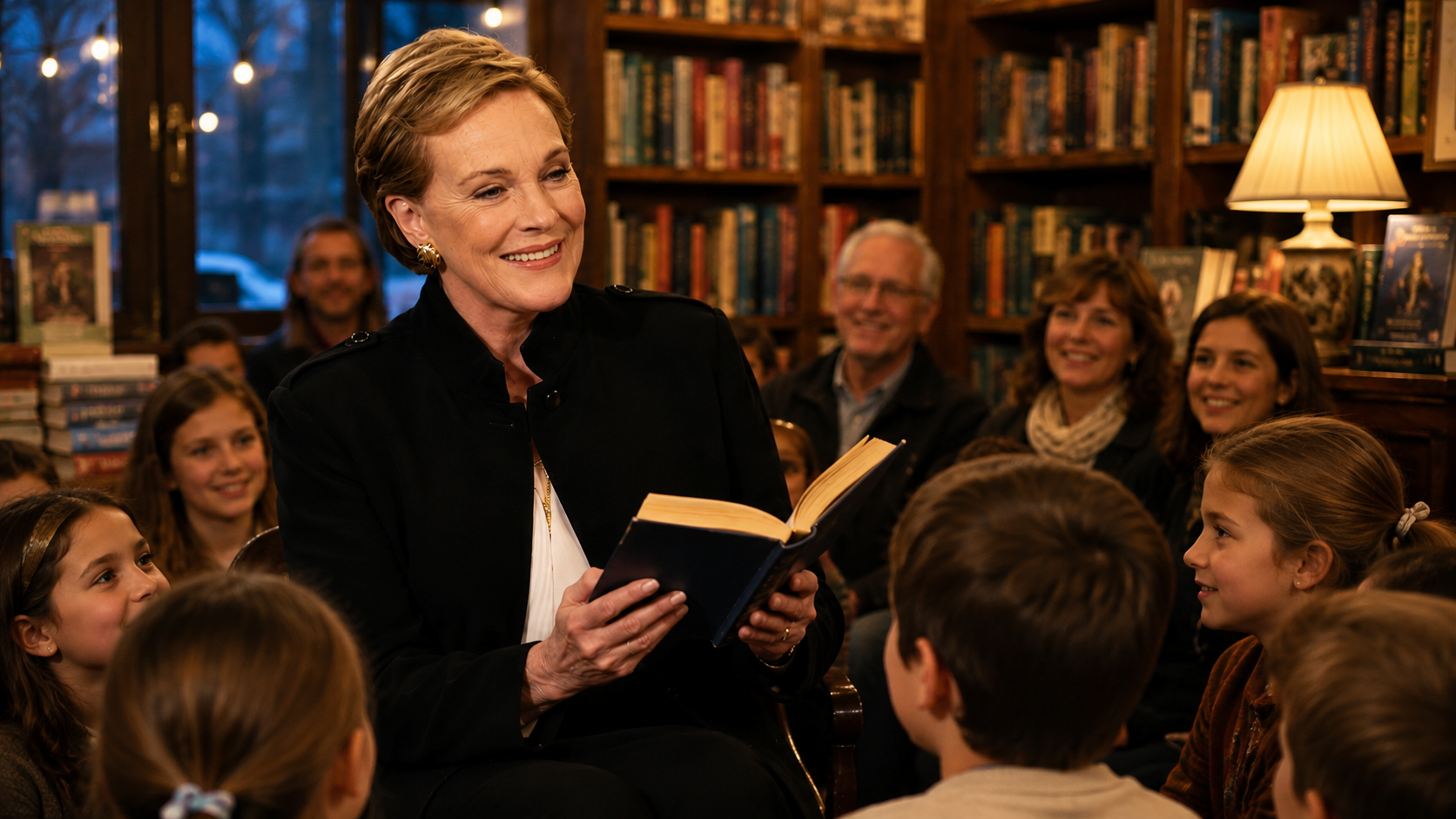
That evening, Julie sat in the reading chair surrounded by children.
She chose a simple story about courage, friendship, and finding one’s way home.
Adults gathered behind them.
Some stood near the windows.
Others sat on the floor.
As Julie read, the room became completely still.
Her voice filled the shop with warmth.
When she reached the final page, she closed the book and looked at the listeners.
“The end of a story,” she said, “is sometimes only the place where another story begins.”
Years later, Hartwell Community Bookshop remained at the heart of Willow Creek.
Emily became its director while continuing her work at the library.
Mr. Hartwell visited every morning at nine o’clock.
He always sat in the same chair with a cup of tea and a book in his hands.
The box of letters stayed beside the counter.
A new sign was placed above it.
LEAVE A STORY FOR SOMEONE WHO MAY NEED IT ONE DAY.
People continued adding notes.
Children wrote about their dreams.
Parents recorded family memories.
Visitors thanked strangers for unexpected kindness.
And once every year, the entire town gathered for a special reading night.
They read old letters.
They shared new stories.
They remembered those who were gone.
They welcomed those who had just arrived.
Julie returned whenever she could.
She never allowed the event to become about her.
Instead, she sat among the townspeople and listened.
Because she understood something Emily had finally learned.
A famous voice might bring people through the door.
But only kindness could make them stay.
And in the little town of Willow Creek, one forgotten bookshop became proof that no community is truly lost while people are still willing to gather, listen, and begin the next chapter together.
The End


