Part 1
For more than fifty years, the little theater on Maple Street had been the heart of the town.
It was not large or fancy. Its red curtains were faded, its wooden seats creaked, and the gold paint around the stage had slowly peeled away with time. But to the people of the town, it was special.
Children had performed their first school plays there. Young couples had gone there on their first dates. Families had laughed together during comedy nights, cried during Christmas concerts, and stood proudly when local singers found their courage on that small stage.
The theater belonged to an elderly couple named George and Clara Whitmore.
George had once been a stage carpenter. He could build anything with wood, nails, and patience. Clara had been a music teacher with a warm smile and a soft voice that could calm even the most nervous child before a performance.
They had spent most of their lives caring for the little theater.
But as the years passed, things changed.
The town grew quieter. People moved away. New entertainment came to phones and big screens. The little theater slowly lost its audience.
Then the roof began to leak.
One winter storm damaged the back wall. The lights stopped working properly. The old piano went out of tune. The curtains became dusty, and the ticket booth window cracked.
George and Clara tried their best to keep it open, but they were getting older. Their hands were slower now. Their savings were nearly gone.
One cold morning, Clara stood in the empty theater and looked at the stage.
“I don’t think we can save it anymore,” she whispered.
George stood beside her, holding his old cap in his hands.
“This place gave people joy,” he said softly. “I wish we could give it one more night.”
Clara’s eyes filled with tears.
“So do I.”
A few days later, something unexpected happened.
Julie Andrews was passing through the town after visiting an old friend nearby. Her car had stopped near Maple Street while her driver checked the directions. As she looked out the window, she noticed the little theater.
There was something about it that made her pause.
The building looked tired, but still beautiful in a quiet way. Above the entrance, faded letters read:
The Whitmore Theater
Julie asked the driver to stop for a moment.
She stepped out and walked closer. On the front door, there was a handwritten note.
Closed until further notice. Thank you for all the memories.
Julie stood there for a long moment.
Then she saw Clara inside, sweeping the floor near the lobby.
Julie gently knocked.
Clara opened the door, surprised.
When she recognized Julie Andrews, she covered her mouth with both hands.
“Oh my,” Clara said. “I must be dreaming.”
Julie smiled kindly.
“No dream, I promise. I saw your theater and wondered if I might come in.”
Clara quickly invited her inside.
The theater was cold, dusty, and quiet. But Julie could still feel its history. She looked at the stage, the old lights, the worn seats, and the photographs on the walls.
There were pictures of children in costumes, town choirs, dance recitals, and Christmas plays from many years ago.
“This place has been loved,” Julie said.
Clara nodded.
“It was our whole life.”
George came from backstage carrying a toolbox. When he saw Julie, he nearly dropped it.
Julie laughed softly and greeted him warmly.
Soon, the three of them sat in the front row. Clara told Julie the story of the theater. She spoke about the first play they hosted, the children who grew up on that stage, and the townspeople who once filled every seat.
George told her how he had repaired the stage floor so many times he knew every board by sound.
“But now,” he said, looking down, “we just don’t have the strength or money to bring it back.”
Julie listened quietly.
Then she looked around the theater again.
After a moment, she said, “Maybe you don’t have to do it alone.”
Clara blinked.
“What do you mean?”
Julie smiled.
“I mean, a theater like this does not belong only to two people. It belongs to everyone who ever found joy here.”
George and Clara looked at each other.
Julie stood and walked onto the stage. Dust rose softly beneath her shoes.
“What if the town helped restore it?” she asked. “What if we gave them a reason to come back?”
Clara’s voice trembled.
“Do you think they would?”
Julie looked at the empty seats.
“I think sometimes people only need to be reminded of what they once loved.”
The next morning, Julie visited the town hall. She spoke with the mayor, local shop owners, teachers, parents, and former performers.
At first, people were unsure.
Everyone was busy. Money was tight. Some said the theater was too old. Others said no one cared anymore.
But then Julie showed them the old photographs from the lobby.
One man saw a picture of himself as a boy dressed as a lion in a school play. A woman found a photo of her late mother singing on stage. A young father saw his parents in the audience from thirty years before.
Slowly, memories came back.
By the end of the meeting, someone offered paint. Someone else offered lumber. A bakery promised food for the workers. A music teacher said her students could perform on opening night.
And just like that, the town began to move.
The next weekend, people gathered at the theater.
They cleaned the seats, repaired the walls, washed the windows, and carried out broken wood. Teenagers painted the lobby. Retired workers fixed the roof. Children helped polish old brass signs.
Julie worked beside them.
She wore simple clothes, tied her hair back, and helped Clara sort through old costumes. She laughed with the children, encouraged the tired workers, and reminded everyone that even small efforts mattered.
George watched from the stage with tears in his eyes.
For the first time in months, he heard the theater alive again.
Not with music yet.
But with voices.
With footsteps.
With hope.
Clara held Julie’s hand and whispered, “You brought them back.”
Julie shook her head gently.
“No, Clara. The theater did. I only opened the door.”
As the days passed, the little theater began to change.
The walls became bright again. The curtains were cleaned and repaired. The old piano was tuned. New lights were placed above the stage. The ticket booth window was replaced.
And on the front door, the sad note was removed.
In its place, a new sign appeared.
Grand Reopening Night — Everyone Welcome
When George saw it, he stood very still.
Then he turned away, wiping his eyes.
Clara smiled through her tears.
For the first time in a long while, the little theater on Maple Street was not closing.
It was waiting for its curtain to rise again.
Part 2 Julie Andrews Helped an Elderly Couple Restore Their Little Theater
Opening night arrived with a golden sunset over Maple Street.
For the first time in years, people lined up outside the Whitmore Theater. Parents held their children’s hands. Elderly neighbors wore their best coats. Teenagers who had helped paint the walls came with proud smiles.
George stood by the door, greeting every guest.
Clara stood near the stage, holding a small program in her shaking hands.
“I’m nervous,” she whispered.
Julie smiled. “That means it still matters.”
Soon, every seat was filled.
The lights dimmed.
The curtain slowly rose.
The first performers were children from the local school. They sang a simple song about home. Their voices were not perfect, but they were full of joy.
Then came a young girl playing the restored piano. After that, a father and daughter performed a funny scene together. The audience laughed, clapped, and wiped away tears.
George and Clara sat in the front row, holding hands.
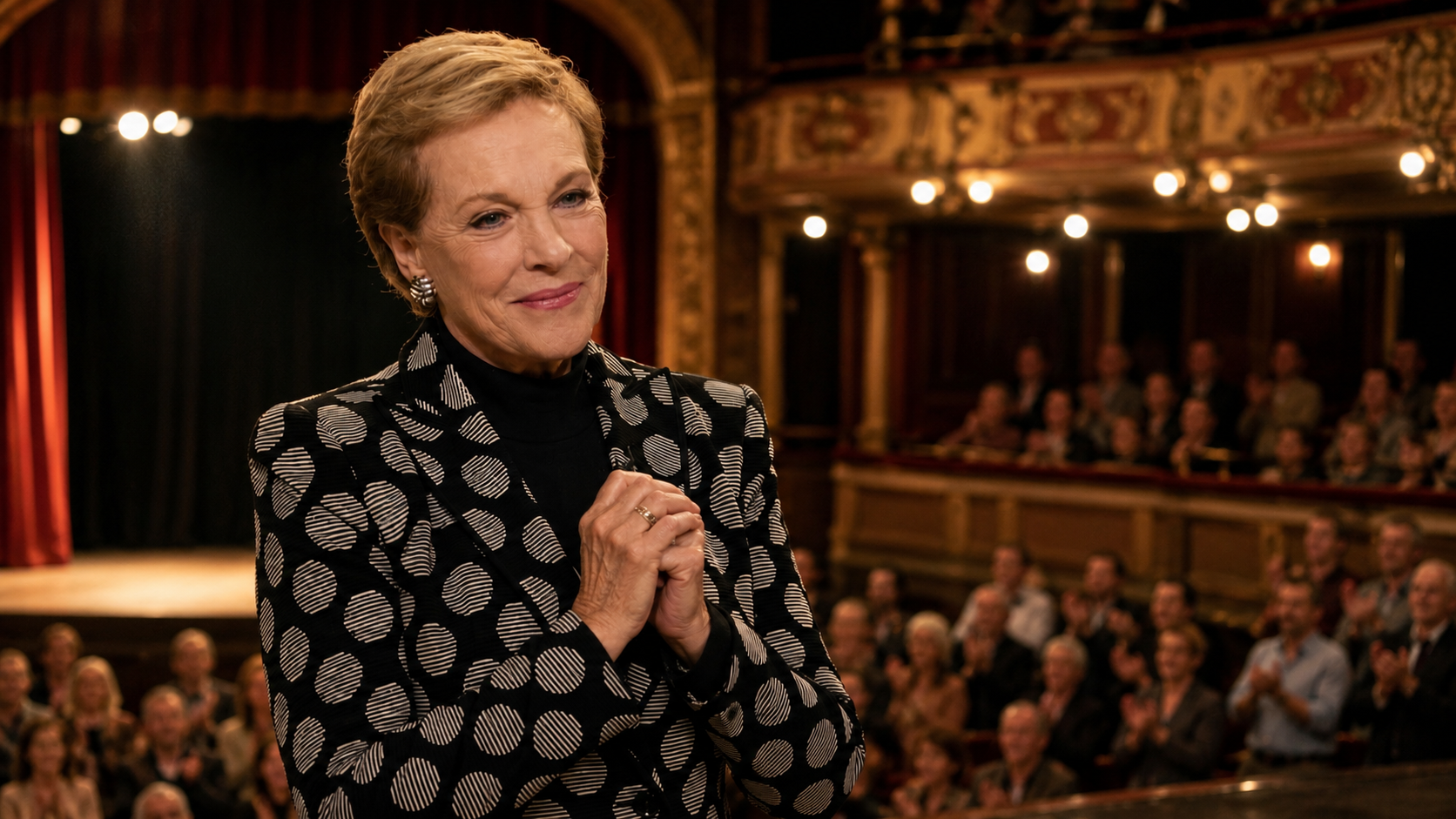
Halfway through the show, Julie walked onto the stage.
The theater became silent.
She looked at the crowd and smiled warmly.
“This theater was never just a building,” she said. “It was a place where this town learned to laugh, sing, dream, and care for one another.”
Clara began to cry softly.
Julie continued, “George and Clara kept this place alive for many years. But tonight, all of you have helped give it a new beginning.”
The audience stood and applauded.
George lowered his head, overcome with emotion. Clara pressed both hands to her heart.
Then Julie invited them onto the stage.
George tried to refuse, but Clara gently pulled him up.
When they reached the center of the stage, Julie handed Clara a small silver key.
“This is not just a key to a theater,” Julie said. “It is a key to all the memories still waiting to be made.”
Clara could barely speak.
George looked at the crowd and said, “We thought this place was finished. But tonight, you showed us it was only resting.”
The audience laughed through their tears.
Then something beautiful happened.
One by one, people began sharing memories.
A woman stood and said she had met her husband at the theater forty years ago.
A man said he had learned confidence there as a shy boy.
A grandmother said her late daughter had sung her first solo on that stage.
Each memory filled the room like music.
By the end of the night, the whole town felt connected again.
The final song was sung by everyone together. Children, parents, grandparents, workers, shop owners, and teachers all joined their voices.
The old theater seemed to glow.
After the show, people stayed for a long time. No one wanted to leave. They hugged George and Clara. They thanked Julie. They promised to keep the theater open.
A local carpenter offered monthly repairs. A teacher planned student plays. A bakery promised snacks for every event. The mayor announced that the town would support the theater as a community center.
George looked at Clara and smiled.
“We got our one more night,” he said.
Clara squeezed his hand.
“No, George,” she said softly. “We got our future back.”
Julie stood near the back of the theater, watching the joy around her.
A little boy came up to her and asked, “Will there be more shows?”
Julie knelt beside him.
“Yes,” she said. “Many more.”
He grinned. “Then I want to be in one.”
Julie smiled.
“That is how every theater begins again.”
Weeks later, the Whitmore Theater was busy almost every weekend. There were music nights, school plays, poetry readings, and charity concerts. People who had once passed the building without looking now stopped to see what was happening inside.
George repaired small things backstage again.
Clara taught children how to stand tall, speak clearly, and believe in themselves.
And Julie received a letter from them every month.
One letter included a photograph.
It showed the theater full of people, the stage bright, and George and Clara standing under the lights with children all around them.
On the back, Clara had written:
You helped us remember that joy can return, even to places we thought were forgotten.
Julie held the photograph for a long time.
Then she placed it on her piano.
Years later, people still talked about that opening night.
They remembered the lights, the music, the laughter, and the moment the whole town stood together.
But most of all, they remembered what Julie Andrews had helped them see:
A place is never truly lost when people still love it.
And sometimes, all a town needs is one open door, one kind heart, and one small stage to bring joy back again.


