Part 1
On a cool autumn afternoon in London, the streets around Covent Garden were alive with music, laughter, and the footsteps of tourists.
Among the talented performers stood a thin seventeen-year-old boy named Daniel.
His violin had scratches along its wooden body, and one of the strings had been replaced with an inexpensive one that never quite stayed in tune. His jacket was old, his shoes were worn, and the small case at his feet held only a few scattered coins.
Still, Daniel played every afternoon.
Music was the only thing that made him feel alive.
Years earlier, his father had taught him how to hold a violin before illness took him away. His mother worked long hours cleaning offices, barely earning enough to pay rent.
Formal music lessons had become impossible.
So Daniel practiced alone.
He listened to recordings in the public library.
He watched old concert videos online whenever he could.
He played in parks, train stations, and busy streets—not just for money, but because he refused to let his father’s dream disappear.
But dreams are difficult to carry when life keeps getting heavier.
That afternoon, very few people stopped to listen.
Some hurried past.
Others tossed in loose change without looking.
A few even complained that he was blocking the walkway.
Daniel finished another piece and quietly lowered his violin.
Maybe everyone was right.
Maybe he wasn’t good enough.
Maybe music was only for people with expensive schools, famous teachers, and wealthy families.
He began packing his instrument.
Just then, an elderly woman wearing a simple blue coat stopped beside him.
She smiled warmly.
“You were about to leave.”
Daniel nodded.
“I don’t think anyone wants to hear me.”
The woman looked at the violin before meeting his eyes.
“I disagree.”
Daniel gave a polite smile.
“I make mistakes.”
“So does every musician.”
“I’m not special.”
She chuckled softly.
“Neither is anyone… until they decide not to quit.”
Something about her calm voice felt comforting.
She wasn’t speaking like a celebrity.
She sounded like a grandmother who simply cared.
“I’m Julie,” she said gently.
Daniel blinked.
Julie?
His eyes widened.
Slowly, recognition spread across his face.
“Julie Andrews?”
She laughed quietly.
“I’m afraid so.”
Daniel nearly dropped his violin.
“I’m… I’m so sorry. I didn’t recognize you.”
“No apology needed.”
She looked toward the violin case.
“May I hear one more song?”
Daniel hesitated.
“My best one?”
“No.”
“My favorite.”
He swallowed nervously.
Then he lifted the violin once more.
This time he closed his eyes.
Instead of worrying about perfect notes…
he simply played.
The melody was gentle.
Hopeful.
Full of longing.
Every note carried memories of his father.
When he finished, the busy street seemed unusually quiet.
Julie Andrews clapped first.
Then several nearby strangers joined her.
Within seconds, dozens of people who had been walking past stopped and applauded.
Daniel stared in disbelief.
Julie smiled.
“You see?”
“They only needed a reason to stop.”
Daniel’s eyes filled with tears.
“I don’t think I’ll ever become a real musician.”
Julie gently placed a hand on his shoulder.
“Daniel…”
“The world doesn’t need perfect musicians.”
“It needs honest ones.”
Those words settled deep inside him.
Before leaving, Julie reached into her bag.
She didn’t hand him money.
Instead, she gave him a small notebook.
The cover was dark green with gold edges.
“It’s empty,” Daniel said.
“Exactly.”
He looked confused.
Julie smiled.
“Fill every page with one thing you learn after each performance.”
“Good or bad.”
“One day you’ll discover that improvement is written one page at a time.”
She wrote something on the first page.
Never measure your dream by today’s audience.
Measure it by tomorrow’s courage.
— Julie Andrews
Daniel carefully closed the notebook as though it were priceless.
“I’ll never forget this.”
Julie smiled.
“I hope you don’t remember me.”
Daniel looked surprised.
“I hope you remember how you felt while playing that last song.”
“That’s the musician you truly are.”
Then she quietly disappeared into the crowd.
Daniel watched until she was gone.
That evening he didn’t go home early.
He stayed.
He played until sunset.
The next day he returned.
Then the next.
Weeks became months.
Months became years.
Every performance ended with a new sentence inside the green notebook.
Some entries were joyful.
Today a little girl danced while I played.
Some were painful.
Only six coins today.
Others reminded him why he continued.
A stranger cried during my last piece.
Maybe music really does matter.
Whenever he felt discouraged, he reread Julie’s message.
Never measure your dream by today’s audience.
Measure it by tomorrow’s courage.
Those words became the foundation of his life.
Years passed.
Daniel earned a scholarship to a respected music conservatory after a local conductor happened to hear him performing outdoors.
He studied tirelessly.
Practiced before sunrise.
Stayed long after everyone else had gone home.
Eventually, invitations to perform began arriving from orchestras across Europe.
Critics praised his emotional performances.
Audiences loved how every note felt deeply personal.
Yet Daniel kept the old violin.
The scratches remained.
The repaired string had long since been replaced, but he never restored the worn finish.
It reminded him where hope had truly begun.
One evening, nearly fifteen years after meeting Julie Andrews, Daniel prepared for the biggest concert of his career.
The historic theater was completely sold out.
Television cameras filled the balconies.
Musicians tuned their instruments backstage.
His manager walked over.
“There’s someone very special in tonight’s audience.”
Daniel smiled politely.
“I’m grateful everyone came.”
The manager grinned.
“No.”
“You don’t understand.”
“I think you’ll want to see the guest list.”
Daniel unfolded the paper.
Halfway down…
His hands froze.
Julie Andrews.
He stared at the name for several silent seconds.
Could it really be her?
He hadn’t seen her since that afternoon in Covent Garden.
He wondered if she would even remember a nervous boy with a worn violin and an empty notebook.
The stage manager called his name.
“It’s time.”
Daniel took one deep breath, slipped the old green notebook into his jacket pocket, picked up his violin, and walked toward the bright lights.
He had no idea that before the night was over, the reunion he had dreamed about for fifteen years would leave an entire audience wiping away tears.
Part 2: The Reunion That Left the Audience in Tears
Daniel stepped onto the stage as the audience rose in applause.
The lights were bright.
The theater was full.
But his eyes searched only one place.
The front rows.
Then he saw her.
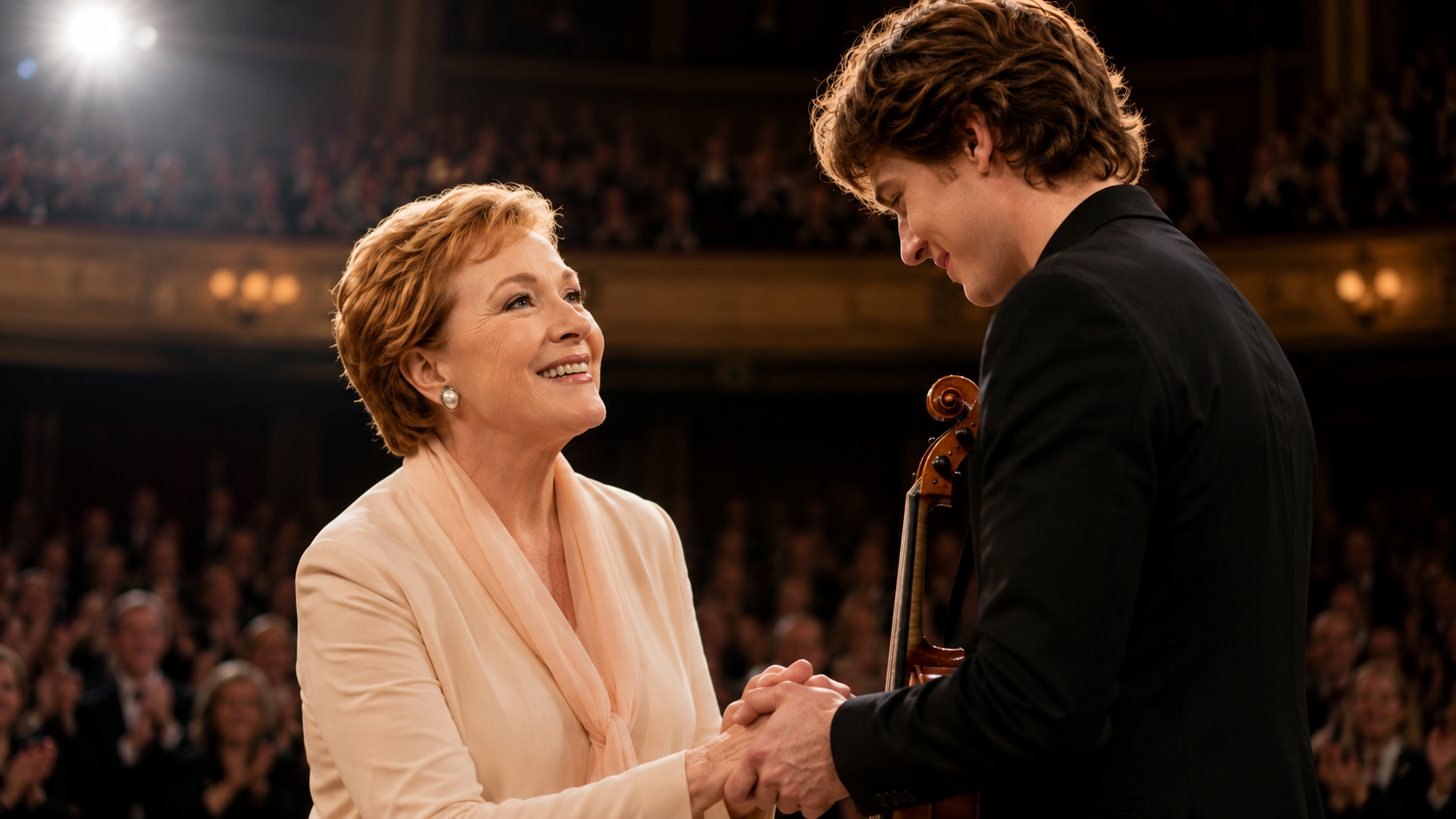
Julie Andrews sat quietly near the center, wearing a soft cream jacket and a gentle smile.
She was older now, but her kindness looked exactly the same.
Daniel felt his throat tighten.
For a moment, he was not a famous musician standing before thousands of people.
He was seventeen again.
A tired boy on a cold street.
A boy who had almost given up.
He placed his violin under his chin and began to play.
The first piece was powerful.
The second was graceful.
The third was filled with joy.
But the final piece was different.
Daniel turned to the audience.
“Before I play my last song,” he said softly, “I want to tell you about someone who changed my life.”
The theater became silent.
“Fifteen years ago, I was playing violin on a street corner. I was poor, discouraged, and ready to quit. That day, a woman stopped and asked me to play one more song.”
Julie lowered her eyes, already understanding.
“She told me the world did not need perfect musicians. It needed honest ones.”
A quiet wave of emotion moved through the audience.
Daniel reached into his jacket and pulled out the old green notebook.
“This was her gift to me.”
He opened the first page.
His voice shook as he read:
“Never measure your dream by today’s audience. Measure it by tomorrow’s courage.”
Then he looked directly at Julie.
“Dame Julie Andrews, I never got the chance to properly thank you.”
The audience gasped softly.
Then all eyes turned toward her.
Julie pressed a hand over her heart.
Daniel smiled through tears.
“This final piece is called Tomorrow’s Courage. I wrote it because of you.”
Then he lifted his violin.
The first note was tender.
It sounded like a lonely street in autumn.
Then the music slowly grew.
It carried sadness, hope, struggle, and strength.
It sounded like a boy learning not to quit.
It sounded like a dream being rebuilt one small note at a time.
Julie’s eyes filled with tears.
Around her, people quietly wiped their faces.
The orchestra joined softly behind Daniel, making the music swell like sunrise after a long night.
When the final note faded, nobody moved.
For a few seconds, the whole theater sat in silence.
Then the audience stood.
The applause thundered through the hall.
Daniel lowered his violin and turned toward Julie.
Without saying a word, he walked down from the stage.
The crowd parted as he reached her row.
Julie stood slowly.
Daniel held out the green notebook.
“I filled every page,” he whispered.
Julie looked at him with tears in her eyes.
“And you filled far more than that,” she said. “You filled hearts.”
Daniel hugged her gently.
The audience applauded even louder.
Some people cried openly.
Others simply smiled, touched by the beauty of a promise kept without ever being spoken.
Later that night, reporters asked Daniel what the greatest moment of his career had been.
He did not mention the sold-out theater.
He did not mention the critics.
He did not mention the awards waiting in his future.
He only said, “The greatest moment was when someone believed in me before I believed in myself.”
Julie Andrews smiled when she heard his answer.
And somewhere, in the pages of an old green notebook, Daniel wrote one final line:
Tonight, I learned that one kind word can echo for a lifetime.
From that day on, Daniel became known not only as a brilliant musician, but as a man who helped young artists find courage.
Whenever he passed a street musician, he stopped.
He listened.
He encouraged.
And sometimes, he gave them a small notebook.
Because he knew the truth now.
Dreams do not always begin on grand stages.
Sometimes they begin on cold sidewalks.
Sometimes they begin with tired hands, an old violin, and one person kind enough to say:
“Please play one more song.”
The End


