The old cabin stood at the edge of Walnut Creek, hidden behind tall grass, broken fences, and years of silence.
For a long time, nobody wanted to go near it.
The roof leaned to one side. The windows were covered in dust. Vines crawled up the wooden walls like the cabin had been slowly disappearing into the earth.
But Michael Landon saw something different.
He saw a place that still had a story.
After years of being forgotten, the cabin was being restored for a small community project. It was meant to become a quiet place where children could read, draw, and learn about kindness, courage, and family.
Michael had agreed to help because the idea touched his heart.
“This old place just needs someone to believe in it again,” he said softly.
The workers smiled, but Michael was serious.
To him, old places were like old people. They carried memories. Some were painful. Some were beautiful. But all of them mattered.
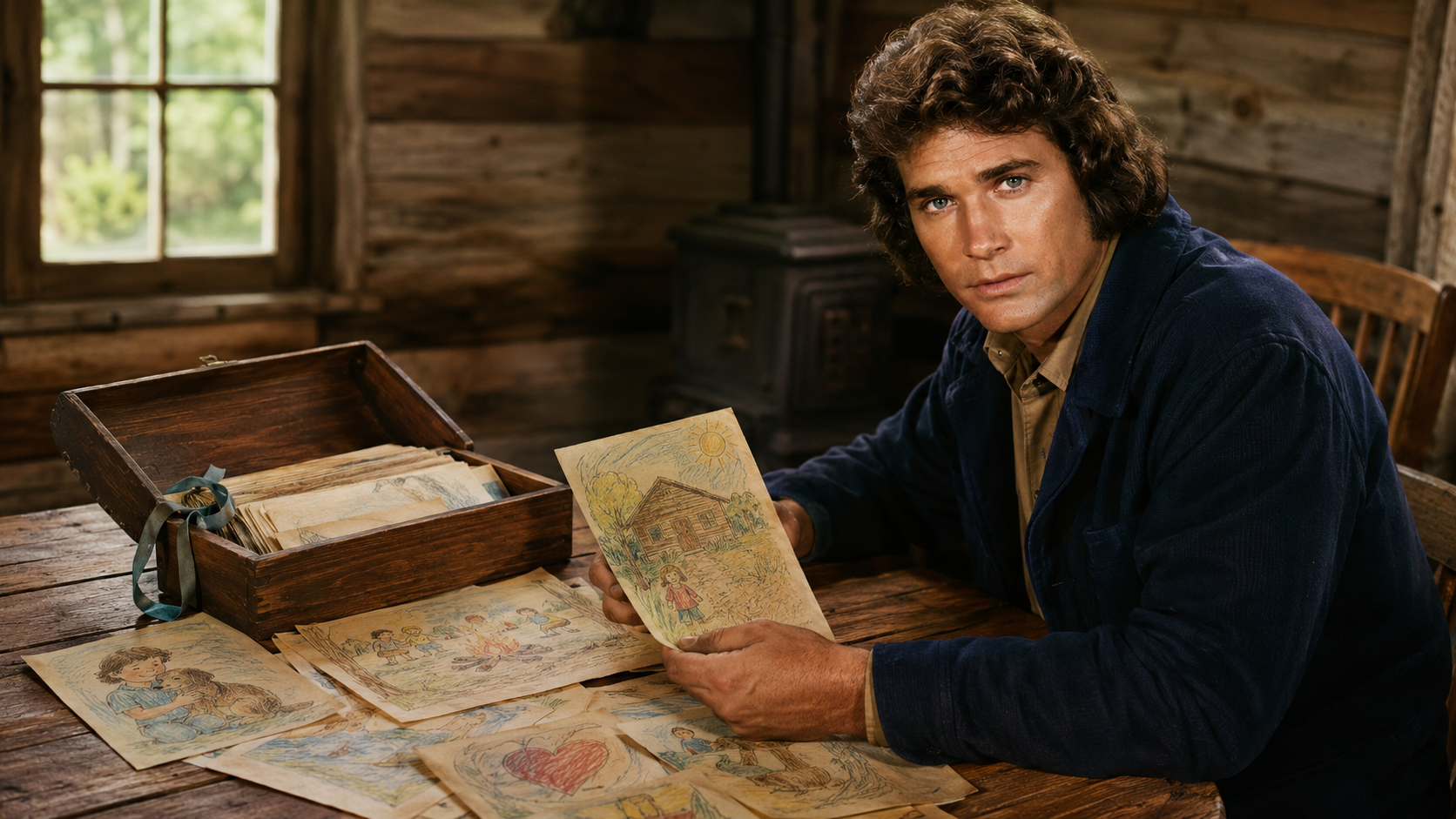
That morning, sunlight spilled through the trees as Michael stepped inside the cabin. The floor creaked under his boots. Dust floated in the air. A cold smell of old wood filled the room.
Most of the furniture was gone. Only a small table, a broken chair, and a rusted stove remained.
But in the corner, beneath a loose floorboard, Michael noticed something.
A small wooden box.
It was covered in dust and tied with a faded blue ribbon.
Michael knelt down and lifted it carefully.
“What did you find?” one worker asked.
“I’m not sure,” Michael replied.
He placed the box on the table and untied the ribbon.
Inside were children’s drawings.
Dozens of them.
Some were made with crayons. Some with pencils. Some were faded by time. The paper was yellow and fragile, but the pictures were still clear.
Michael picked up the first drawing.
It showed a little girl standing beside the cabin. Above her head was a bright yellow sun. Under the picture, in careful child handwriting, were the words:
“This is the place where I learned not to be afraid.”
Michael froze.
He slowly looked at the others.
One drawing showed a boy holding a dog.
Another showed children sitting around a fire.
Another showed a woman handing bread to a hungry child.
Each picture had a sentence written at the bottom.
“She gave me soup when nobody else did.”
“I slept here when the storm came.”
“This house kept us warm.”
The room became very quiet.
Michael sat down slowly, holding the drawings like they were treasure.
This cabin had not been empty after all.
It had once been a shelter.
A place where frightened children had found safety.
A place where kindness had quietly lived.
Michael’s eyes softened.
“Who made these?” someone whispered.
Michael looked at the box again. At the bottom was a folded note.
He opened it carefully.
The handwriting was old and shaky.
“These children came here with heavy hearts. I asked each one to draw something good they still believed in. I told them hope does not disappear just because life becomes hard.”
The note was signed:
Mrs. Clara Bennett
No one in town had spoken that name in years.
But Michael remembered hearing about her.
Clara Bennett had been a widowed schoolteacher who lived alone in the cabin many years ago. People said she was quiet, gentle, and always ready to help.
But nobody knew she had helped this many children.
Michael looked again at the drawings.
Suddenly, the cabin felt alive.
He could almost hear children laughing. He could imagine Clara standing near the stove, warming soup, drying tears, and telling scared children that tomorrow could still be better.
Michael held up one drawing.
It showed a small hand reaching toward a bright star.
Below it were the words:
“One day, I will shine too.”
Michael swallowed hard.
“We’re not just restoring a cabin,” he said.
“We’re restoring a promise.”
From that moment, the project changed.
The workers no longer saw broken walls and old wood. They saw a place that had carried children through their darkest days.
Michael asked the town library to search old records. He asked neighbors if they remembered Clara Bennett. He wanted to know who the children were.
At first, no one had answers.
Then an elderly woman named Ruth came to the cabin.
She walked slowly with a cane. Her hands trembled as she looked at the drawings laid across the table.
Then she pointed to one picture.
A little girl. A yellow sun. A cabin.
“That one is mine,” Ruth whispered.
Michael turned to her gently.
Ruth’s eyes filled with tears.
“I was eight years old,” she said. “My father had left. My mother was sick. We had nowhere to go during a winter storm. Mrs. Bennett brought us here. She gave me a blanket and told me I was brave.”
She touched the paper with shaking fingers.
“I forgot I drew this.”
Michael smiled softly.
“You didn’t forget the hope,” he said.
Ruth cried then, not from sadness, but from the feeling of being remembered.
Soon, more people came.
An old farmer recognized a drawing of a dog.
A retired nurse found a picture she had made as a child.
A quiet man stood in front of a drawing of a broken heart stitched together with red crayon.
“That was mine,” he said. “Mrs. Bennett told me broken things can still love.”
The cabin became more than a restoration project.
It became a place where hidden memories returned.
Every drawing opened a door.
Every picture told a story.
And every story proved one thing:
Kindness given long ago can still warm the world many years later.
But one drawing remained a mystery.
It was folded at the bottom of the box.
The paper was darker than the rest.
Michael opened it slowly.
It showed the cabin surrounded by children, flowers, and light.
In the center stood Mrs. Bennett.
But beside her was a small boy with no face drawn in.
Under the picture were the words:
“He was the one she waited for.”
Michael stared at the sentence.
“Who was he?” Ruth asked quietly.
Michael did not know.
But something about that faceless boy felt important.
And deep in his heart, Michael knew the cabin still had one more secret to tell.
End of Part 1
The next morning, Michael returned to the cabin before anyone else arrived.
The sky was pale blue. The grass was wet with dew. Birds sang from the trees as if the whole place had awakened.
But Michael could only think about the final drawing.
“He was the one she waited for.”
He placed it on the table and studied it again.
The faceless boy stood beside Mrs. Bennett, surrounded by children. His hands were small. His coat was colored brown. Above him, a bright star had been drawn in yellow crayon.
Michael looked at the back of the paper.
There, almost hidden by age, was one word:
Samuel
Michael began searching.
He visited the town hall. He looked through old school records, church papers, and newspaper clippings. After hours of searching, he found a small notice from many years ago.
Missing Child: Samuel Bennett, age 7. Last seen near Walnut Creek after heavy flooding.
Michael’s heart sank.
Samuel Bennett.
Clara Bennett’s son.
The cabin suddenly felt different.
All those years, Clara had helped lost and hurting children while carrying the pain of losing her own.
Maybe that was why she opened her door.
Maybe every child she helped reminded her of the son she never stopped waiting for.
Michael sat quietly with the old newspaper in his hands.
“She turned her grief into kindness,” he whispered.
That afternoon, Ruth returned with more people from town. Michael shared what he had found.
The room fell silent.
The story of Clara Bennett became even more powerful.
She had lost her child, yet she had become a motherly light for many others.
She could have closed her heart.
Instead, she opened her home.
One retired nurse wiped her eyes.
“She saved me when I was little,” she said. “And I never knew she was hurting that deeply.”
A farmer removed his hat.
“We should have remembered her better.”
Michael nodded.
“Then let’s remember her now.”
Together, the town decided the restored cabin would be named The Clara Bennett House of Hope.
But Michael wanted more than a sign on the door.
He wanted the drawings to be protected.
So he worked with the library, the school, and the local museum. Each drawing was gently cleaned, copied, framed, and placed inside the cabin.
Under every picture, they wrote the story behind it.
Ruth’s drawing became the first one on the wall.
“This is the place where I learned not to be afraid.”
Beside it, they placed a small note:
Ruth was eight when Clara gave her shelter during a winter storm. She grew up to help children in need, just as Clara helped her.
More stories followed.
The boy with the dog became a veterinarian.
The girl who drew a star became a teacher.
The child who drew the stitched heart became a counselor.
Each life had been touched by Clara’s kindness.
Each life had carried that kindness forward.
Then came the final drawing.
The one with Samuel.
Michael placed it in the center of the room.
Below it, he wrote:
“For Samuel Bennett, the little boy Clara never stopped loving. And for every child who found hope because her love did not end.”
On opening day, the whole town came.
Children arrived with their parents. Elderly people came with tears in their eyes. Former students, neighbors, and strangers filled the yard.
The cabin no longer looked forgotten.
Its walls were repaired. The windows shined. Flowers grew near the steps. A small wooden sign hung above the door:
The Clara Bennett House of Hope
Michael stood on the porch and looked at the crowd.
“This cabin teaches us something simple,” he said. “Sometimes the greatest heroes are not the loudest people. Sometimes they are quiet souls who leave soup on the stove, blankets by the fire, and hope in the hearts of children.”
The crowd listened in silence.
Michael continued.
“Clara Bennett lost something precious. But she did not let loss make her bitter. She let love become bigger than pain. Because of that, many children grew up believing they mattered.”
Ruth stepped forward with a small box in her hands.
“I brought something,” she said.
She opened it and took out an old blue ribbon.
“It was from Clara,” Ruth explained. “She tied it around my blanket the night she helped me. I kept it all these years.”
Michael smiled.
Then Ruth tied the ribbon around the handle of the cabin door.
Everyone clapped softly.
Not loudly.
Just softly.
The kind of applause that feels like a prayer.
After the ceremony, children entered the cabin. They looked at the old drawings with wide eyes. Some asked questions. Some stood quietly.
At the small table near the window, Michael placed new paper and crayons.
A little girl sat down and began to draw.
Michael watched as she drew the cabin, the sun, and a line of children holding hands.
At the bottom, she wrote:
“Hope lives here.”
Michael’s eyes filled with tears.
Many years earlier, Clara Bennett had asked scared children to draw something good they still believed in.
Now, a new child was doing the same.
The story had not ended.
It had only been waiting.
As evening came, golden light touched the cabin walls. The town slowly went home, but Michael stayed behind for a moment.
He stood inside the quiet room, surrounded by drawings from the past and one fresh picture from the present.
He thought of Clara.
He thought of Samuel.
He thought of every child who had walked through that door afraid and left with a little more courage.
Then he smiled.
The cabin was no longer empty.
It was full of voices.
Full of memories.
Full of love.
And on the wall, the final drawing seemed to glow in the fading light.
A mother.
A missing son.
A circle of children.
And a promise that kindness, once given, never truly disappears.
End of Part 2


