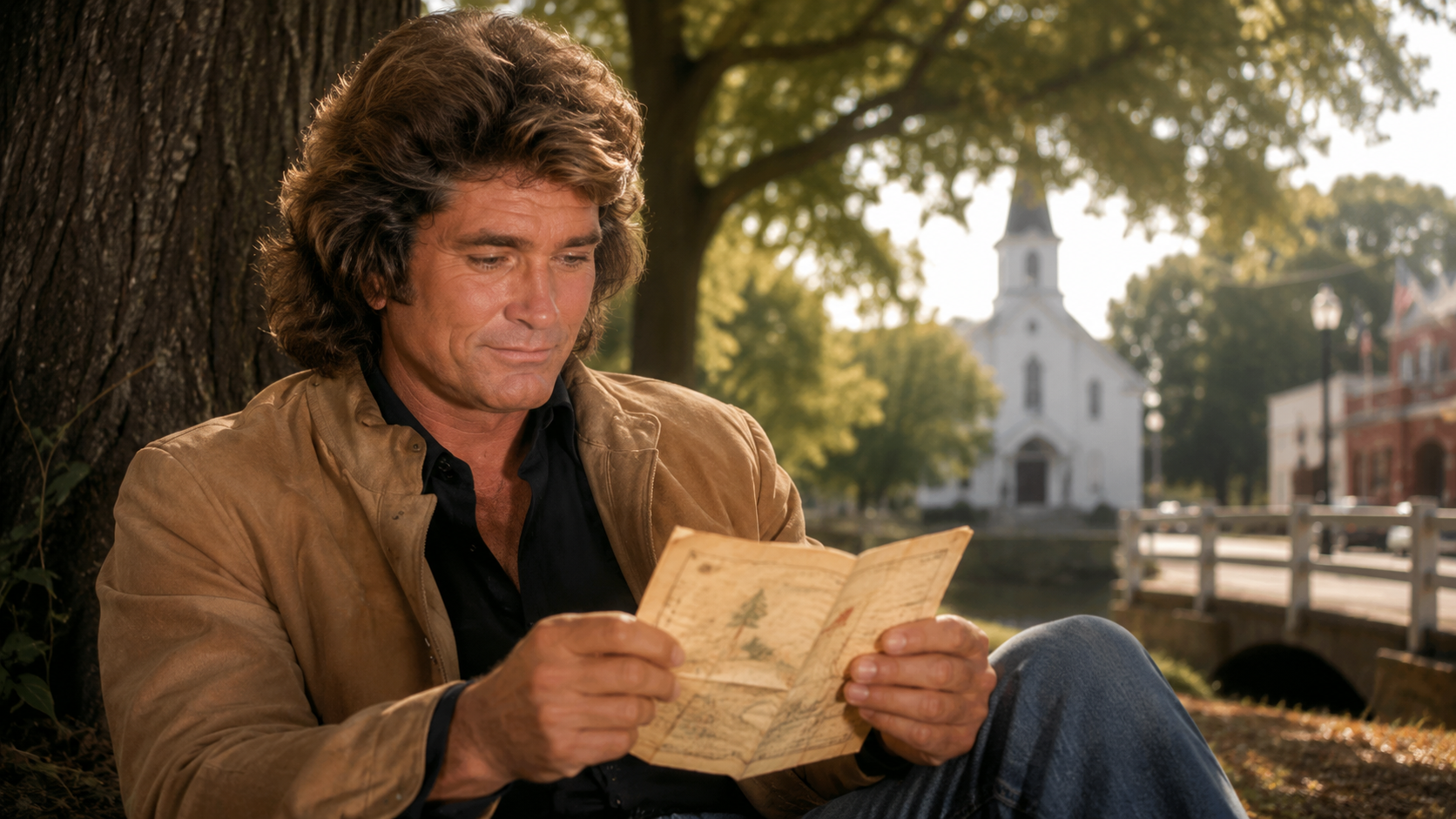
The old wooden box had been locked away for more than forty years.
It sat quietly in the back room of a small-town museum, covered in dust, forgotten by almost everyone except the elderly volunteer who cleaned around it every Friday morning.
The box had once belonged to a child named Annie Miller.
No one knew much about Annie anymore. Her family had moved away long ago. Her school had closed. Even the house where she once lived had been torn down and replaced by a parking lot.
But inside that box was something that would soon bring her memory back to life.
It began on a rainy afternoon, when the museum decided to restore an old Michael Landon film display. The display had been damaged by time. The photographs had faded, the frame had cracked, and the small collection of letters from fans had turned yellow at the edges.
To the town, Michael Landon was more than a television star. His stories had given families comfort. His characters had taught people about kindness, courage, faith, and love. Many people in town had grown up watching him on screen, feeling as though he was part of their own family.
So when the museum received a newly restored portrait of Michael Landon, they planned a small celebration.
While preparing the display, Clara Benson, the museum volunteer, opened the old wooden box.
Inside, she found drawings, letters, and one folded piece of paper tied with a faded blue ribbon.
When she opened it, she smiled.
It was a map.
Not a real map with street names or numbers, but a child’s map. It was drawn in colored pencil. There were crooked trees, a little bridge, a church with a tall steeple, and a big red X beside a place labeled:
“The Treasure That Makes Sad People Smile.”
At the bottom, in shaky handwriting, were the words:
“For Michael Landon, if he ever comes to our town.”
Clara felt her heart tighten.
She carefully unfolded the rest of the paper. On the back was a letter from Annie.
“Dear Mr. Landon,” it began, “I made this map because you help people feel brave on TV. If you ever feel sad, follow this map. The treasure is not money. It is something better.”
Clara sat down slowly.
The letter had never been mailed.
No one knew why Annie had written it. No one knew if Michael Landon had ever known she existed.
But Clara knew one thing.
This map deserved to be followed.
The next morning, the museum invited a small group of fans, historians, and townspeople to join a special walk through town. They called it “Michael Landon’s Lost Treasure Trail.”
They began at the museum, holding copies of Annie’s old map.
The first stop was the little bridge. It still stood at the edge of town, though it had been rebuilt many times. Under one of the railings, they found a small carved heart with the initials A.M.
Clara touched it gently.
“She really was here,” someone whispered.
The second stop was the church.
The church was old now, but still beautiful. Its white paint was peeling, and the bell no longer rang as loudly as it once had. Inside, the group found an elderly man sitting alone in the back pew.
His name was Samuel.
When Clara showed him the map, his eyes filled with tears.
“I knew Annie,” he said softly. “She was the kindest child in our school.”
Everyone grew quiet.
Samuel explained that Annie had been sick when she was young. She could not always run and play like the other children, so she spent most of her time drawing, writing letters, and making little gifts for lonely people.
“She loved Michael Landon,” Samuel said. “She said his stories made her feel like there was still good in the world.”
Clara looked down at the map.
“What happened to her?” she asked.
Samuel took a slow breath.
“She passed away before her tenth birthday.”
No one spoke for a moment.
The rain tapped gently against the church windows.
Then Samuel pointed to the next mark on the map.
“If you want to find the treasure,” he said, “you need to go to the old schoolyard.”
The old schoolyard was no longer a school. The building had been turned into a community center, but the big oak tree was still there.
The map showed the red X near that tree.
Everyone gathered around as Clara knelt near the roots. She brushed away leaves and dirt until her fingers touched something hard.
It was a small metal tin.
The lid was rusty, but it opened.
Inside was no gold.
No jewelry.
No money.
Only paper.
Folded notes.
Tiny drawings.
And one photograph of a little girl with bright eyes, holding a handmade sign that read:
“Kindness Is Treasure.”
Clara’s hands trembled as she opened the first note.
It said:
“Give this to someone who forgot how special they are.”
Another said:
“Tell one lonely person they matter.”
Another said:
“Smile at someone who looks sad.”
There were dozens of notes, each one written by Annie.
The final note was addressed to Michael Landon.
Clara read it aloud.
“Dear Mr. Landon, if you found this, thank you for teaching me that family is not only the people in your house. Family can be anyone who loves, helps, and forgives. I do not have gold to give you, but I have my best treasure. Please help people remember to be kind.”
By the time Clara finished reading, many people were crying.
They had followed a child’s map expecting a mystery.
Instead, they found a message that had waited decades to be heard.
And somehow, through the memory of Michael Landon and the heart of one little girl, the town began to change.
The story of Annie’s map spread faster than anyone expected.
At first, it was only shared at the museum. Then someone posted a photo of the old map online. Soon, people from nearby towns began visiting the community center to see the oak tree and the little tin box.
But Clara did not want Annie’s treasure to become just another display behind glass.
She believed Annie had wanted something more.
So the museum created a new tradition.
Every visitor was invited to take one of Annie’s kindness notes and complete the message written on it.
If the note said, “Tell one lonely person they matter,” the visitor had to do exactly that.
If it said, “Give this to someone who forgot how special they are,” they had to find someone who needed encouragement.
Then they could return and write their own note for someone else.
At first, only a few people joined.
A young boy gave a note to his teacher, who had been having a hard year.
A widow gave a note to the grocery clerk who always helped carry her bags.
A teenager left one on the porch of a neighbor who had lost his dog.
Then the kindness began to grow.
People started fixing fences for elderly neighbors. Families cooked meals for those who were sick. Children drew pictures for nursing home residents. Strangers paid for coffee, wrote thank-you cards, and visited people who had not had company in months.
The old schoolyard became a place of hope again.
One afternoon, Clara returned to the oak tree and found Samuel sitting beneath it.
He held one of Annie’s notes in his hand.
“I never told anyone this,” Samuel said, “but Annie gave me a note once when we were children.”
Clara sat beside him.
“What did it say?”
Samuel smiled through tears.
“It said, ‘You are not invisible.’”
He looked toward the community center, where children were laughing near the door.
“I was a quiet boy,” he continued. “My father had left, and I felt like nobody saw me. Annie did. That little note stayed in my pocket for years.”
Clara gently touched his arm.
“She changed your life.”
Samuel nodded.
“And now she is changing many more.”
A few weeks later, the museum held the Michael Landon restoration celebration.
The newly restored portrait stood in the center of the room. Around it were fan letters, old photographs, and now, Annie’s map.
But the most powerful part of the display was not the picture.
It was the wall beside it.
Hundreds of kindness notes covered the wall. Some were written by children. Some were written by parents. Some were written by people who had once felt forgotten.
One note said:
“Because of Annie, I called my brother after ten years.”
Another said:
“I forgave my mother today.”
Another said:
“I helped my neighbor, and now we have dinner together every Sunday.”
At the bottom of the wall was Annie’s original message:
“Kindness Is Treasure.”
Clara stood before the crowd and spoke with a gentle voice.
“Michael Landon gave many people stories about love, family, and faith. Annie was one of those people. She was only a child, but she understood something many adults forget. The greatest treasure is not what we keep. It is what we give.”
The room went silent.
Then Samuel stepped forward with one final surprise.
In his hands was an old envelope.
“I kept this for forty years,” he said.
Inside was the first note Annie had ever given him.
The paper was fragile, but the words were still clear.
“You are not invisible.”
Samuel placed it beside her map.
“For Annie,” he whispered.
That day, the town made a promise.
Every year, on the date the map was found, they would hold Kindness Day. No speeches. No big awards. Just simple acts of love.
And every year, people would gather under the oak tree to read Annie’s notes.
Some said the treasure had finally been found.
But Clara believed the truth was even more beautiful.
The treasure had never been buried.
It had been waiting inside every person who chose to care.
And although Michael Landon never held Annie’s map in his hands, the stories he shared had reached a little girl’s heart. In return, her small message reached an entire town.
Not with gold.
Not with fame.
But with kindness.
And that was worth more than anything.


