The Box in the Attic
For forty years, the old Walton house held its secrets quietly.
The mountain had changed over time. The road was wider now. New houses stood where open fields once stretched under the morning sun. But the old home still carried the same feeling. The porch still faced the hills. The kitchen still seemed to remember the sound of laughter. And upstairs, beneath the slanted roof, the attic waited in silence.
It was Elizabeth Walton who found the box.
She had returned to Walton’s Mountain after many years away. The house needed repairs, and the family had agreed it was time to clean out the rooms that had been left untouched for too long. Most of what she found was expected: old quilts, schoolbooks, cracked picture frames, and jars filled with buttons.
Then, behind a loose board near the attic wall, she saw a small wooden chest.
It was covered in dust.
Her hands trembled as she pulled it out.
On the top, written in faded pencil, were three words:
John-Boy’s papers.
Elizabeth sat back on her heels and stared at it.
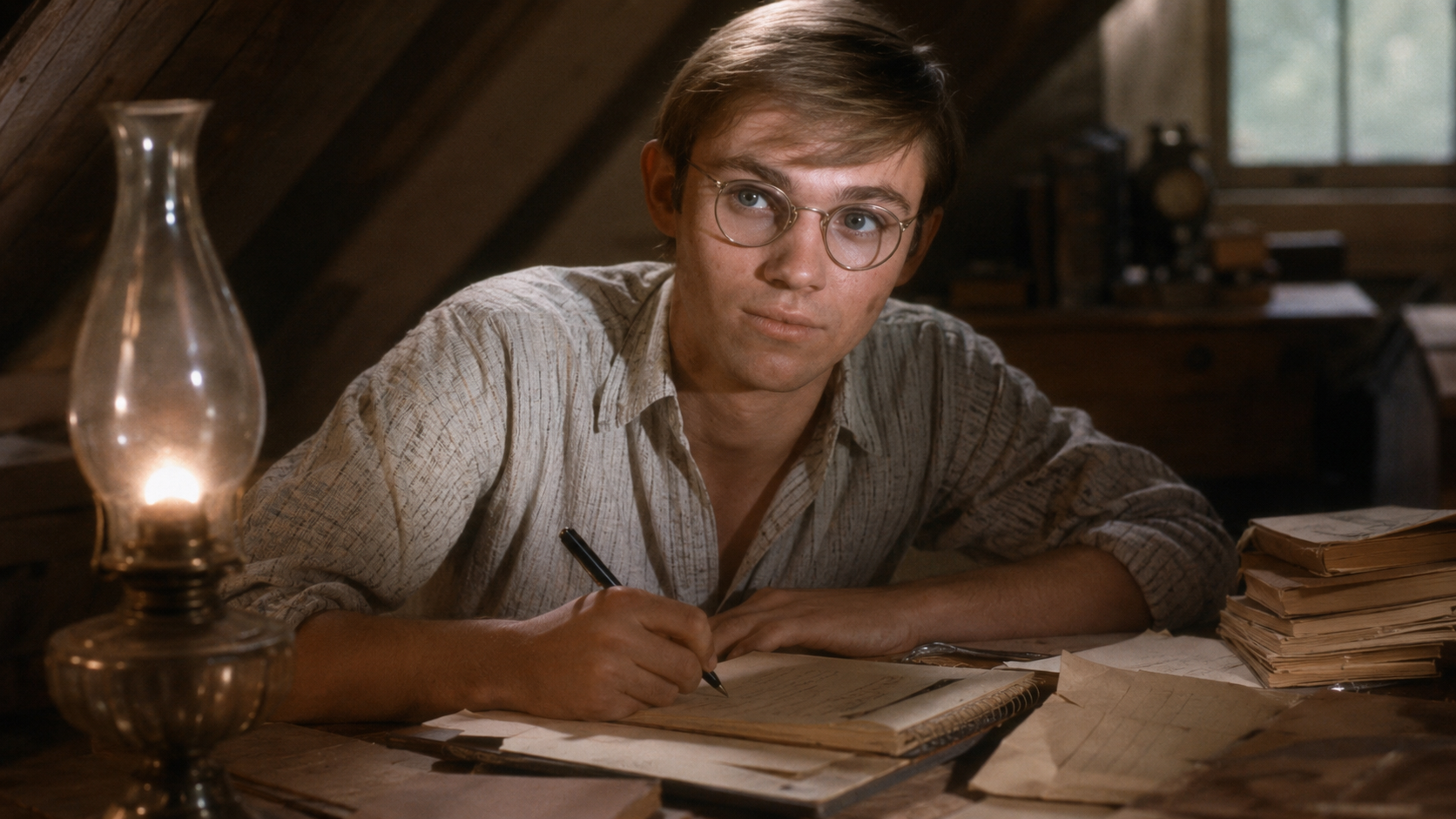
John-Boy had been gone for several years now. Even after all that time, saying his name still brought a soft ache to her heart. He had become a respected writer, just as everyone knew he would. But to the family, he was still the boy at the upstairs window, writing by lamplight while the rest of the house slept.
Inside the chest were letters, notebooks, and loose pages tied with string.
At the bottom was a thick stack of yellowed paper.
The title page read:
The Mountain Remembers
A Novel by John Walton Jr.
Elizabeth covered her mouth.
No one had ever heard of this book.
At first, she thought it might be an early draft of something he had already published. But as she began reading, she knew it was different. The story was about a family on a mountain during hard times. It was about hunger, hope, faith, pride, mistakes, and forgiveness.
The names were changed, but Elizabeth knew every person.
There was a father who worked until his hands bled.
A mother who kept love alive when money was gone.
A grandfather who spoke in jokes but carried deep wisdom.
A grandmother who prayed with strength strong enough to hold the house together.
And children who grew up learning that love was sometimes loud, sometimes quiet, and sometimes shown through sacrifice.
Elizabeth read until the light faded from the attic window.
Then she reached the last section.
The final chapter was missing.
Only one page remained at the end.
On it, John-Boy had written:
I cannot finish this yet. Some truths must wait until the heart is ready.
Elizabeth cried before she even understood why.
The next morning, she called the family.
One by one, they came back to the mountain.
Jason arrived first, carrying his guitar case though his hands were older now.
Mary Ellen came with a box of medical files she said she did not need but brought anyway.
Ben arrived with his usual smile, though his eyes softened when he saw the manuscript.
Jim-Bob walked through the door quietly, looking around as if he could still hear airplanes overhead.
Erin came last, holding a covered dish and wiping tears before anyone noticed.
They gathered around the kitchen table, the same table where they had once shared soup, cornbread, arguments, dreams, and prayers.
Elizabeth placed the manuscript in the center.
“I found it in the attic,” she said. “It’s John-Boy’s. And it’s unfinished.”
For a long time, no one spoke.
Then Jason touched the first page gently.
“He never told me,” he whispered.
“He didn’t tell any of us,” Mary Ellen said.
Ben looked toward the stairs. “Maybe he meant for us to find it.”
Elizabeth shook her head. “The last chapter is missing.”
The room grew still.
That night, they took turns reading the pages aloud.
Sometimes they laughed.
Sometimes they argued over who a character was supposed to be.
Sometimes they fell silent because John-Boy had written something so true that it felt like he was sitting there with them.
He had remembered everything.
The winter when food was short.
The night their father walked home exhausted but still smiled for the children.
The time their mother sold something precious so one of them could have what they needed.
The little fights that had once seemed so big.
The quiet forgiveness that came later.
But the deeper they read, the more they realized something.
John-Boy had not written the book only about the family.
He had written it for them.
Near the end, the story changed. The children were grown. The parents were older. The house was quieter. And the writer in the story returned home, carrying guilt in his heart.
He believed he had left too much behind.
He wondered if chasing his dream had cost him the simple love he once knew.
Mary Ellen wiped her eyes.
“He thought that?” she asked.
Jason looked down. “Maybe all writers carry ghosts.”
Elizabeth turned the last page again.
“I have to find the final chapter,” she said.
And that was when Jim-Bob remembered something.
“John-Boy gave me an envelope once,” he said slowly. “Years ago. He told me not to open it unless the mountain called us home.”
Everyone looked at him.
Jim-Bob swallowed.
“I thought he was just being John-Boy.”
The next morning, he drove to his old workshop.
And hidden inside a metal toolbox, beneath old airplane parts and folded newspaper, he found the envelope.
On the front, in John-Boy’s handwriting, were the words:
For my family, when they are ready.
The Final Chapter
They opened the envelope at the kitchen table.
No one wanted to rush.
Outside, evening settled over Walton’s Mountain. The trees moved softly in the wind, and the old house creaked like it was listening too.
Elizabeth unfolded the pages.
The handwriting was John-Boy’s.
Older. Slower. But still his.
At the top, he had written:
Final Chapter: What the Mountain Gave Back
Elizabeth began to read.
In the chapter, the writer returned home after many years. He expected to find only memories. Instead, he found the love he had been afraid he had lost.
The house was worn.
The porch boards were loose.
The rooms were smaller than he remembered.
But every corner held a piece of someone’s heart.
He sat at the old table and finally understood something. A family does not end when children leave home. Love does not disappear because life carries people in different directions.
Love waits.
Love remembers.
Love forgives.
Then the story turned personal.
John-Boy had written directly to each of them.
To Jason, he wrote that music had been the sound of courage in their home.
To Mary Ellen, he wrote that her strength had saved more people than she would ever know.
To Erin, he wrote that kindness was not weakness, but one of the strongest things a person could carry.
To Ben, he wrote that laughter had helped the family survive the hardest days.
To Jim-Bob, he wrote that every dream deserved wings, even if the world did not understand it.
And to Elizabeth, he wrote:
You were the youngest, but you saw more than any of us knew. You kept the child inside this family alive. Never think your memories are small. They are the light by which the rest of us find our way home.
Elizabeth could barely continue.
Then came the part that broke them.
John-Boy wrote about their parents.
He wrote that their father had taught him the meaning of honest work, but also the pain of watching a good man carry too much alone.
He wrote that their mother had been the quiet center of everything, the one who gave even when she had nothing left to give.
He wrote that Grandpa had taught him stories could heal.
He wrote that Grandma had taught him faith could stand firm even in storms.
And then he wrote:
I spent my life trying to become a writer. But the truth is, I became one long before my name was ever printed in a book. I became a writer at that table, listening to my family speak. I became a writer in the barn, in the fields, on the road, and beside the radio at night. Every word I ever wrote began here.
Jason turned away, pressing his hand over his eyes.
Mary Ellen reached for his arm.
Elizabeth kept reading.
The final pages told of the writer walking up the mountain one last time. He looked back at the house glowing in the distance. He heard voices from the past, not as ghosts, but as blessings.
His father calling from the mill.
His mother singing in the kitchen.
His brothers laughing.
His sisters whispering secrets upstairs.
Grandpa teasing Grandma.
Grandma telling everyone to hush and be grateful.
And then the writer understood.
He had not lost home.
He had carried it with him all along.
The final lines were simple.
When my time comes, do not remember me as a man who left the mountain. Remember me as a boy who loved it so much that he spent his whole life trying to put it into words.
Goodnight, my family.
Goodnight, my mountain.
Goodnight, all of you.
Elizabeth stopped reading.
No one moved.
The only sound was the wind outside and the soft ticking of the old clock.
Then Ben bowed his head.
“I can hear him,” he whispered.
Jason nodded. “So can I.”
For a long while, they sat together in the golden light of the kitchen, holding the last gift John-Boy had left them.
Weeks later, the manuscript was published exactly as he had written it.
The title stayed the same.
The Mountain Remembers
Readers everywhere fell in love with it. Some said it felt like sitting at their own family table again. Others said it reminded them to call a brother, forgive a sister, visit a parent, or return to a place they had forgotten.
But it was the final chapter that touched people most.
Bookstores reported that readers cried openly while reading the last pages. Letters arrived by the thousands. People wrote that John-Boy’s words made them remember their own homes, their own losses, and the people who had loved them into becoming who they were.
On Walton’s Mountain, the family gathered once more.
They placed a copy of the book on John-Boy’s old desk by the upstairs window.
Elizabeth opened it to the final page.
Outside, the sun slipped behind the hills.
For a moment, the room felt warm, as if a lamp had just been lit.
Elizabeth smiled through her tears.
“Goodnight, John-Boy,” she whispered.
And somewhere in the quiet heart of the mountain, it felt as if a familiar voice answered back.
“Goodnight.”


