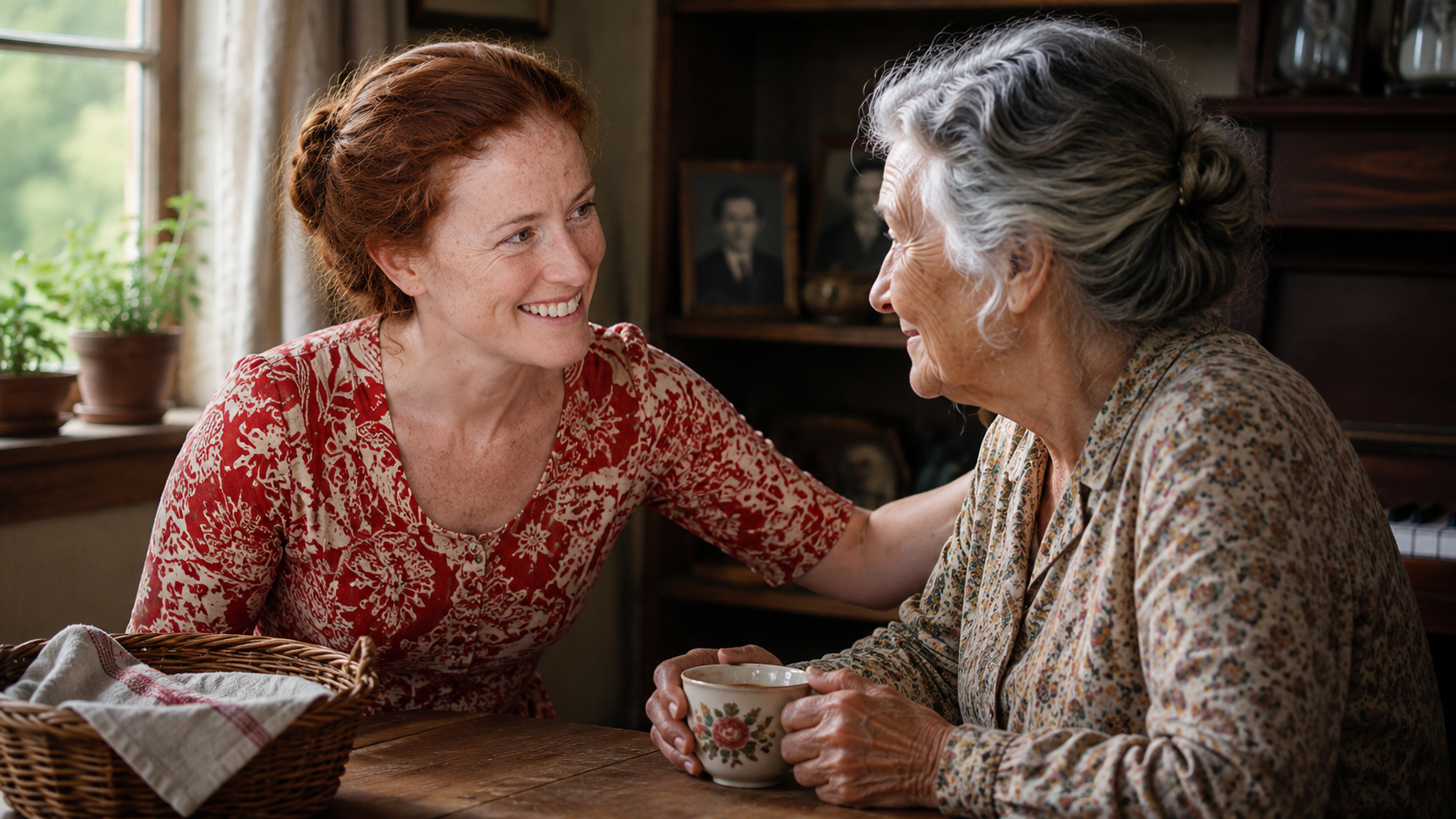
Elizabeth Walton had always noticed things other people missed.
She noticed when the birds stopped singing before rain came. She noticed when her mother’s smile looked tired, even when Olivia said she was fine. She noticed when Grandpa sat alone on the porch longer than usual, staring toward the mountains like he was remembering something he could not say out loud.
But one autumn morning, Elizabeth noticed something that changed everything.
It happened on her walk home from Ike Godsey’s store.
The air was cool, and the trees around Walton’s Mountain were glowing with orange and gold leaves. Elizabeth carried a small paper bag with thread for her mother and peppermint sticks for herself. She was almost home when she saw a little house at the end of a narrow dirt path.
She had passed that path many times before, but she had never walked down it.
The house looked lonely.
Its white paint had faded. The porch sagged in the middle. A broken rocking chair sat near the door, covered with dust and fallen leaves. No smoke came from the chimney.
Elizabeth stopped.
“Does anybody live there?” she asked Jason, who was walking beside her.
Jason glanced over. “That’s Mrs. Whitaker’s place.”
“Who’s Mrs. Whitaker?”
“An old woman,” he said. “She’s lived there forever, I guess.”
Elizabeth frowned. “I’ve never seen her.”
Jason shrugged. “Nobody sees her much.”
That answer bothered Elizabeth.
All afternoon, she kept thinking about the lonely little house and the woman inside it.
At supper, while everyone passed bowls of potatoes and beans, Elizabeth suddenly asked, “Mama, do you know Mrs. Whitaker?”
The table grew quiet for a moment.
Olivia looked up. “I know of her. She lost her husband years ago. Her children moved away.”
“Does anyone visit her?”
John Walton paused with his fork in his hand. “Not as often as they should, I suppose.”
Grandma sighed softly. “Folks get busy. Then one day, busy turns into forgotten.”
Those words stayed with Elizabeth.
Forgotten.
She could not imagine anything sadder than being alive in a house while the whole world passed by without knocking.
The next morning, Elizabeth wrapped two warm biscuits in a cloth, added a small jar of blackberry jam, and placed them in a basket.
“Where are you headed?” Mary Ellen asked.
“To visit someone.”
“Who?”
“Someone forgotten.”
Mary Ellen raised an eyebrow, but Elizabeth was already out the door.
The walk to Mrs. Whitaker’s house felt longer than it had before. When Elizabeth reached the porch, she hesitated. The house was very quiet.
Then she knocked.
For a long time, no one came.
Elizabeth almost turned away.
Then the door opened just a crack.
An elderly woman peered out. Her silver hair was pinned loosely behind her head, and her face looked thin and tired. Her eyes were pale blue, like a winter sky.
“Yes?” the woman asked.
Elizabeth held up the basket. “I brought you breakfast.”
The woman stared at her. “Why?”
Elizabeth smiled gently. “Because everybody should have warm biscuits.”
For the first time, Mrs. Whitaker’s face softened.
She opened the door a little wider.
“Well,” she said quietly, “I suppose you’d better come in before they get cold.”
Inside, the house smelled of old books, lavender, and wood smoke. There were photographs on the wall, but most were covered with dust. A quilt lay folded over a chair. A piano stood in the corner, silent and untouched.
Elizabeth sat at the kitchen table while Mrs. Whitaker poured tea.
At first, the old woman said very little. She moved slowly, as if every step reminded her of years gone by. But Elizabeth did not rush her. She simply sat, ate a biscuit, and talked about simple things.
She talked about Jim-Bob trying to fix something and making it worse.
She talked about Ben teasing Erin.
She talked about Grandpa falling asleep during one of John-Boy’s serious stories and then pretending he had been listening the whole time.
Mrs. Whitaker tried not to smile.
But she did.
When Elizabeth stood to leave, Mrs. Whitaker walked her to the door.
“Thank you for the biscuits,” she said.
“I can come again tomorrow,” Elizabeth replied.
Mrs. Whitaker looked surprised. “You don’t have to.”
“I know,” Elizabeth said. “But I want to.”
The next day, Elizabeth returned.
And the day after that.
Soon, the visits became part of her life.
Sometimes she brought food from Olivia. Sometimes she brought flowers. Sometimes she brought nothing at all except her time.
Little by little, Mrs. Whitaker began to talk.
She told Elizabeth about her husband, Samuel, who used to play the piano every Sunday evening. She spoke of her two sons, both grown and living far away. She spoke of letters that had stopped coming.
“One day,” Mrs. Whitaker said, staring into her tea, “people just forget your name.”
Elizabeth reached across the table and touched her hand.
“I won’t.”
Mrs. Whitaker looked at her for a long moment.
Then her eyes filled with tears.
That afternoon, before Elizabeth left, Mrs. Whitaker opened an old wooden box and took out a small photograph.
It showed Mrs. Whitaker as a young woman, standing beside a smiling man in a suit. They looked happy. Full of hope.
“This was taken the day Samuel asked me to marry him,” she said.
Elizabeth smiled. “You were beautiful.”
Mrs. Whitaker laughed softly. “I was young.”
“You’re still beautiful,” Elizabeth said.
The old woman turned away quickly, but not before Elizabeth saw the tears on her cheek.
From that day on, something changed.
Mrs. Whitaker began brushing her hair neatly before Elizabeth arrived. She opened the curtains. She let sunlight into rooms that had been dark for years.
One afternoon, Elizabeth found her sitting at the piano.
“Do you play?” Elizabeth asked.
“I used to.”
“Will you play for me?”
Mrs. Whitaker placed her hands on the keys. At first, the notes were slow and unsure. Then the melody grew stronger.
The music filled the little house.
For the first time, it no longer felt forgotten.
It felt alive.
But Elizabeth did not know that Mrs. Whitaker was hiding something.
And soon, one simple visit would become something much bigger than either of them expected.
Winter came early to Walton’s Mountain.
The wind turned sharp, and frost covered the fields each morning. Elizabeth still visited Mrs. Whitaker whenever she could, but one day, when she reached the little house, no smoke rose from the chimney.
That worried her.
She knocked.
No answer.
She knocked again.
Still nothing.
“Mrs. Whitaker?” Elizabeth called.
Her heart began to pound.
She pushed the door open and stepped inside.
The house was cold.
In the kitchen, she found Mrs. Whitaker sitting in a chair, wrapped in a thin shawl. Her face was pale, and her hands trembled.
“Mrs. Whitaker!” Elizabeth cried.
The old woman opened her eyes slowly. “Oh, child. I didn’t mean to frighten you.”
Elizabeth ran to her side. “You’re freezing.”
“I ran out of wood last night.”
Elizabeth did not waste a second. She hurried home as fast as her legs could carry her.
When she burst through the Walton front door, everyone turned.
“Daddy!” she cried. “Mrs. Whitaker needs help!”
John Walton grabbed his coat. Grandpa reached for his hat. Jason and Ben followed with arms ready for firewood.
Within the hour, the quiet little house was full of life.
John built a fire. Olivia brought soup. Grandma checked Mrs. Whitaker’s hands and wrapped her in a warmer blanket. Grandpa fixed the loose board on the porch. The boys stacked firewood beside the door.
Mrs. Whitaker sat near the fire, overwhelmed.
“I don’t know what to say,” she whispered.
Olivia smiled. “You don’t have to say anything.”
Elizabeth knelt beside her. “You’re not forgotten anymore.”
The words broke something open in Mrs. Whitaker’s heart.
She began to cry.
Not loud tears. Quiet ones. The kind she had been holding back for years.
After that day, the whole Walton family began to visit.
Grandma brought pies. Grandpa told stories. John-Boy read aloud from his writing. Jason played music. Even Jim-Bob came to repair the old gate, though he hit his thumb twice and made Mrs. Whitaker laugh until she had to wipe her eyes.
But the greatest change happened in Elizabeth.
She learned that kindness did not have to be big to matter.
A biscuit mattered.
A knock on the door mattered.
A child sitting at a kitchen table mattered.
One evening, Mrs. Whitaker gave Elizabeth a small envelope.
“What’s this?” Elizabeth asked.
“Something I should have given away long ago.”
Inside was a letter addressed to Mrs. Whitaker’s youngest son.
Elizabeth looked up. “You never sent it?”
Mrs. Whitaker shook her head. “I was too proud. Then too hurt. Then too old.”
Elizabeth held the letter carefully. “Do you still want him to have it?”
Mrs. Whitaker’s voice trembled. “Yes.”
John Walton mailed the letter the next morning.
Weeks passed.
Then, just before Christmas, a car came slowly up the road to Mrs. Whitaker’s house.
Elizabeth was there, helping hang paper snowflakes in the window, when she saw a man step out. He was middle-aged, with tired eyes and a nervous face.
Mrs. Whitaker stood frozen.
“Mother,” the man said softly.
The old woman covered her mouth with both hands.
For a moment, no one moved.
Then he walked up the porch steps and wrapped his arms around her.
“I’m sorry,” he whispered. “I should have come sooner.”
Mrs. Whitaker held him tightly. “You came now.”
Elizabeth watched from the doorway, tears in her eyes.
That Christmas, Mrs. Whitaker was not alone.
Her son stayed for supper at the Walton house. He told stories from faraway places, and Mrs. Whitaker smiled more than Elizabeth had ever seen.
Later that night, as snow began to fall, Mrs. Whitaker sat beside Elizabeth near the fire.
“You changed my life,” the old woman said.
Elizabeth shook her head. “I only came to visit.”
Mrs. Whitaker smiled. “Sometimes that is enough.”
Years later, Elizabeth would remember those words.
She would remember the lonely house, the cold kitchen, the silent piano, and the first warm biscuit in a basket.
Most of all, she would remember that people are not forgotten all at once.
They are forgotten one missed visit at a time.
And sometimes, they are found again the same way.
One visit.
One hand held.
One heart willing to care.
On Walton’s Mountain, Elizabeth learned that love did not always arrive with grand speeches or big promises.
Sometimes love simply knocked on the door.
And waited until someone opened it.


