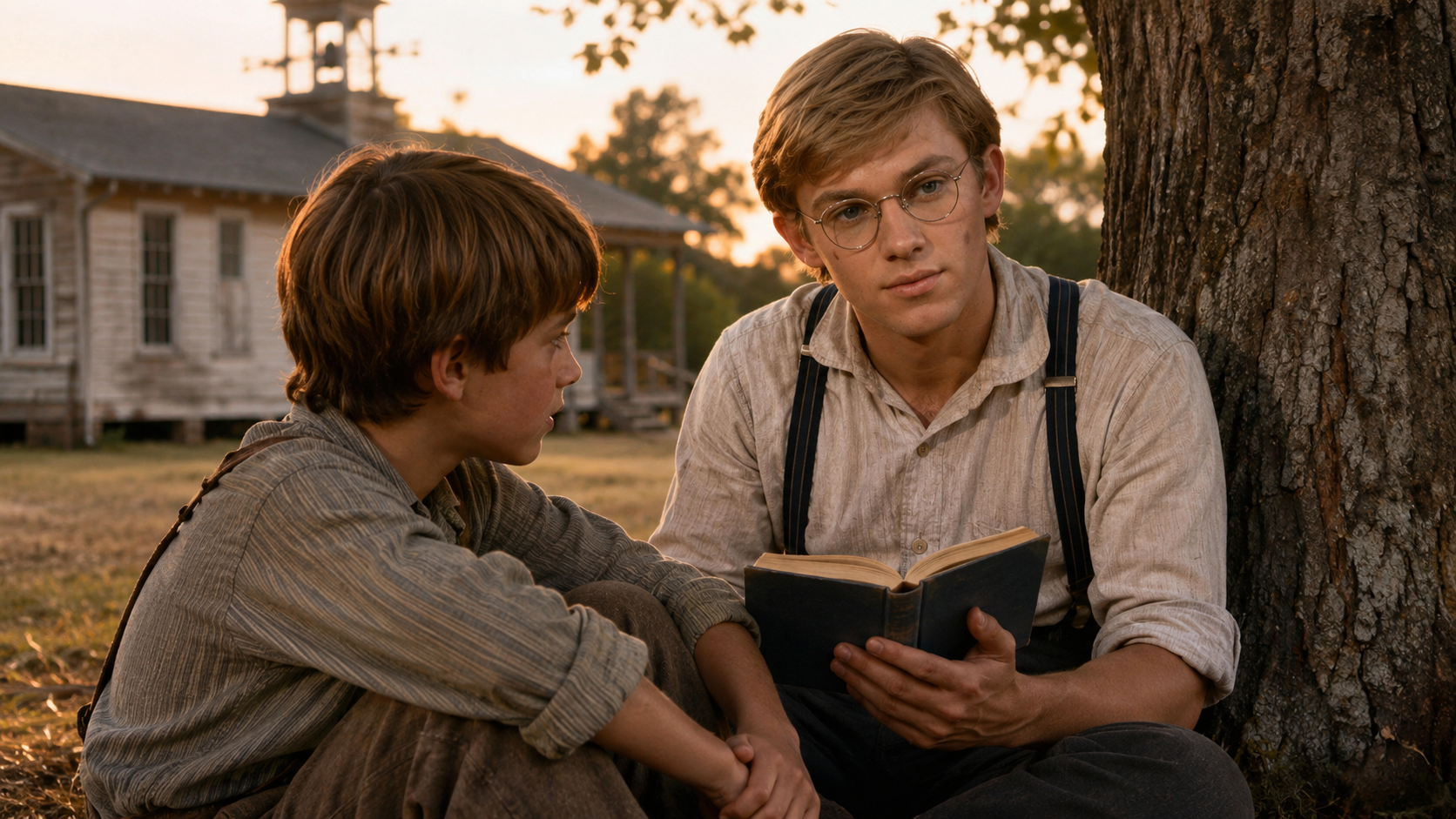
The Boy Behind the Schoolhouse
On a cool autumn morning on Walton’s Mountain, John-Boy Walton walked down the dirt road with his books tied under one arm and his mind full of dreams.
He was always thinking about words.
Words for stories.
Words for poems.
Words for the newspaper he hoped to write for one day.
To John-Boy, words were like little lanterns. They could light up dark places inside a person’s heart.
But not everyone felt that way.
Behind the schoolhouse, near the old oak tree, there was a boy named Caleb Miller.
Caleb was twelve years old, thin as a fence rail, and quieter than the morning fog. He never joined the other children during lunch. He never raised his hand in class. When Miss Hunter asked him to read, he stared down at his desk like the words had turned into stones.
Some children laughed.
Caleb never cried.
He only looked smaller.
One afternoon, John-Boy stayed late to help Miss Hunter stack books. As he stepped outside, he heard a soft sound behind the schoolhouse.
It was Caleb.
He was sitting on the ground, holding a torn reader in his lap.
“I can’t do it,” Caleb whispered to himself. “I’ll never do it.”
John-Boy stood still for a moment. Then he walked closer.
“Caleb?”
The boy quickly shut the book.
“I wasn’t doing anything.”
John-Boy sat beside him, not too close.
“That book gave me trouble once too,” he said gently.
Caleb looked at him with doubt.
“You can read everything.”
“Not everything,” John-Boy said. “Sometimes I read a sentence five times before it makes sense.”
Caleb looked away.
“My pa says reading is for people with soft hands. Says I’m better off working.”
John-Boy studied the boy’s rough fingers. They were already cracked from chores.
“Maybe your pa is wrong about that.”
Caleb’s face tightened.
“Nobody talks about my pa.”
John-Boy nodded. “Fair enough.”
For a while, they sat in silence.
Then John-Boy pointed to the book.
“Would you like me to read with you? Just one page.”
Caleb shook his head.
“I’ll mess it up.”
“Then we’ll mess it up together.”
That was the first day.
The next afternoon, Caleb was behind the schoolhouse again.
And the next.
John-Boy never made him feel ashamed. He never laughed when Caleb mixed up letters or forgot a word. He broke each sentence into smaller pieces. He told Caleb that reading was not a race.
“It’s like climbing a hill,” John-Boy said. “You take one step, then another.”
Slowly, Caleb began to try.
At first, he could only read simple words.
Sun.
Hill.
Home.
Then short sentences.
The dog ran.
The boy came home.
One day, Caleb read a whole paragraph without stopping.
When he finished, he looked shocked.
John-Boy smiled.
“You did it.”
Caleb touched the page like it was something precious.
“I did, didn’t I?”
But life on Walton’s Mountain was not always gentle.
Caleb’s father, Mr. Miller, was a hard man who believed work mattered more than dreams. When he found Caleb reading by lantern light one night, he threw the book into the corner.
“You wasting time again?”
Caleb said nothing.
The next day, he did not come to school.
Then another day passed.
Then a week.
John-Boy grew worried. After chores, he walked to the Miller place. The house looked tired. The barn leaned to one side. Caleb was chopping wood near the fence.
“Caleb,” John-Boy called.
Caleb froze.
“You shouldn’t be here.”
“Why not?”
“My pa says school is finished for me.”
John-Boy’s heart sank.
“But you were learning.”
Caleb looked down at the axe in his hand.
“Learning don’t put food on the table.”
John-Boy wanted to argue, but he saw the sadness in Caleb’s eyes.
So instead, he pulled a small notebook from his pocket.
“I wrote some words for you. Easy ones first. Then harder ones.”
Caleb looked at the notebook.
“I can’t keep that.”
“Yes, you can.”
“My pa will find it.”
“Hide it somewhere safe.”
Caleb took it slowly.
For months, John-Boy helped him in secret.
Sometimes behind the church.
Sometimes near the creek.
Sometimes in the woods while Caleb pretended to gather kindling.
John-Boy brought old newspapers, schoolbooks, and scraps of stories he had written himself. Caleb learned to read by reading about mountains, trains, farms, storms, and families who did not give up.
Then, one winter morning, the Miller family left Walton’s Mountain.
No goodbye.
No note.
Just an empty house and wagon tracks in the snow.
John-Boy stood outside the Miller place, feeling a strange ache in his chest.
He wondered if Caleb had taken the notebook.
He wondered if he would keep reading.
He wondered if one small act of kindness could survive in a world that often felt too hard.
Years passed.
John-Boy grew older.
He wrote more stories.
He left Walton’s Mountain and came back again, carrying dreams, disappointments, and memories.
But every now and then, when he saw a boy struggling over a book, he thought of Caleb Miller.
The lonely boy behind the schoolhouse.
The boy who once whispered, “I’ll never do it.”
John-Boy never knew what became of him.
Until one evening, many years later, there came an unexpected knock at the Walton door.
The Knock at the Door
It was a cold evening, the kind that made the Walton house glow warm from the inside.
Olivia was setting supper on the table. Grandma was fussing over the biscuits. Grandpa was telling Jim-Bob that no machine in the world could ever beat a stubborn mule.
John-Boy sat near the window with a notebook in his lap.
Then came the knock.
Everyone grew quiet for a moment.
John Walton opened the door.
A tall man stood on the porch, dressed in a dark coat. He held his hat in both hands. His face was older, stronger, but his eyes carried something familiar.
“Evening,” the man said softly. “I’m looking for John-Boy Walton.”
John-Boy stood.
“I’m John-Boy.”
The man looked at him for a long moment.
Then his voice broke.
“I don’t suppose you remember a boy named Caleb Miller.”
John-Boy’s eyes widened.
“Caleb?”
The man smiled through tears.
“Yes, sir.”
John-Boy stepped forward and embraced him.
For a moment, no one said anything.
The lonely boy from behind the schoolhouse had come back as a grown man.
The Waltons welcomed him inside. Olivia gave him coffee. Grandma gave him biscuits before he could even sit down.
Caleb looked around the room.
“I used to dream about this house,” he said. “I remembered the light in the windows. I remembered hearing laughter from the road.”
John-Boy sat across from him.
“Where did you go?”
“West Virginia first,” Caleb said. “Then Ohio. Then farther north. My pa found mill work. Life was hard.”
He paused.
“But I kept the notebook.”
John-Boy stared at him.
“You did?”
Caleb reached into his coat and pulled out an old, worn notebook. The edges were bent. The cover was faded. But John-Boy knew it at once.
Caleb placed it on the table like a treasure.
“I hid it inside a loose board in the wagon,” he said. “Every night, I read a little. Sometimes only one line. Sometimes only one word.”
His hands trembled.
“That notebook changed my life.”
John-Boy swallowed hard.
“I only wanted to help.”
“You did more than help,” Caleb said. “You gave me a door.”
The room went still.
Caleb explained that after he learned to read, he began reading everything he could find. Old newspapers. Church bulletins. Store signs. Medicine labels. Work notices.
One day, he helped a mill worker read a letter from his son. Another day, he helped a widow understand a legal paper. Later, a kind teacher noticed him reading outside a library and helped him study at night.
Years went by.
Caleb became a teacher.
Not in a grand city school.
Not in a place with polished floors.
He became a teacher for children who had been forgotten.
Poor children.
Farm children.
Mill children.
Children who believed they were too slow, too ashamed, or too old to learn.
“I taught them the way you taught me,” Caleb said. “Slowly. Kindly. One step at a time.”
John-Boy’s eyes filled with tears.
Caleb opened his bag and took out a newspaper clipping.
It showed a small schoolhouse with children standing on the steps.
“This is my school,” Caleb said. “We named the reading room after you.”
John-Boy looked down at the clipping.
The sign above the door read:
The John Walton Jr. Reading Room
John-Boy could not speak.
Olivia covered her mouth with her hand.
Grandpa cleared his throat and pretended to look out the window.
Caleb smiled.
“I came all this way because I wanted you to know. Every child who learns to read in that room carries a little piece of what you gave me.”
John-Boy shook his head softly.
“I was just a boy helping another boy.”
“That’s how most good things begin,” Caleb said.
After supper, the family gathered by the fire. Caleb told stories about his students. One little girl wanted to become a nurse. One boy wanted to read the Bible to his grandmother. Another child had read his first book and slept with it under his pillow.
John-Boy listened with a full heart.
That night, after everyone had gone to bed, John-Boy sat at his desk.
He opened his journal and began to write.
“Sometimes we believe kindness disappears after we give it away. But it does not disappear. It travels. It grows. It becomes part of people we may never see again. And one day, if we are blessed, it comes knocking at our door.”
Outside, the mountain rested under a blanket of stars.
Inside, the Walton home was quiet.
But John-Boy knew something had changed.
The small lessons behind the schoolhouse had not been small at all.
A lonely boy had learned to read.
Then he had taught others.
And through him, John-Boy’s kindness had gone farther than he ever dreamed.
The next morning, Caleb prepared to leave.
At the door, he handed John-Boy the old notebook.
“I think this belongs to you.”
John-Boy shook his head.
“No, Caleb. You keep it.”
Caleb smiled.
“I was hoping you’d say that.”
They laughed softly.
Then Caleb stepped off the porch and walked down the road, no longer the frightened boy who hid behind the schoolhouse.
He was a man who carried light.
John-Boy watched until Caleb disappeared beyond the trees.
And for the rest of his life, whenever John-Boy doubted whether one person could truly make a difference, he remembered that knock at the door.
He remembered the notebook.
He remembered Caleb Miller.
And he remembered that sometimes, teaching one child to read can help change the lives of many.


