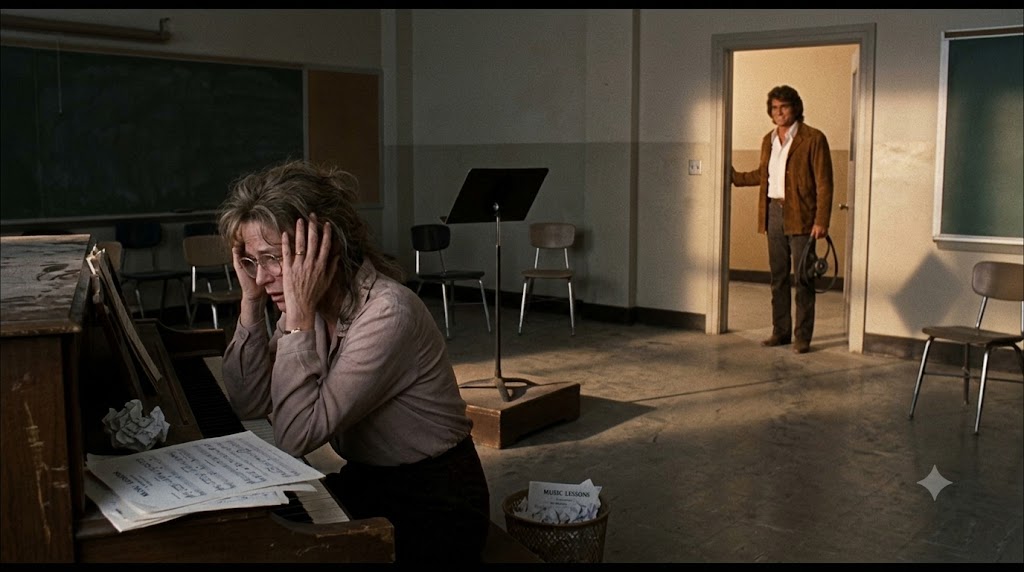
 The Quiet Room
The late afternoon sun cut through the dusty windows of Room 104, casting long, sharp shadows across the scratched linoleum floor. Clara adjusted her glasses, staring at the small mountain of sheet music piled on her desk. The middle school was quiet now, the chaotic stampede of footsteps long gone.
Clara leaned back in her chair and let out a heavy sigh. She was exhausted—not just the kind of tired that a good night’s sleep could fix, but a deep, bone-weary exhaustion that had been building for months.
When she took the job as the music teacher at this underfunded school, she had envisioned a room filled with passionate students, the harmonious blending of voices, and the joy of watching young minds discover the magic of melody. Instead, she faced a daily battle against broken instruments, zero budget, and an administration that viewed the arts as an afterthought.
Just an hour earlier, the principal had subtly hinted that the music program was on the chopping block for next semester.
“We have to prioritize the essentials, Clara,” he had said with a sympathetic but empty shrug.
She looked at her worn-out upright piano, its varnish peeling. She felt like a failure. Her passion had turned into a chore, and her savings were nearly drained from buying reeds, strings, and sheet music out of her own pocket.
Clara pulled a neat, typed letter from her top drawer. It was her resignation. She just needed to sign it, leave it on the principal’s desk, and walk away. She picked up her pen, her hand trembling slightly. Music had been her life, but she had nothing left to give.
Suddenly, the heavy wooden door to her classroom creaked open.
Clara snapped her head up, ready to tell a lingering student to head home. Instead, she froze.
Standing in the doorway was a man wearing a familiar leather jacket and a warm, crinkly smile. His thick, wavy brown hair was unmistakable. He looked around the modest room with genuine curiosity, his eyes finally landing on her.
It was Michael Landon.
The Maestro of Hope
Clara blinked, wondering if the exhaustion was finally causing her to hallucinate. “Can… can I help you?” she stammered, quickly sliding her hand over the resignation letter to hide it.
“I hope so,” Michael said, his voice carrying that same grounded, comforting resonance she had heard for years on television. “My car threw a belt a couple of miles down the road. The mechanic said it’ll be an hour, so I decided to take a walk. I heard a piano from the sidewalk and followed the sound. I hope I’m not interrupting.”
Clara swallowed hard. “No, not at all. I was actually just… wrapping things up.”
Michael walked into the room, his presence instantly making the dreary classroom feel a little brighter. He stopped by a bulletin board covered in hand-drawn musical notes and smiled. He then wandered over to her battered piano, running a finger gently along the wood.
“She looks like she’s seen a lot of songs,” Michael remarked softly. He struck a single middle C. The note was slightly out of tune, but it echoed warmly in the empty room.
“She has,” Clara said, her defenses dropping slightly. “Though I’m afraid she might not be seeing many more. The school is cutting the budget. To be honest, Mr. Landon, I was just about to sign my resignation. I love music, but it feels like I’m fighting a losing battle alone.”
Michael stopped and looked at her, his expression shifting from casual warmth to deep empathy. He walked over to the front row of student desks and pulled up a chair, sitting down across from her.
“You know,” Michael began, leaning forward, “when we were filming Little House on the Prairie, and even back on Bonanza, people used to tell me how simple it must be to make a television show. But it’s never simple. There were days the weather wouldn’t cooperate, the equipment broke, the budget ran out, and I felt like pulling my hair out. I wanted to pack up and go home more times than I can count.”
Clara listened, captivated by his honesty.
“But then,” Michael continued, pointing a finger toward the empty chairs around him, “I would think about the people sitting on the other side of the screen. The families who needed a little bit of light, a little bit of hope at the end of a hard day. That’s what you do here, Clara. Look at these chairs.”
He gestured around the room.
“You aren’t just teaching kids how to read notes on a page. You’re giving them a voice when they feel unheard. You’re giving them a safe place to fail, to grow, and to create something beautiful out of nothing. That is a rare, sacred thing. If you walk away, who fills that void for them?”
Clara looked down at her desk. A tear escaped and rolled down her cheek. The weight of his words hit her completely. She had been so focused on the lack of money, the broken instruments, and her own exhaustion that she had forgotten the kids who did show up, the ones whose faces lit up when they finally mastered a chord.
Michael stood up and gently tapped the desk. “Don’t let the bureaucracy steal your song, Clara. The world has enough noise. It needs people like you to keep the music alive.”
Before she could fully process everything, a car horn honked twice from the parking lot outside. Michael smiled and checked his watch. “Sounds like my ride is here.”
He walked back to the door, paused, and looked over his shoulder. “Keep playing,” he said with a wink.
As the door clicked shut, the silence returned to Room 104, but it no longer felt heavy. It felt full of possibility.
Clara looked down at the resignation letter. Without hesitating, she grabbed it, crumpled it into a tight ball, and tossed it into the recycling bin. She walked over to the piano, sat on the bench, and lifted the lid.
She pressed her fingers to the keys, and for the first time in months, Clara began to play.


