Part 1
The Choir Behind the Hospital Doors
The children’s hospital was usually filled with quiet sounds.
Soft footsteps moved through the hallways. Nurses spoke gently outside patient rooms. Machines beeped beside beds where children rested, healed, and waited for better days.
But every Wednesday afternoon, one room on the third floor sounded different.
That was the day the hospital choir practiced.
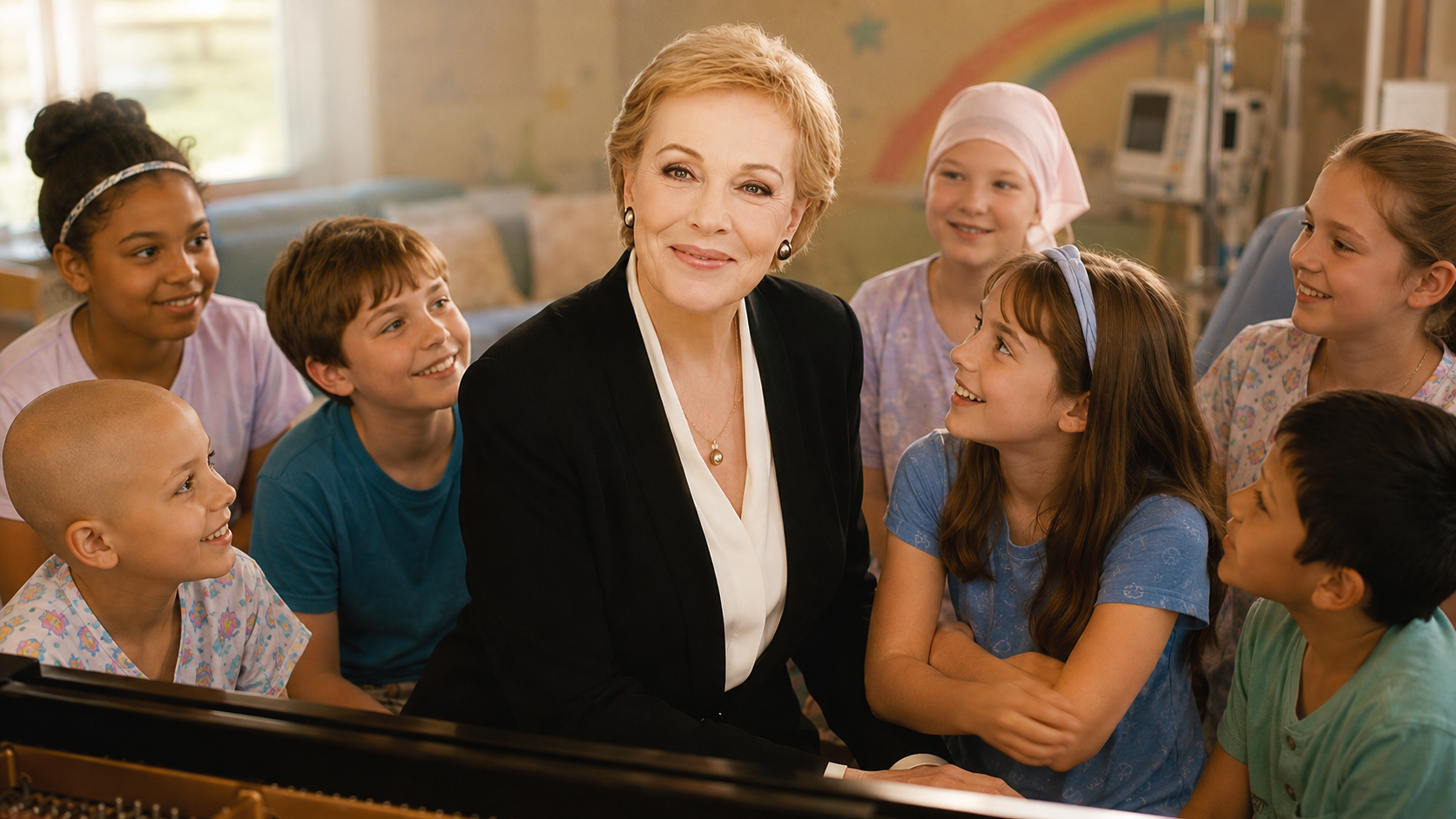
The choir was not big. It was made up of children who were staying at the hospital for many different reasons. Some had cancer. Some were recovering from surgery. Some were learning to walk again. Some were too weak to stand, so they sang from wheelchairs or hospital beds.
Their voices were not always perfect.
Sometimes a child missed a note. Sometimes someone had to stop singing to cough. Sometimes a nurse had to help a little singer back to their room before practice was over.
But to everyone who heard them, their music was beautiful.
The choir was led by a kind music teacher named Miss Clara. She believed that singing could help the children feel brave, even on the hardest days.
“Music does not take away every pain,” she often told them. “But it reminds us that hope is still alive.”
One little girl in the choir loved those words more than anyone.
Her name was Lily Parker. She was nine years old, with bright eyes, a soft smile, and a blue scarf she wore every day. Lily had been in the hospital for many months. Some days she felt strong. Other days she felt tired and scared.
But when she sang, something changed.
For a few minutes, Lily did not feel like a sick child in a hospital room. She felt like a bird flying above the clouds.
Her favorite singer in the whole world was Julie Andrews.
Lily had watched old movie clips of Julie singing with her grandmother before she became sick. Her grandmother used to say, “That voice can make a cloudy day feel bright.”
Lily believed that with all her heart.
One afternoon, Miss Clara brought exciting news to choir practice.
“The hospital is holding a special concert next Friday,” she said. “Families, doctors, nurses, and other patients will come. And our choir has been asked to sing the final song.”
The children cheered.
Lily smiled, but her hands twisted nervously in her lap.
“What song will we sing?” asked a boy named Max.
Miss Clara held up the sheet music.
“A song about hope,” she said. “A song that reminds people they are not alone.”
Lily looked at the paper, then whispered, “I wish Julie Andrews could hear us.”
The room became quiet for a moment.
Miss Clara smiled gently. “Maybe she will, in some way.”
But Lily shook her head. “No, I mean really hear us. I think she would understand.”
That evening, Miss Clara sat alone in the music room after everyone had gone. Lily’s words stayed in her mind.
She knew it was impossible.
Julie Andrews was a famous star, loved by people all over the world. She had inspired generations with her voice, her grace, and her kindness. Why would someone like that come to a small hospital concert?
Still, Miss Clara did something brave.
She wrote a letter.
She told Julie about the children’s choir. She wrote about Lily, who loved music even when she was afraid. She wrote about the concert and how much it would mean if Julie could send a short message of encouragement.
Miss Clara did not expect a reply.
But three days later, the hospital received a quiet phone call.
The woman on the phone spoke warmly.
“Miss Andrews received your letter,” she said. “She was very touched.”
Miss Clara held her breath.
Then the woman continued, “She would like to come in person.”
Miss Clara nearly dropped the phone.
“In person?” she whispered.
“Yes,” the woman said. “But she would like it to be a surprise for the children.”
For the next week, the secret was carefully kept.
Only Miss Clara, the hospital director, and a few nurses knew. The children practiced every day without knowing that someone very special was coming to hear them sing.
Lily worked harder than anyone.
Even on days when she felt tired, she asked Miss Clara to bring the music to her room.
“I want to be ready,” Lily said.
“Ready for what?” Miss Clara asked softly.
Lily smiled. “For the moment when someone needs hope.”
At last, the day of the concert arrived.
The hospital auditorium was decorated with paper stars, handmade signs, and flowers donated by local families. Parents filled the front rows. Nurses stood along the walls. Doctors slipped in between appointments, still wearing their white coats.
The children’s choir sat together near the stage.
Lily held her song sheet tightly. Her grandmother sat in the front row, wiping her eyes before the music even began.
The concert started with cheerful songs. Some children clapped along. Some parents laughed softly. For a little while, the hospital did not feel so heavy.
Then Miss Clara stepped to the microphone.
“Our final song is for every child, every parent, every nurse, and every doctor who has ever needed a little hope,” she said.
The choir began to sing.
At first, the voices were small.
Then they grew stronger.
Lily sang with all the courage she had. Her voice trembled, but she did not stop.
As the final verse began, the auditorium doors opened quietly.
A woman stepped inside wearing a simple cream coat and a gentle smile.
For a moment, no one noticed.
Then one nurse gasped.
Miss Clara saw her and felt tears fill her eyes.
Julie Andrews had arrived.
Part 2
The Song That Filled Every Heart
Julie Andrews stood quietly at the back of the auditorium, listening.
She did not want to interrupt the children. She simply watched them sing, her eyes soft with emotion.
Then Lily looked up.
At first, she thought she was dreaming.
The woman standing near the door looked exactly like the person from the old videos her grandmother had shown her. The same graceful smile. The same kind eyes.
Lily stopped singing for half a second.
Then Julie gently placed one finger over her lips, as if to say, Keep going.
So Lily kept singing.
Her voice grew stronger than it had ever been.
One by one, the other children noticed Julie too. Some stared in surprise. Some smiled through tears. But none of them stopped. They sang as if their hearts had opened wide.
When the song ended, the room was completely still.
Then the auditorium filled with applause.
Parents cried. Nurses hugged each other. Even some of the doctors wiped their eyes.
Julie walked slowly to the stage.
Miss Clara could hardly speak. “Children,” she said, her voice shaking, “we have a very special guest with us today.”
Julie smiled at the choir.
“I hope you do not mind that I listened from the back,” she said gently. “I did not want to miss a single note.”
The children laughed softly.
Lily stared at her with wide eyes.
Julie turned toward her. “And you, my dear, sang with such courage.”
Lily’s lips trembled. “I was scared.”
Julie stepped closer and took her hand.
“That is what made it brave,” she said. “Bravery is not singing because you are never afraid. Bravery is singing even when fear is sitting beside you.”
Lily began to cry.
Julie knelt beside her wheelchair and wiped one tear from her cheek.
“Your voice carried hope today,” Julie said. “Not because it was perfect, but because it was honest.”
Then Julie looked at the whole choir.
“I came here because Miss Clara told me about your music,” she said. “But now that I have heard you, I believe you have given me a gift far greater than the one I brought.”
A little boy raised his hand. “Did you bring a gift?”
Julie smiled. “I did.”
She nodded to Miss Clara, who handed her a small folder.
“I brought a song,” Julie said. “A simple one. And I wondered if you might allow me to sing it with you.”
The children gasped.
Lily covered her mouth.
Julie sat at the piano beside Miss Clara. She did not perform like a distant star. She sang softly, kindly, as if she were singing in a family living room.
The children joined her.
Their voices rose together.
Some were strong. Some were shaky. Some were barely above a whisper. But together, they made something beautiful.
The song filled the room with warmth.
It floated into the hallway, where nurses stopped to listen. It reached patients who could not attend the concert. It touched parents who had spent too many nights praying beside hospital beds.
For those few minutes, no one felt alone.
When the song ended, Julie stayed with the children.
She signed programs. She listened to their stories. She asked their names and remembered them. She thanked the nurses. She hugged parents. She sat beside Lily’s grandmother and told her, “You raised a child with a very bright spirit.”
Before Julie left, Lily gave her something.
It was a small paper star from the stage decoration. On the back, Lily had written:
Thank you for helping me sing when I was scared.
Julie held the paper star close to her heart.
“No, my dear,” she said. “Thank you for reminding me why songs matter.”
Months passed.
The story of Julie’s secret visit spread through the hospital, but the people who were there remembered something deeper than fame.
They remembered kindness.
They remembered how one song made tired hearts feel strong again.
Lily kept singing. Some days were still hard, but she no longer believed fear meant she was weak. She believed fear was something she could sing through.
The hospital choir grew bigger after that day. More children joined. More families came to listen. The music room became a place where hope lived.
And every year, on the same Friday, the hospital held a special concert called The Hope Song.
At the end of each concert, Miss Clara would hold up a small paper star in a frame.
Then she would tell the children, “This star reminds us of the day a song filled every heart with hope.”
And somewhere, in every voice that rose from that little hospital choir, there was a piece of Julie Andrews’ kindness.
Not loud.
Not proud.
Just gentle, bright, and unforgettable.


