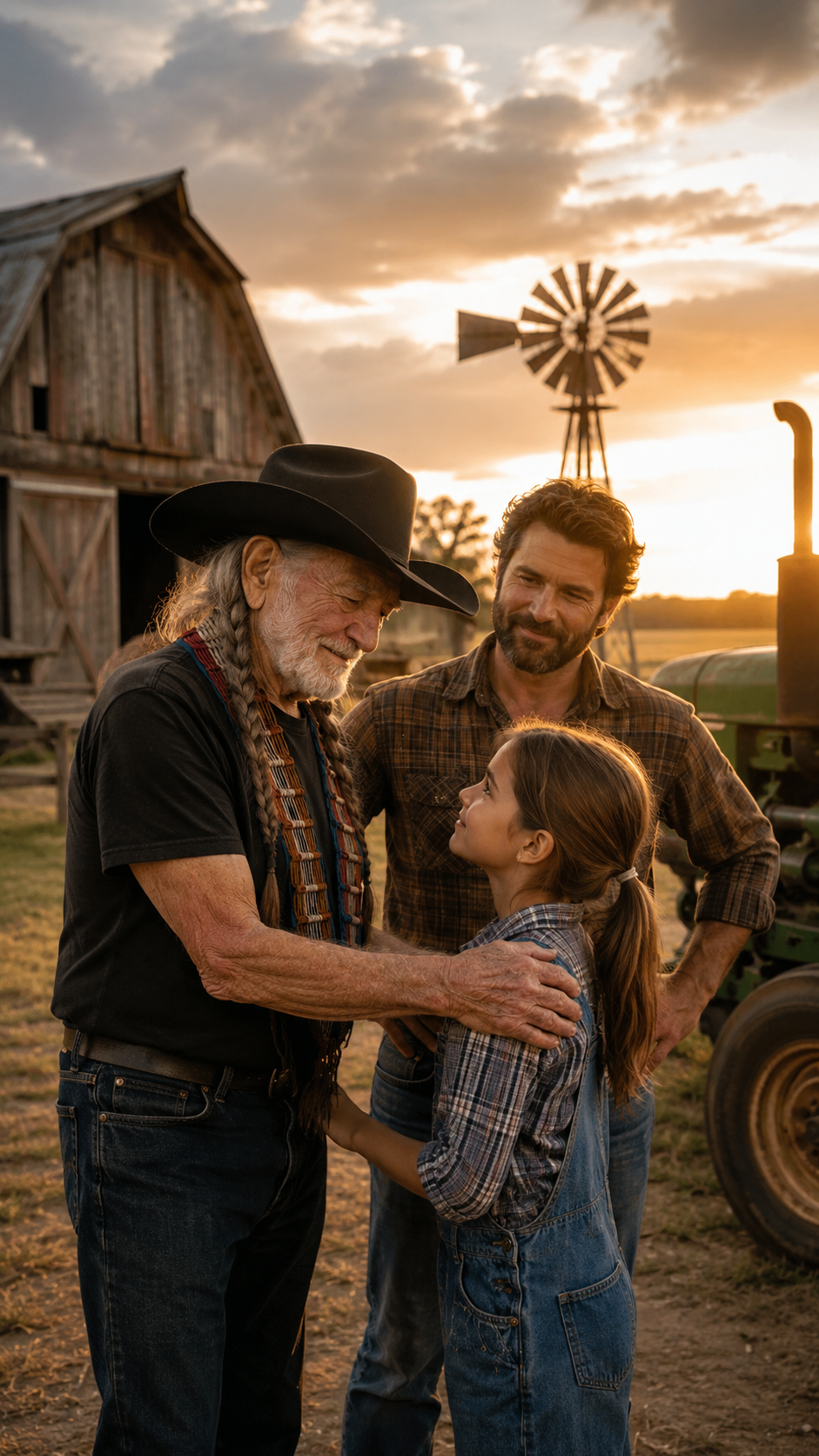
Part 1: The Farm No One Could Save
The Miller family farm had been standing outside a small Texas town for almost one hundred years.
It was not a rich farm. It was not famous. It did not have fancy gates or shining barns. But to the Miller family, it was home.
For three generations, the Millers had grown corn, hay, and vegetables on that land. Children had learned to walk in the soft dirt. Grandparents had watched sunsets from the old wooden porch. Every fence post, every tree, and every row of crops carried a memory.
But by the summer of 1987, the farm was dying.
Samuel Miller, the old farmer who owned it, was seventy-two years old. His hands were rough, his back was bent, and his heart was tired. He had spent his whole life working that land, just like his father and grandfather before him.
His wife, Clara, had passed away two years earlier. Since then, the house felt too quiet.
Samuel’s son, Daniel, had tried to help keep the farm alive. But bills kept coming. The tractor broke down twice. Rain came too late. The bank wanted money they did not have.
One evening, Samuel sat at the kitchen table with Daniel and Daniel’s young daughter, Emily. Papers were spread across the table. The bank’s final notice sat on top.
Daniel looked at his father with sad eyes.
“Pa,” he said softly, “we may have to sell.”
Samuel did not answer right away.
He looked out the window at the fields. The sun was going down, painting everything gold.
“This land raised us,” Samuel whispered. “I don’t know who we are without it.”
Emily, who was only nine years old, reached for his hand.
“Grandpa,” she said, “maybe someone will help.”
Samuel smiled a little, but his eyes were wet.
“Sometimes help doesn’t come, sweetheart.”
A week later, the farm was listed for sale.
People came to look at it, but most shook their heads. The barn needed work. The house was old. The fields were dry. One man said he would tear it all down and build storage units.
That broke Samuel’s heart.
Then one afternoon, a quiet stranger arrived.
He wore jeans, boots, and a faded hat pulled low over his face. He walked slowly around the land, not saying much. He touched the fence. He looked at the barn. He stood in the field for a long time.
Daniel thought he looked familiar, but he could not place him.
The stranger finally turned to Samuel and asked, “How long has your family been here?”
Samuel answered, “Since my grandfather. Nearly a century.”
The man nodded.
“That means something,” he said.
Before leaving, the stranger looked back at the house.
“Some places are worth saving,” he said.
A few days later, the bank called Daniel.
The farm had been bought.
Daniel felt his stomach drop.
“Who bought it?” he asked.
The banker paused.
“The buyer asked to remain private,” he said. “But there is one condition.”
Daniel held his breath.
“What condition?”
“You and your father are allowed to stay.”
Daniel thought he had heard wrong.
The banker continued, “The new owner does not want to remove you. He wants the farm restored. He has paid the debt in full.”
Daniel nearly dropped the phone.
That evening, Samuel sat on the porch and cried for the first time in years.
Emily hugged him tightly.
“See, Grandpa?” she said. “Help did come.”
But no one knew who had saved them.
Not yet.
Part 2: The Gift Left Behind
The next morning, trucks arrived at the Miller farm.
Men repaired the roof. A mechanic fixed the tractor. New wood was brought for the barn. The fields were cleared and prepared for planting again.
Samuel kept asking who was paying for it all.
No one would tell him.
All they said was, “A friend of the farm.”
Months passed, and the farm began to breathe again.
The old barn stood strong. The fields turned green. Daniel started selling crops at the town market again. Emily helped her grandfather feed the animals before school.
For the first time in a long time, there was laughter in the house.
Then, one cool autumn morning, a letter arrived.
It was addressed to Samuel Miller.
Inside was a simple note written in gentle handwriting.
“Dear Mr. Miller,
I know what it means to love the land. I know what it means to fight for family, for home, and for the people who came before us.
This farm belongs to your family. I only bought it so no one else could take it away.
Keep growing. Keep believing. And someday, when you are able, help someone else hold on.
With respect,
Willie Nelson.”
Samuel stared at the letter for a long time.
Daniel read it twice.
Emily whispered, “Willie Nelson saved our farm?”
Samuel smiled through tears.
“He didn’t just save the farm,” he said. “He saved our family.”
Years went by.
Samuel lived long enough to see Emily grow up. Before he passed away, he gave her the letter and told her, “This land was saved by kindness. Don’t ever forget that.”
Emily never did.
She became a teacher, but every summer she returned to the farm. Later, she brought her own children there. They ran through the same fields she had once played in. They sat under the same tree where Samuel used to rest.
Daniel grew old on that porch, just like his father had.
One day, many years later, Emily found another envelope hidden inside an old wooden box in the barn. It was from Willie Nelson too, written years before.
Inside was one final surprise.
The farm had been placed in a family trust. It could not be sold to developers. It could not be taken away easily. It was meant to remain with the Miller family for generations.
Emily covered her mouth and cried.
Her teenage son, Jacob, stood beside her.
“Mom,” he asked, “why would someone do all this for people he barely knew?”
Emily looked out at the fields.
“Because some people understand that kindness is bigger than fame,” she said.
Years later, Jacob became the one to run the farm. He added a small sign near the front gate.
It did not mention money.
It did not mention fame.
It simply read:
“This farm was saved by love, faith, and one quiet act of kindness.”
And every year, when the crops grew tall and the sun set over the Texas fields, the Miller family remembered the man who came quietly, asked for nothing, and left behind a gift that changed three generations forever.


